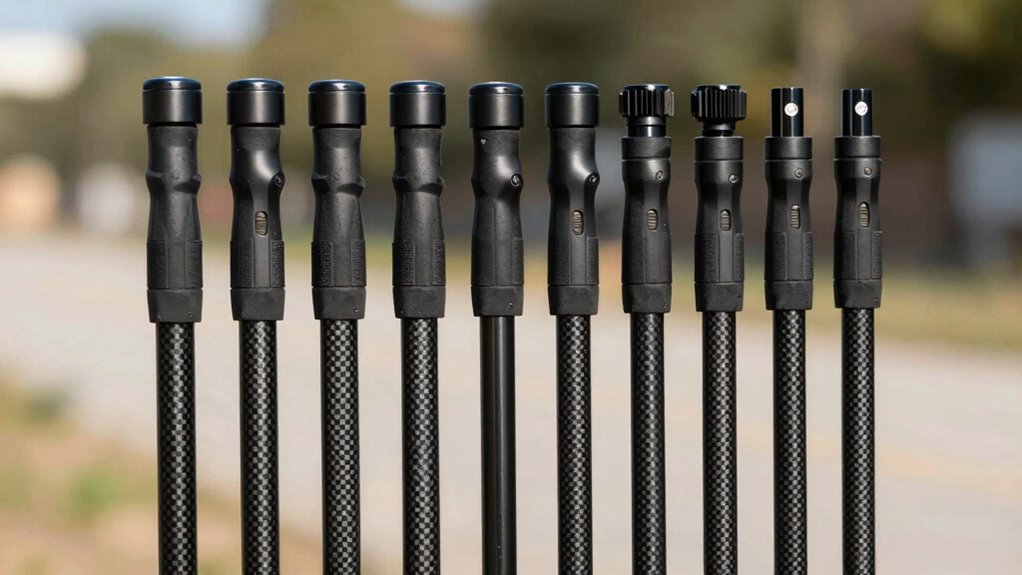
For field recording, my best overall pick is the RØDE Boompole Pro for its lightweight carbon fiber construction and practical reach. The Saramonic BoomPole Lite stands out for its internal XLR cable, while the E-Image BC06P suits close work where a shorter pole is easier to control. The main tradeoff is between reach and handling: longer, multi-section poles can cover more setups but may take more care to extend and manage. Cable routing, locking sections, and microphone mounting also shape how smoothly a pole fits into a field kit. Read on for the full comparison and help choosing the right pole for your recording work.

Prime made for students and young adults
- Fast, free delivery for dorm and study essentials
- Prime Video and Amazon Music included
- Member-only deals
Complete the kit

Key Takeaways
- The RØDE Boompole Pro leads the roundup as a lightweight general-purpose choice, while the E-Image BC16P prioritizes extended reach with six sections and a 16-foot maximum length.
- Internal cable routing is a practical differentiator: the Saramonic BoomPole Lite and E-Image BC06P include internal XLR cables, while several alternatives leave cable management to the user.
- Shorter poles such as the 50-inch Audix MicroBoom and 6-foot E-Image BC06P favor controlled, close microphone placement over covering distant action.
- The NEEWER MS-300CB and MS-300C share a 9.8-foot maximum reach; the MS-300C lists a 2.4-foot collapsed length, which may suit kits where packed size matters.
- The roundup spans fixed-use, compact, and long-reach designs, so section count and maximum length matter less than matching the pole to the recording distance and how often it will be repositioned.
| RØDE Boompole Pro Carbon Fiber Microphone Boom Pole |  | Best for Professional Field Recording | Material: Carbon fiber | Weight: 535 g (1.2 lb) | Length range: 810 mm to 3 m | VIEW ON AMAZON | See Our Full Breakdown |
| Audix MicroBoom 50-inch Carbon Fiber Boom Arm |  | Best for Fixed Overhead Placement | Material: Carbon fiber | Length: 50 inches | Weight: 2.1 pounds | VIEW ON AMAZON | See Our Full Breakdown |
| NEEWER MS-300CB Telescopic Carbon Fiber Microphone Boom Pole, 9.8 ft |  | Best Accessory Bundle | Material: Carbon fiber | Weight: 1.3 lb (580 g) | Adjustable length: 2.4–9.8 ft (74.5–300 cm) | VIEW ON AMAZON | See Our Full Breakdown |
| Saramonic BoomPole Lite 8.2′ Carbon Fiber Boom Pole with Internal XLR Cable, Cable Ties & Case |  | Best for Integrated XLR Cable Management | Material: Reinforced carbon fiber | Weight: 1.6 lb | Length range: 3.3–8.2 ft (1–2.5 m) | VIEW ON AMAZON | See Our Full Breakdown |
| Andoer MK-3000 9.8ft Carbon Fiber Microphone Boom Pole |  | Best Lightweight Long-Reach Pick | Material: Carbon fiber | Weight: 467 g (16.5 oz) | Extended length: 90–300 cm (3–9.8 ft) | VIEW ON AMAZON | See Our Full Breakdown |
| E-Image BC06P 6 ft Carbon Fiber Telescoping Boom Pole with Internal XLR Cable |  | Best for Short, Cable-Managed Setups | Length: 6 ft | Material: Carbon fiber | Weight: 3.1 pounds | VIEW ON AMAZON | See Our Full Breakdown |
| Xinbo 3.3m 3K Carbon Fiber Microphone Boom Pole |  | Best for Lightweight Long Reach | Material: 100% 3K carbon fiber | Sections: 4 | Extended length: 3.3 m | VIEW ON AMAZON | See Our Full Breakdown |
| E-Image BC16P 16 ft Carbon Fiber 6-Section Telescoping Boom Pole with Internal XLR Cable |  | Best for Maximum Reach with Internal XLR | Length: 16 ft (title) | Sections: 6 | Material: Carbon fiber | VIEW ON AMAZON | See Our Full Breakdown |
| RAUBAY MA01 Carbon Fiber Microphone Boom Pole, 3.6-9ft, 1/4″ & 3/8″ Mounts |  | Best for Lightweight Interviews | Material: Carbon fiber | Weight: 1.43 lbs (648 g) | Extended length: 8.97 ft (273.5 cm) | VIEW ON AMAZON | See Our Full Breakdown |
| E-Image BC12 5-Section Telescoping Carbon Fiber Microphone Boom Pole |  | Best for Adjustable, Case-Ready Setups | Material: Carbon fiber | Sections: 5 | Adjustable sections: 4 | VIEW ON AMAZON | See Our Full Breakdown |
| Deity 5-Section Extendable 8.5 Feet Carbon Fiber Boom Pole |  | Best for Travel | Brand: Deity | Model: DTS0309D60 | Material: Carbon fiber | VIEW ON AMAZON | See Our Full Breakdown |
| Andoer Carbon Fiber Telescoping Microphone Boom Pole |  | Best for Long Reach on a Light Build | Material: Eight-layer carbon fiber | Sections: 4 | Length: 36.2–118.2 inches | VIEW ON AMAZON | See Our Full Breakdown |
| NEEWER MS-300C Telescopic Carbon Fiber Microphone Boom Pole, 2.4–9.8 ft |  | Best for Accessory-Ready Field Kits | Brand: NEEWER | Model: MS-300C | Material: Carbon fiber and aluminum alloy | VIEW ON AMAZON | See Our Full Breakdown |
| carbon fiber boom pole for field recording | Material | Weight | Sections | Warranty |
|---|---|---|---|---|
| RØDE Boompole Pro Carbon Fiber | Carbon fiber | 535 g (1.2 lb) | 5 | 1 year |
| Audix MicroBoom 50-inch Carbon | Carbon fiber | 2.1 pounds | — | — |
| NEEWER MS-300CB Telescopic Car | Carbon fiber | 1.3 lb (580 g) | 5 | 1 year |
| Saramonic BoomPole Lite 8.2′ C | Reinforced carbon fiber | 1.6 lb | 3 | 2 years |
| Andoer MK-3000 9.8ft Carbon Fi | Carbon fiber | 467 g (16.5 oz) | 4 | — |
| E-Image BC06P 6 ft Carbon Fibe | Carbon fiber | 3.1 pounds | — | One year manufacturer warranty |
| Xinbo 3.3m 3K Carbon Fiber Mic | 100% 3K carbon fiber | 515 g | 4 | 1 year |
| E-Image BC16P 16 ft Carbon Fib | Carbon fiber | 5 pounds | 6 | 1 year |
| RAUBAY MA01 Carbon Fiber Micro | Carbon fiber | 1.43 lbs (648 g) | 3 | 1 year |
| E-Image BC12 5-Section Telesco | Carbon fiber | 2.03 pounds | 5 | — |
| Deity 5-Section Extendable 8.5 | Carbon fiber | 1.1 lb | 5 | — |
| Andoer Carbon Fiber Telescopin | Eight-layer carbon fiber | 12.8 ounces | 4 | — |
| NEEWER MS-300C Telescopic Carb | Carbon fiber and aluminum alloy | 1.3 lb (580 g) | 5 | — |
More Details on Our Top Picks
RØDE Boompole Pro Carbon Fiber Microphone Boom Pole
The RØDE Boompole Pro is a focused choice for field recordists who need a long reach in a lightweight pole made for shotgun microphones and RØDE’s Blimp windshield system. Its 810 mm to 3 m range gives me room to work close in tight locations and extend overhead when the mic needs to stay out of frame. Five twist-lock sections make length changes practical during a take, while the 535 g weight is lower than the Andoer MK-3000’s 467 g only slightly? Actually the Andoer is lighter, and it reaches the same 3 m maximum; the RØDE’s advantage is its stated professional shotgun and Blimp fit. The tradeoff is a simpler kit: cable clips are sold separately, and the listed specs do not include a cable or carry case. I’d choose the NEEWER MS-300CB for bundled location accessories; this is better when brand-specific mic support matters more.
Pros:- Carbon fiber construction at 535 g
- Extends from 810 mm to 3 m
- Five twist-lock sections for quick length changes
- Designed for professional shotgun microphones and the RØDE Blimp
Cons:- Cable clips are sold separately
- No carry case or cable is listed among the included items
- Less versatile mounting details are provided than for the NEEWER MS-300CB
Best for: Field recordists using a professional shotgun microphone with a RØDE Blimp who want a three-metre carbon fiber pole.
Not ideal for: Buyers who want cable management and a carry bag included, or who need a stated internal XLR cable.
- Material:Carbon fiber
- Weight:535 g (1.2 lb)
- Length range:810 mm to 3 m
- Sections:5
- Lock type:Twist locks
- Thread size:3/8 inch
- Finish:Powder coated
- Warranty:1 year
Our verdict“Choose the RØDE Boompole Pro if your shotgun and Blimp setup takes priority over included cable accessories.”
Audix MicroBoom 50-inch Carbon Fiber Boom Arm
The Audix MicroBoom 50 serves a different field-recording need from handheld poles: it is a 50-inch arm for positioning an Audix Micros series condenser over a fixed recording area. Its internal shielded cable pathway keeps wiring contained, which can help maintain a tidy setup around a choir, orchestra, or theater stage. That makes it more suited to planned, stationary coverage than the RØDE Boompole Pro, whose three-metre telescoping reach is better for an operator following action. At 2.1 pounds, the Audix is also substantially heavier than the handheld RØDE and NEEWER options. Its best results depend on Audix Micros compatibility, and the supplied description does not specify telescoping adjustment or a carry case. I’d pick it for stable overhead placement with the matching mic family, but skip it for mobile location work.
Pros:- 50-inch reach for overhead microphone placement
- Internal shielded cable pathway keeps the setup tidy
- Carbon fiber arm
- Designed to pair with Audix Micros series microphones
Cons:- At 2.1 pounds, it is heavier than the handheld RØDE and NEEWER poles
- Best results are tied to Audix Micros series compatibility
- No telescoping range or carry case is specified
Best for: Location sound teams placing an Audix Micros condenser over a fixed choir, orchestra, or theater performance area.
Not ideal for: Solo boom operators who need to follow moving action, or recordists using a non-Audix microphone and handheld pole setup.
- Material:Carbon fiber
- Length:50 inches
- Weight:2.1 pounds
- Cable path:Internal shielded cable pathway
- Base type:Tripod
- Microphone pairing:Audix Micros series
- Finish:Matte Black or Matte White
Our verdict“Choose the MicroBoom 50 for a fixed overhead Audix Micros setup, not for handheld field booming.”
NEEWER MS-300CB Telescopic Carbon Fiber Microphone Boom Pole, 9.8 ft
For location recordists building a kit from scratch, the NEEWER MS-300CB stands out because the pole comes with cable straps, a shoulder strap, a storage bag, and thread adapters. Its 2.4 to 9.8 ft range covers close placement and overhead booming, while the 1.3 lb body is close in weight to the RØDE Boompole Pro. Unlike the RØDE, the NEEWER includes accessories for cable management and transport; compared with the Saramonic BoomPole Lite, it reaches farther and weighs less, but does not list an internal XLR cable. The 4.4 lb load limit gives a clear ceiling for heavier microphone and accessory combinations. Multiple adapters broaden mounting options, though buyers still need compatible hardware for their rig. This is a practical all-round field kit, with less reach than longer poles elsewhere in the roundup.
Pros:- Extends from 2.4 to 9.8 ft
- Carbon fiber body weighs 1.3 lb
- Includes storage bag, shoulder strap, and three cable straps
- Adapters support 1/4 in, 3/8 in, and 5/8 in mounting threads
Cons:- Maximum load capacity is 4.4 lb
- No internal XLR cable is specified
- Different microphone setups may need additional compatible mounting hardware
Best for: Location recordists who want a light, nearly ten-foot pole with a bag, shoulder strap, cable straps, and mounting adapters included.
Not ideal for: Operators using a heavy microphone rig near or above the 4.4 lb limit, or anyone who requires an internal XLR cable.
- Material:Carbon fiber
- Weight:1.3 lb (580 g)
- Adjustable length:2.4–9.8 ft (74.5–300 cm)
- Sections:5
- Maximum load capacity:4.4 lb (2 kg)
- Mounting threads:1/4 in, 3/8 in, and 5/8 in via included adapters
- Included accessories:Storage bag, shoulder strap, three cable straps, and two adapters
- Warranty:1 year
Our verdict“Choose the MS-300CB for an accessory-rich field kit with near ten-foot reach and a moderate load limit.”
Saramonic BoomPole Lite 8.2′ Carbon Fiber Boom Pole with Internal XLR Cable, Cable Ties & Case
The Saramonic BoomPole Lite is the most ready-to-cable option here: its internal coiled XLR cable keeps a connection routed through the pole, avoiding the external cable straps supplied with the NEEWER MS-300CB. A padded case and five cable ties add useful location-kit details. The three-section design adjusts from 3.3 to 8.2 ft, a shorter maximum reach than the RØDE Boompole Pro’s 3 m and the NEEWER’s 9.8 ft. Its 1.6 lb weight is also higher than either of those options. On the other hand, the 6.6 lb load capacity is above the NEEWER’s stated 4.4 lb limit, and included adapters support common mounting threads. I’d favor it when a built-in XLR path matters more than maximum reach or minimum weight; the shorter range is a real constraint for wide scenes.
Pros:- Internal coiled XLR cable keeps wiring contained
- Includes padded carry case and five cable ties
- Supports loads up to 6.6 lb
- Includes 3/8 in and 5/8 in adapters for its 1/4-20 stud
Cons:- 8.2 ft maximum reach is shorter than the RØDE and NEEWER poles
- Weighs 1.6 lb, more than the RØDE Boompole Pro and NEEWER MS-300CB
- Three sections offer fewer extension stages than the five-section alternatives
Best for: Field recordists who want a contained XLR cable path, padded case, and broad load capacity for a compact-to-medium reach setup.
Not ideal for: Boom operators who regularly need reach beyond 8.2 ft or prioritize the lightest possible pole.
- Material:Reinforced carbon fiber
- Weight:1.6 lb
- Length range:3.3–8.2 ft (1–2.5 m)
- Sections:3
- Internal cable:Coiled XLR
- Mount:1/4-20 stud with 3/8 in and 5/8 in adapters
- Maximum load capacity:6.6 lb
- Warranty:2 years
Our verdict“Choose the BoomPole Lite when integrated XLR routing and a case matter more than long reach or low weight.”
Andoer MK-3000 9.8ft Carbon Fiber Microphone Boom Pole
At 467 g, the Andoer MK-3000 is the lightest handheld pole in this group while still extending to 9.8 ft. That combination suits operators who need overhead reach across a long take but want to limit arm fatigue. Its internal cable routing also keeps wiring neater than the NEEWER MS-300CB’s external cable straps. Both reach the same stated maximum, though NEEWER includes more location accessories and mounting adapters. The Andoer lists a 6.6 lb load limit, higher than NEEWER’s 4.4 lb, but its 3/8-inch connector means buyers should check their microphone mount before packing. The four quick-release sections provide fewer adjustment stages than the five-section RØDE. A carrying bag is included; the mini tripod and microphone are not, so this remains a pole rather than a complete recording rig.
Pros:- Lightweight at 467 g (16.5 oz)
- Extends from 3 to 9.8 ft
- Internal cable routing
- Supports loads up to 6.6 lb and includes a carrying bag
Cons:- Mini tripod and microphone are not included
- The 3/8-inch connector may require checking mount compatibility
- Includes fewer listed cable and mounting accessories than the NEEWER MS-300CB
Best for: Boom operators who prioritize low handheld weight, long reach, and internal cable routing with a compatible 3/8-inch mount.
Not ideal for: Buyers who need a microphone, mini tripod, or a broad set of mounting adapters in the same kit.
- Material:Carbon fiber
- Weight:467 g (16.5 oz)
- Extended length:90–300 cm (3–9.8 ft)
- Sections:4
- Maximum load:3 kg (6.6 lb)
- Pipe diameter:19–28 mm (0.7–1.1 in)
- Connector:3/8-inch screw
- Included:Microphone pole and carrying bag
Our verdict“Choose the MK-3000 for long handheld takes where low weight and internal cable routing outweigh a more complete accessory bundle.”
E-Image BC06P 6 ft Carbon Fiber Telescoping Boom Pole with Internal XLR Cable
The E-Image BC06P is the focused choice when six feet of reach is enough and you want the XLR lead routed inside the pole. Its internal coiled cable helps keep wire from snagging as you reposition a mic, while the side-output XLR gives you a direct connection at the base. Compared with the longer E-Image BC16P, this model is easier to manage in tight interiors, though it gives up the reach needed to work farther from a subject or camera. The listing gives a 3.1-pound weight, a notable load for a short pole during extended overhead takes. I’d favor it for compact ENG and documentary setups where integrated cabling matters more than maximum reach; operators prioritizing low carry weight should compare lighter options such as the Xinbo 3.3m.
Pros:- Internal coiled XLR cable helps reduce tangles while extending the pole
- Side-output XLR base connects to an external recorder
- Six-foot reach suits close work in confined interiors
- Specified for indoor and outdoor field recording
Cons:- Six-foot maximum reach is shorter than the E-Image BC16P and many interview poles
- Listed weight of 3.1 pounds can add fatigue during long overhead takes
Best for: ENG and documentary recordists who need a short pole with an integrated XLR path for indoor or outdoor shoots.
Not ideal for: Boom operators who need long reach or low overhead fatigue; its six-foot length and listed 3.1-pound weight are limiting together.
- Length:6 ft
- Material:Carbon fiber
- Weight:3.1 pounds
- Cable:Internal coiled XLR
- Base output:Side-output XLR
- Connector gender:Male-to-female
- Usage:Indoor and outdoor
- Warranty:One year manufacturer warranty
Our verdict“Choose the BC06P for close-range recording where built-in XLR routing matters more than long reach or a light carry.”
Xinbo 3.3m 3K Carbon Fiber Microphone Boom Pole
At 515 g, the Xinbo pairs a 3.3-meter reach with a notably light listed weight, making it a strong fit for operators who hold a pole overhead for extended takes. Its four-section design and anodized aluminum twist locks give the reach finer adjustment than a short fixed-length setup, and the included 3/8-inch to 1/4-inch adapter broadens mount compatibility. Compared with the RAUBAY MA01, the Xinbo extends farther and weighs less, while the RAUBAY has a built-in cable channel and a shorter stated collapsed length. That distinction matters: the Xinbo contracts only to 1.04 meters, so it can be awkward on public transport or in a small kit bag. I’d rank it for mobile field recordists who value low arm load over compact packing; it does not list integrated XLR wiring.
Pros:- Long 3.3-meter extended length
- Listed weight of 515 g can reduce arm fatigue
- Four sections allow adjustable reach
- Includes 3/8-inch and 1/4-inch thread adapter
Cons:- 1.04-meter contracted length is cumbersome for compact transport
- No internal cable or cable channel is specified
- The supplied details do not state a carrying case
Best for: Field recordists needing long overhead reach with a low listed pole weight and using their own external cable setup.
Not ideal for: Traveling operators who need a compact pole or anyone seeking built-in XLR cabling.
- Material:100% 3K carbon fiber
- Sections:4
- Extended length:3.3 m
- Contracted length:1.04 m
- Weight:515 g
- Lock type:Anodized aluminum twist lock
- Thread size:3/8 inch and 1/4 inch
- Warranty:1 year
Our verdict“Pick the Xinbo if low weight and 3.3-meter reach outweigh the long packed length and separate cable management.”
E-Image BC16P 16 ft Carbon Fiber 6-Section Telescoping Boom Pole with Internal XLR Cable
The E-Image BC16P is the reach-first option in this group: its title specifies 16 feet, and the six sections let an operator extend toward a subject while keeping more distance from the camera. The internal coiled XLR also keeps a loose cable from hanging along the pole, a practical advantage over the cable-channel-free Xinbo. Its side-output XLR base is designed for connection to an external recorder. The tradeoff is a listed five-pound weight, which can make long overhead takes tiring compared with the RAUBAY MA01 at 1.43 pounds. There is also a specification conflict: the listing gives a maximum height of 56 inches despite the 16-foot title, and dimensions of 56 inches. I’d choose it only when its claimed reach and integrated cable address a specific need and the reach figure is confirmed.
Pros:- Six-section telescoping design is listed with a 16-foot length
- Internal coiled XLR cable helps avoid a loose external lead
- Side-output XLR base connects to an external recorder
- Specified for ENG, EFP, documentary, and field recording
Cons:- Listed five-pound weight can be tiring for extended overhead use
- Length information conflicts with the stated 56-inch maximum height
- Six sections require more adjustments when setting or changing reach
Best for: Sound teams who need a long pole with internal XLR routing for ENG, documentary, or field work and can confirm its usable extension.
Not ideal for: Solo operators prioritizing low fatigue or buyers who need an unambiguous verified maximum length before purchase.
- Length:16 ft (title)
- Sections:6
- Material:Carbon fiber
- Cable:Internal coiled XLR
- Base:Side-output XLR
- Weight:5 pounds
- Dimensions:56 x 3 x 3 inches
- Maximum height:56 inches (listing; conflicts with title)
- Warranty:1 year
Our verdict“Consider the BC16P for long-reach work with internal XLR only after confirming its actual maximum extension.”
RAUBAY MA01 Carbon Fiber Microphone Boom Pole, 3.6-9ft, 1/4″ & 3/8″ Mounts
The RAUBAY MA01 balances useful interview reach with a manageable listed weight of 1.43 pounds. It extends to 8.97 feet, giving a field operator more distance than the six-foot E-Image BC06P without committing to the Xinbo’s 3.3-meter maximum. Its built-in cable channel, foam handle, and anti-slip rubber plug suit handheld interview work where cable control and grip affect repositioning. Dual 1/4-inch and 3/8-inch screws also cover common shock mounts and clips. The compromise is its 3.56-foot collapsed length: that is easier to carry than the Xinbo’s 1.04-meter contracted length, but still not a particularly compact pack. The supplied listing does not specify internal XLR wiring, unlike the E-Image models, so I’d choose this for light, flexible mic placement rather than a fully integrated cable route.
Pros:- Listed weight of 1.43 pounds supports longer handheld use
- Extends from 3.56 to 8.97 feet for adjustable interview reach
- Built-in cable channel helps keep a separate lead managed
- Dual 1/4-inch and 3/8-inch mounts suit common accessories
Cons:- 3.56-foot collapsed length can be awkward for compact transport
- No internal XLR cable is specified
- Maximum reach is shorter than the Xinbo 3.3m
Best for: Solo interviewers and documentary shooters who want sub-9-foot reach, low listed weight, and a cable channel for a separately routed lead.
Not ideal for: Recordists who need internal XLR cabling, very long reach, or a pole that packs into a small bag.
- Material:Carbon fiber
- Weight:1.43 lbs (648 g)
- Extended length:8.97 ft (273.5 cm)
- Collapsed length:3.56 ft (108.5 cm)
- Sections:3
- Mount thread size:1/4 inch and 3/8 inch
- Cable management:Built-in cable channel
- Warranty:1 year
Our verdict“Choose the MA01 for lightweight interview work when a cable channel and broad mount compatibility matter more than compact packing.”
E-Image BC12 5-Section Telescoping Carbon Fiber Microphone Boom Pole
The E-Image BC12 takes a practical middle ground: it reaches 138 inches, contracts to 34.5 inches, and comes with a padded carrying case with shoulder pad. That gives it more reach than the RAUBAY MA01 while packing shorter than the Xinbo, whose contracted length is 1.04 meters. Four independently adjustable friction-lock sections let an operator set only the extension needed, useful when a scene changes from close dialogue to a wider shot. A built-in cable raceway helps guide a lead, though the listing does not describe an internal XLR cable like the E-Image BC06P. At 2.03 pounds, it is lighter on paper than the BC16P, but still heavier than the RAUBAY. I’d place it for crews who want a carry-ready generalist with flexible length; the listed dimensions of 40 inches also differ from the 34.5-inch minimum.
Pros:- 138-inch maximum length covers a broad range of recording positions
- Four independently adjustable friction-lock sections allow tailored extension
- Built-in cable raceway helps guide a microphone lead
- Includes padded carrying case with shoulder pad
Cons:- At 2.03 pounds, it is heavier than the RAUBAY MA01
- Cable raceway is specified, but internal XLR wiring is not
- Listed 40-inch dimensions differ from the 34.5-inch minimum length
Best for: Field crews wanting a general-purpose adjustable pole with a supplied case, cable raceway, and reach for interviews or location dialogue.
Not ideal for: Operators who need internal XLR wiring, minimum carry length, or the lowest possible handheld weight.
- Material:Carbon fiber
- Sections:5
- Adjustable sections:4
- Length range:34.5–138 inches
- Mount compatibility:1/4-inch or 3/8-inch
- Cable management:Built-in cable raceway
- Weight:2.03 pounds
- Included accessories:Padded carrying case with shoulder pad
Our verdict“Choose the BC12 if you want adjustable reach and a supplied carrying case, and can work with a raceway instead of internal XLR.”
Deity 5-Section Extendable 8.5 Feet Carbon Fiber Boom Pole
The Deity DTS0309D60 suits field recordists who carry their kit between locations and want a pole that packs down small. At 27.5 inches folded and 1.1 pounds, it is easier to stow than the nearly 10-foot NEEWER MS-300C, though the Deity gives up some reach at 8.5 feet. Its five carbon fiber sections offer useful positioning range, while CNC aluminum collars provide sturdy locking points. The removable foam grip can help tame handling noise and can be taken off for a different grip setup. The main limitation is weather: it is listed as not water resistant, so wet exterior shoots call for extra care. Choose it for compact transport, not maximum reach or rain exposure.
Pros:- Light 1.1-pound carbon fiber build is easier to hold through a recording session.
- Folds to 27.5 inches for convenient packing and transport.
- CNC aluminum collars provide durable section locks.
- Removable foam grip offers a handling-noise buffer and grip customization.
Cons:- Not water resistant, limiting confidence in wet outdoor conditions.
- 8.5-foot reach is shorter than the NEEWER MS-300C’s 9.8 feet.
- Five sections require multiple locks to set the pole length.
Best for: Location sound recordists who travel with medium-sized luggage and need a lightweight pole that packs down to 27.5 inches.
Not ideal for: Recordists working in rain or needing nearly 10 feet of reach, since it is not water resistant and extends to 8.5 feet.
- Brand:Deity
- Model:DTS0309D60
- Material:Carbon fiber
- Extended length:8.5 feet
- Folded length:27.5 inches
- Weight:1.1 lb
- Sections:5
- Maximum weight recommendation:1.6 kg
- Hand grip:Removable foam
Our verdict“Choose the Deity if compact packing and low carrying weight matter more than maximum reach or wet-weather use.”
Andoer Carbon Fiber Telescoping Microphone Boom Pole
The Andoer telescoping pole is a strong fit for operators who want nearly 10 feet of reach without carrying a heavy pole: it weighs just 12.8 ounces and extends to 118.2 inches. That makes it longer than the Deity DTS0309D60, whose 8.5-foot maximum favors compact travel over reach. Four sections mean fewer extensions to adjust than the five-section Deity and NEEWER MS-300C. Padded grips and foam-wrapped ends support comfortable handling, and its 1/4-inch and 3/8-inch mounts suit compatible microphones and accessories. The listed 6.6-pound load capacity is ample for many setups, but operators should still check the weight and balance of their full microphone assembly. The 36.2-inch collapsed length is less packable than the Deity.
Pros:- Very light at 12.8 ounces for extended handheld use.
- Extends to 118.2 inches for positioning microphones farther from the operator.
- Four sections require fewer adjustments than five-section alternatives.
- Padded grips and foam-wrapped ends support comfortable handling.
Cons:- Collapsed length of 35.04 inches takes more packing space than the Deity.
- Twist-lock setup needs adjustment when changing length.
- Mount compatibility is limited to the listed 1/4-inch and 3/8-inch screw types.
Best for: Field recordists who prioritize a very light pole with nearly 10 feet of reach and use microphones with 1/4-inch or 3/8-inch mounts.
Not ideal for: Travelers who need the shortest packed pole, since its listed length is 35.04 inches and the Deity folds to 27.5 inches.
- Material:Eight-layer carbon fiber
- Sections:4
- Length:36.2–118.2 inches
- Weight:12.8 ounces
- Load capacity:6.6 lb
- Mount compatibility:1/4-inch or 3/8-inch screw mount
- Product dimensions:35.04 × 2.95 × 2.17 inches
- Included accessories:3 fastener tapes
Our verdict“Pick the Andoer for an unusually light pole with nearly 10 feet of reach, provided its longer collapsed length fits your kit.”
NEEWER MS-300C Telescopic Carbon Fiber Microphone Boom Pole, 2.4–9.8 ft
The NEEWER MS-300C makes sense for field recordists who want a broad adjustment range and a ready-to-pack accessory set. It spans 2.4 to 9.8 feet, giving it more reach than the Deity and a shorter minimum length for close placement. Its included storage bag, shoulder strap, cable straps, and thread adapters reduce the small setup gaps that can slow a location kit. At 1.3 pounds, it is heavier than the 12.8-ounce Andoer, while its five sections mean more locks to handle when adjusting length. The 4.4-pound load limit also trails the Andoer’s listed 6.6 pounds, so heavier microphone assemblies need a careful fit check. Compared with the Deity, the NEEWER prioritizes reach and supplied accessories over compact folded length.
Pros:- Adjusts from 2.4 to 9.8 feet for close placement or overhead reach.
- Carbon fiber construction keeps weight to 1.3 pounds.
- Thread adapters support several listed microphone and mount sizes.
- Includes a storage bag, shoulder strap, and cable straps.
Cons:- 4.4-pound load capacity is lower than the Andoer’s listed 6.6 pounds.
- Five sections require more lock adjustments than the four-section Andoer.
- Heavier than both the Andoer and the Deity.
Best for: Location recordists building a flexible kit who want nearly 10 feet of reach, multiple thread adapters, and included carrying and cable-management accessories.
Not ideal for: Operators with heavier microphone assemblies above its 4.4-pound load limit or those seeking the lightest pole for long handheld takes.
- Brand:NEEWER
- Model:MS-300C
- Material:Carbon fiber and aluminum alloy
- Adjustable length:2.4–9.8 ft (74.5–300 cm)
- Sections:5
- Weight:1.3 lb (580 g)
- Maximum load capacity:4.4 lb (2 kg)
- Mounting threads:Integrated 3/8-inch screw; 3/8-inch to 5/8-inch and 1/4-inch to 3/8-inch adapters
- Included accessories:Storage bag, shoulder strap, 3 cable straps, and 2 thread adapters
Our verdict“Choose the NEEWER if you want broad reach and supplied field accessories, and your microphone setup stays within its 4.4-pound load limit.”

How We Picked
I compared these poles around the demands of field recording: usable reach, handling burden, section design, cable routing, mounting compatibility, and how easily a pole can fit into a working kit. Carbon fiber is a useful starting point for reducing carry weight, but it does not by itself tell me how stable or convenient a pole will feel; length, number of sections, and cable setup all affect daily use. I gave credit to features that solve clear field problems, such as internal XLR routing for a tidier cable run or a shorter form for controlled placement.
The ranking favors versatile choices that balance reach and practical handling, then gives specialized picks their place for compact setups, long-distance placement, or distinct mounting needs. Models with similar maximum lengths are separated by details such as collapsed length and cable inclusion, rather than by reach alone. Product specifications supplied for this roundup do not establish every detail of locking performance, noise handling, or durability, so I treat those as points buyers should confirm before choosing.
Factors to Consider When Choosing Carbon Fiber Boom Pole For Field Recording
I would choose a boom pole by starting with the recording situation, then checking how the pole behaves as part of the whole audio kit. Maximum length is easy to compare on paper, but it is only useful when the pole remains manageable, compatible, and quick to set up.
Match reach to where the microphone needs to be
Think about the usual distance between you and the sound source, including whether you record over crowds, around camera frames, or in tight interiors. A pole that extends far beyond your regular needs can add sections to manage without improving most recordings. Shorter models may feel easier to position for interviews or nearby ambience, while long-reach designs help when the microphone must stay well outside the scene. Do not choose from maximum length alone; check how much reach you can use while keeping a comfortable grip and stable placement. If your assignments vary, a telescoping model can cover more situations, but it may take longer to set up than a dedicated shorter pole.
Weigh handling against pole length
Carbon fiber can reduce the burden of carrying and holding a pole, but a long extended pole still creates leverage on your hands and arms. That effort increases as the microphone moves farther from your grip, so a few extra feet can matter during a long take. Buyers often focus on the pole’s material and overlook how long they will need to hold it aloft. Consider your recording duration, microphone weight, and whether a second operator or support stand will be available. When sessions involve frequent repositioning, easier control can be more useful than the longest reach in the group.
Plan the cable path before buying
An internal XLR cable can reduce loose cable movement and make a setup look cleaner, which is useful when working near people or moving through a location. It can also make cable access or replacement less straightforward, depending on the design. An external cable is easy to inspect and swap, but it needs secure attachment and enough slack for extension. Do not assume that a built-in cable suits every recorder or microphone; check the connector type and cable length against your own equipment. If you use multiple microphones or change configurations often, a pole that lets you choose your cable may be more adaptable.
Check collapsed length and section count
A boom pole has to travel between locations as well as reach the microphone, so collapsed length can determine whether it fits your bag or vehicle. More sections can help a pole pack shorter or offer a wider extension range, but each additional joint adds a point to extend, lock, and keep clean. For field work in dust or wet conditions, a simpler design may be easier to inspect and maintain. Compare both the stored length and the number of sections rather than treating either figure as a complete measure of portability. Leave room in your kit plan for the microphone mount and any cable that protrudes when packed.
Confirm the mount and the rest of the audio chain
Mount compatibility affects whether the pole works with your microphone holder, shock mount, and existing accessories. The RAUBAY MA01 lists both 1/4-inch and 3/8-inch mounts, while other poles may require an adapter or a specific attachment. Check the thread standard before purchase, especially if you already own a shock mount you want to keep using. Also account for the microphone’s weight and the XLR connection, since a compatible thread alone does not guarantee a tidy or balanced setup. A small adapter can solve a fit issue, but it adds another part to pack and keep track of.
Pay for features that solve your recording problem
A premium carbon fiber pole makes the most sense when low carry burden, frequent use, or a demanding reach justifies the choice. For occasional recording, a simpler pole with suitable length and a compatible mount may cover the essentials. Internal cabling can save setup effort, while a longer extension range can reduce the need to reposition; neither feature is useful if it complicates your regular workflow. Buyers sometimes pay for maximum extension they rarely use or overlook the cost of adding a cable and mount separately. Decide which recurring inconvenience you want to remove, then compare poles by that benefit.
Frequently Asked Questions
Is the RØDE Boompole Pro a better choice than a 16-foot pole for most field recording?
For a general field kit, I would favor the RØDE Boompole Pro when manageable handling and everyday versatility matter more than maximum reach. The E-Image BC16P is aimed at situations where the microphone needs to sit farther away, but its six sections and extended length call for more deliberate handling. A longer pole can be valuable for film sets, wildlife work, or recording around obstacles. If your typical subjects are nearby, extra reach may add bulk and effort without changing your results. Choose based on the distance you regularly need, not the largest number on the specification sheet.
Should I choose a boom pole with an internal XLR cable?
Internal cabling is useful when you want fewer loose cable runs to snag or move during a take. The Saramonic BoomPole Lite and E-Image BC06P include internal XLR cables, giving them a distinct setup advantage over poles where cable management is external. An integrated cable may be less convenient if you need a different length, connector, or quick replacement. Check that its connection suits both your microphone and recorder before buying. If you already have a cable system you trust, external routing can remain the more flexible choice.
What length should I get for interviews and ambient recordings?
There is no single length that suits both jobs, because interview placement and ambient capture can call for different distances. A shorter pole can give you more direct control in a close interview setup, while a longer telescoping model can help position a microphone over or away from a scene. The Audix MicroBoom 50-inch is among the shorter options here; the NEEWER models reach 9.8 feet. Consider the environments you record in and the distance needed to keep the pole and operator out of frame or out of the sound field. If you regularly switch between close and distant work, prioritize an extension range you can handle comfortably.
Are the NEEWER MS-300C and MS-300CB meaningfully different?
Both are listed with a 9.8-foot maximum reach, so their headline extension is similar. The MS-300C lists a 2.4-foot collapsed length, a useful detail if storage space is a constraint. The supplied product names do not establish enough additional specifications to claim a broad performance difference between them. Compare the complete listings for section count, included accessories, cable arrangements, and mounting details before choosing. If those details match your needs equally well, packed length can help break the tie.
Can a short boom pole work for field recording, or do I need a long one?
A short pole can work well when the microphone only needs to sit just outside a nearby subject or when controlled placement matters more than distance. In this roundup, the Audix MicroBoom 50-inch and E-Image BC06P represent that closer-work end of the range. They are less suited to setups that require reaching over people or keeping the operator farther from a sound source. Before buying, map out the real microphone position for your common assignments, including whether the pole itself must stay out of camera view. A longer model makes sense when those distances recur, not simply as future-proofing.
Conclusion
For the broadest mix of field recording tasks, I recommend the RØDE Boompole Pro as my best overall pick. The NEEWER MS-300C is my best value style of choice for buyers seeking a 9.8-foot telescoping option with a stated 2.4-foot collapsed length; compare its listing details with the MS-300CB before deciding. For a premium long-reach setup, the E-Image BC16P is the specialist pick, while beginners who want internal XLR cabling can start with the Saramonic BoomPole Lite. Choose the Audix MicroBoom 50-inch or E-Image BC06P for close, controlled work, and look at the RAUBAY MA01 when its listed 1/4-inch and 3/8-inch mounts match your accessories.
Fall Picks
fall essentials
As an affiliate, we earn on qualifying purchases.