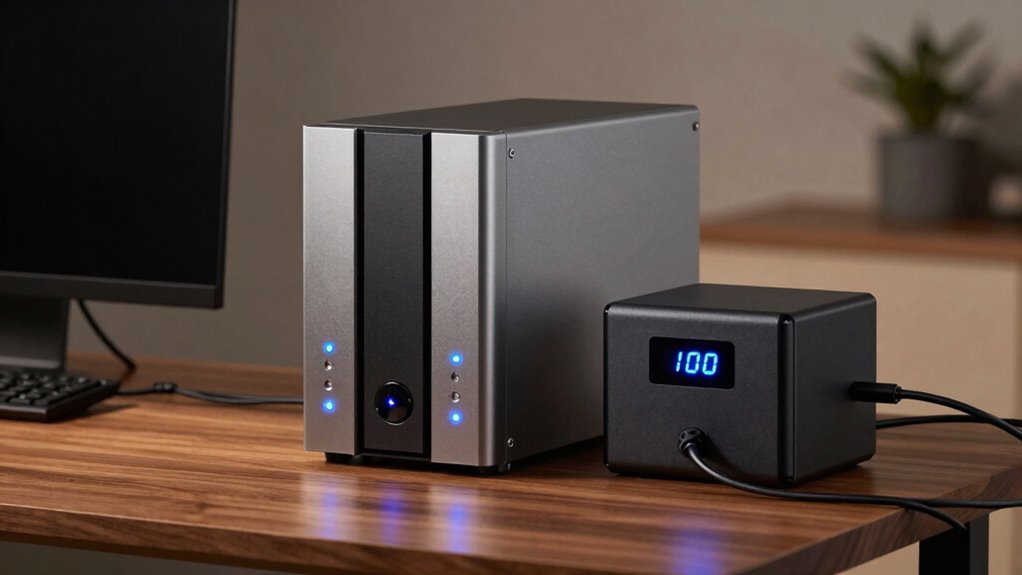
A UPS battery backup for NAS systems is the difference between a clean shutdown and corrupted RAID arrays after a power cut, and not every UPS on the market is built for the job. The CyberPower CP1500PFCRM2U earns my best overall pick thanks to its pure sinewave output and rack-mount design — exactly what power-factor-corrected NAS power supplies expect. The APC BE850G2 is a strong alternative if you want a trusted brand at a lower capacity, and the GOLDENMATE 1500VA LiFePO4 stands out for its long-life lithium battery that may never need replacing during your NAS’s lifetime. The main tradeoffs in this category come down to sinewave versus simulated sinewave output, battery chemistry, and whether you need enough runtime and USB connectivity for automated shutdown software. Keep reading for the full breakdown of all 15 models.

Prime made for students and young adults
- Fast, free delivery for dorm and study essentials
- Prime Video and Amazon Music included
- Member-only deals
Key Takeaways
- Pure sinewave output (CyberPower CP1500PFCRM2U) is the safest match for active PFC power supplies found in Synology, QNAP and TerraMaster NAS units; simulated sinewave models work but carry more risk.
- Lithium and LiFePO4 models from GOLDENMATE outlast sealed lead-acid units by years, trading higher upfront cost for freedom from the 3–5 year battery replacement cycle.
- A UPS without USB data connectivity cannot trigger your NAS’s auto-shutdown, so small APC units like the BE425M only protect against brief flickers, not extended outages.
- The UGREEN US3000 solves a niche problem — direct DC backup for select NAS and router setups — with far less capacity than any AC UPS on this list.
- Wattage ratings matter more than VA ratings: a 1500VA/1000W unit realistically supports a multi-drive NAS plus network gear, while 600W-class units suit single or dual-bay systems only.
| CyberPower CP1500AVRLCD3 Intelligent LCD UPS Battery Backup (1500VA/900W) |  | Best Overall | Capacity: 1500VA / 900W | Topology: Line Interactive | Output Waveform: Simulated Sine Wave | VIEW ON AMAZON | See Our Full Breakdown |
| APC BE425M Back-UPS Battery Backup and Surge Protector |  | Best Budget Pick for Routers and Modems | Capacity: 425VA / 255W | Runtime: Up to 15 minutes at 100W load | Outlets: 6 total: 4 battery backup + surge, 2 surge-only | VIEW ON AMAZON | See Our Full Breakdown |
| CyberPower CP1500PFCRM2U PFC Sinewave UPS Battery Backup |  | Best for Rackmount NAS Setups | Capacity: 1500VA / 1000W | Output Waveform: Sine Wave | Outlets: 8 NEMA 5-15R | VIEW ON AMAZON | See Our Full Breakdown |
| GOLDENMATE 1000VA/800W Lithium UPS Battery Backup and Surge Protector |  | Best Long-Term Investment | Capacity: 1000VA / 800W | Battery Type: Lithium Iron Phosphate (LiFePO4) | Output Waveform: Pure Sine Wave | VIEW ON AMAZON | See Our Full Breakdown |
| APC Back-UPS 650 Battery Backup and Surge Protector (BVN650M1) |  | Best Compact Option for Small Setups | Capacity: 360W maximum | Voltage: 120V | Outlets: 7 plus USB charging port | VIEW ON AMAZON | See Our Full Breakdown |
| CyberPower EC850LCD Ecologic UPS Battery Backup and Surge Protector |  | Best Budget Starter Pick | Capacity: 850VA / 500W | Outlets: 12 total (6 battery backup, 6 surge-only, 3 ECO-controlled) | Output waveform: Simulated sine wave | VIEW ON AMAZON | See Our Full Breakdown |
| GOLDENMATE 1500VA/1000W LiFePO4 UPS Battery Backup and Surge Protector |  | Best Premium Lithium Upgrade | Capacity: 1500VA / 1000W | Battery type: LiFePO4, 3,000+ charge cycles | Output waveform: Pure sine wave | VIEW ON AMAZON | See Our Full Breakdown |
| APC BX1500M UPS Battery Backup & Surge Protector |  | Best for Long Runtimes | Capacity: 1500VA / 900W | Backup runtime: Up to 68 minutes at 100W load | Outlets: 10 total (5 battery backup, 5 surge-only) | VIEW ON AMAZON | See Our Full Breakdown |
| GOLDENMATE 1000VA/600W Lithium UPS Battery Backup & Surge Protector, White |  | Best for Automatic NAS Shutdown | Capacity: 1000VA / 600W | Battery type: LiFePO4, 10+ year lifespan, 5,000+ cycles | Output waveform: Pure sine wave | VIEW ON AMAZON | See Our Full Breakdown |
| GOLDENMATE 1000VA/600W Lithium UPS Battery Backup & Surge Protector, Gray | | Best Low-Maintenance Value | Capacity: 1000VA / 600W | Battery type: LiFePO4, 10+ year lifespan, 5,000+ cycles | Output waveform: Pure sine wave | VIEW ON AMAZON | See Our Full Breakdown |
| APC BE600M1 UPS Battery Backup and Surge Protector |  | Best Budget Pick for Light Network Gear | Model: BE600M1 | Battery-backed outlets: 5 | Surge-only outlets: 2 | VIEW ON AMAZON | See Our Full Breakdown |
| GOLDENMATE 1500VA/1000W Lithium UPS Battery Backup & Surge Protector, White |  | Best Premium Long-Term Investment | Capacity: 1500VA / 1000W | Battery Type: LiFePO4, 51.2V, 5.8Ah | Battery Lifespan: 10+ years, 3,000+ charge cycles | VIEW ON AMAZON | See Our Full Breakdown |
| UGREEN NAS UPS US3000 – 120W DC 12000mAh Battery Backup |  | Best Dedicated Companion for UGREEN NAS | Model: US3000 | Battery Capacity: 12000mAh Li-ion | Power Output: 120W DC | VIEW ON AMAZON | See Our Full Breakdown |
| APC BE650G1 550VA/330W Uninterruptible Power Supply Battery Backup |  | Best for Splitting NAS and Peripherals | Capacity: 550VA / 330W | Runtime: Up to 22 minutes at 100W load | Outlets: 8 total: 4 battery backup + surge, 4 surge-only | VIEW ON AMAZON | See Our Full Breakdown |
| APC BE850G2 UPS Battery Backup and Surge Protector |  | Best Mid-Size All-Rounder | Capacity: 850VA / 450W | Runtime: Up to 35 minutes at 100W load | Outlets: 9 NEMA outlets: 6 battery-backup, 3 surge-only | VIEW ON AMAZON | See Our Full Breakdown |
| ups battery backup for nas system | Capacity | Outlets |
|---|---|---|
| CyberPower CP1500AVRLCD3 Intel | 1500VA / 900W | 12 NEMA 5-15R (6 battery backup + surge, 6 surge only) |
| APC BE425M Back-UPS Battery Ba | 425VA / 255W | 6 total: 4 battery backup + surge, 2 surge-only |
| CyberPower CP1500PFCRM2U PFC S | 1500VA / 1000W | 8 NEMA 5-15R |
| GOLDENMATE 1000VA/800W Lithium | 1000VA / 800W | 8 NEMA 5-15R |
| APC Back-UPS 650 Battery Backu | 360W maximum | 7 plus USB charging port |
| CyberPower EC850LCD Ecologic U | 850VA / 500W | 12 total (6 battery backup, 6 surge-only, 3 ECO-controlled) |
| GOLDENMATE 1500VA/1000W LiFePO | 1500VA / 1000W | 8 |
| APC BX1500M UPS Battery Backup | 1500VA / 900W | 10 total (5 battery backup, 5 surge-only) |
| GOLDENMATE 1000VA/600W Lithium | 1000VA / 600W | 8x NEMA 5-15P |
| GOLDENMATE 1000VA/600W Lithium | 1000VA / 600W | 8x NEMA 5-15P |
| APC BE600M1 UPS Battery Backup | — | — |
| GOLDENMATE 1500VA/1000W Lithiu | 1500VA / 1000W | 8x NEMA 5-15P (surge + battery backup) |
| UGREEN NAS UPS US3000 | — | — |
| APC BE650G1 550VA/330W Uninter | 550VA / 330W | 8 total: 4 battery backup + surge, 4 surge-only |
| APC BE850G2 UPS Battery Backup | 850VA / 450W | 9 NEMA outlets: 6 battery-backup, 3 surge-only |
More Details on Our Top Picks
CyberPower CP1500AVRLCD3 Intelligent LCD UPS Battery Backup (1500VA/900W)
This option stands out for balancing capacity, monitoring, and price in a way that suits most home NAS setups. The Automatic Voltage Regulation quietly corrects brownouts and minor sags without touching the battery, which matters for a NAS that runs 24/7 in regions with dirty power. Compared with the APC BE425M, the extra capacity means a multi-drive NAS can ride through longer outages and shut down gracefully rather than crashing mid-write. The color LCD is more useful than the simple LED indicators on smaller APC units, giving real-time load and runtime data at a glance. The tradeoff is the simulated sine wave output — fine for most NAS power supplies, but owners of active PFC units should step up to the CP1500PFCRM2U. An 8-hour recharge also means a second outage the same day may find the battery flat.
Pros:- Automatic Voltage Regulation handles minor fluctuations without draining the battery
- Color LCD panel provides real-time load, battery, and runtime diagnostics
- 3-year warranty including battery plus a $500,000 connected equipment guarantee
- Six battery-backed outlets plus USB-A and USB-C charging for phones and tablets
Cons:- Simulated sine wave output can cause issues with active PFC power supplies
- 8-hour battery recharge time leaves little protection for back-to-back outages
Best for: Home NAS owners running a 2-4 drive system who want long runtime, diagnostics, and strong warranty coverage without rackmount hardware
Not ideal for: Owners of active PFC power supplies or rack-enclosed NAS units — the simulated sine wave and tower shape are wrong fits there
- Capacity:1500VA / 900W
- Topology:Line Interactive
- Output Waveform:Simulated Sine Wave
- Outlets:12 NEMA 5-15R (6 battery backup + surge, 6 surge only)
- Battery Charge Time:8 hours
- Form Factor:Mini-Tower
- Warranty:3 years including battery
- Connected Equipment Guarantee:$500,000
Our verdict“The most sensible all-around choice for a typical desktop or shelf-mounted NAS that needs serious runtime and monitoring at a mainstream price.”
APC BE425M Back-UPS Battery Backup and Surge Protector
This model makes the list for a specific job: keeping the network alive, not the NAS itself. At 425VA/255W, it comfortably covers a router, modem, and switch for roughly 15 minutes — usually enough to outlast brief blips or complete an internet-dependent task. Compared with the APC BVN650M1, it trades raw capacity for a lower cost of entry and a wall-mountable body that tucks neatly behind a desk or shelving unit. The honest limitation is scale: a multi-bay NAS will drain it almost instantly, so it should pair with a bigger unit like the CyberPower CP1500AVRLCD3 rather than replace one. With only four battery-backed outlets, it is built for a compact network stack and nothing more ambitious.
Pros:- Affordable entry point for basic network protection
- Compact, wall-mountable design fits behind furniture or on a shelf
- Six outlets accommodate a small network stack
- Wiring fault indicator and audible alarms flag problems early
Cons:- Only 255W capacity — not enough for a multi-bay NAS under load
- Just four of the six outlets provide battery backup
Best for: Buyers who mainly need to keep a router, modem, and switch online through short outages without spending much
Not ideal for: Anyone expecting NAS runtime — 255W of capacity will shut a multi-drive system down within moments
- Capacity:425VA / 255W
- Runtime:Up to 15 minutes at 100W load
- Outlets:6 total: 4 battery backup + surge, 2 surge-only
- Mounting:Floor or wall mount
- Warranty:3 years
- Equipment Protection:$75,000
Our verdict“A smart, cheap insurance policy for your internet gear — pair it with a larger UPS for the NAS itself.”
CyberPower CP1500PFCRM2U PFC Sinewave UPS Battery Backup
For a NAS living in a server rack, this is the clear pick. The true sine wave output is the key differentiator against the CyberPower CP1500AVRLCD3: active PFC power supplies — common in purpose-built NAS and server hardware — can behave unpredictably on simulated sine wave, and this model removes that risk entirely. The 10.5-inch short-depth chassis is rarer than it sounds; many rackmount UPS units run deep enough to collide with cabling in compact racks, and this one avoids that. All eight outlets sit on battery backup, unlike consumer units that split outlets between surge-only and battery. The tradeoff is format and budget: if the NAS sits on a shelf, the tower-style CP1500AVRLCD3 or the GOLDENMATE 1000VA delivers similar protection without paying for rack ears and a shallower engineering package.
Pros:- True sine wave output fully compatible with active PFC power supplies
- Short 10.5-inch depth fits space-limited and compact racks
- All 8 NEMA 5-15R outlets provide battery backup and surge protection
- Automatic voltage regulation extends battery life during brownouts
Cons:- Rackmount design is awkward and overpriced for non-racked setups
- Premium feature set commands a higher price than tower equivalents
Best for: Owners of rack-enclosed NAS or home server racks with active PFC power supplies who need clean power and a shallow chassis
Not ideal for: Desk and shelf setups — the rackmount form factor wastes money and mounting hardware on a tower NAS build
- Capacity:1500VA / 1000W
- Output Waveform:Sine Wave
- Outlets:8 NEMA 5-15R
- Depth:10.5 inches
- Display:Multifunction color LCD
- Voltage Regulation:Automatic Voltage Regulation
- Warranty:3 years including battery
- Connected Equipment Guarantee:$500,000
Our verdict“The right choice when a racked, PFC-based NAS demands clean sine wave power in a shallow chassis — skip it for anything on a shelf.”
GOLDENMATE 1000VA/800W Lithium UPS Battery Backup and Surge Protector
This pick makes the most sense for buyers thinking in decades rather than warranty cycles. The LiFePO4 battery is rated for more than 5,000 charge cycles and a lifespan past 10 years — sealed lead-acid units in the CP1500AVRLCD3 or APC BX1500M typically need replacement every 3-5 years, so the math favors lithium over time. The pure sine wave output at this capacity is unusual in the value segment and matches what the pricier rackmount CP1500PFCRM2U offers, making it safe for active PFC supplies. USB communication supports automated NAS shutdown scripts through standard software. Tradeoffs exist: the cooling fan switches on during heavy battery use, which matters in a quiet office or bedroom, and 800W caps what a large multi-drive array with expansion headroom can draw.
Pros:- LiFePO4 battery rated for over 5,000 cycles and 10+ years of service
- Pure sine wave output safe for active PFC power supplies
- All 8 outlets provide battery backup and surge protection
- USB connection enables automatic NAS shutdown software
Cons:- Cooling fan activates during heavy battery usage, adding noise
- 800W maximum output limits large multi-drive or expansion-heavy builds
Best for: Set-and-forget NAS owners who want a battery that outlasts multiple lead-acid replacements and clean power for PFC supplies
Not ideal for: Silence-sensitive rooms and high-draw arrays — fan noise under load and the 800W ceiling are real constraints
- Capacity:1000VA / 800W
- Battery Type:Lithium Iron Phosphate (LiFePO4)
- Output Waveform:Pure Sine Wave
- Outlets:8 NEMA 5-15R
- Battery Lifespan:10+ years, over 5,000 charge cycles
- Communication:USB
- Cooling Noise:Below 50 dB
- Weight:5.9 kg
Our verdict“Buy it if you plan to keep the same NAS running for a decade and would rather never swap a battery again.”
APC Back-UPS 650 Battery Backup and Surge Protector (BVN650M1)
This model suits a modest single-drive or two-bay NAS that needs just enough power to shut down cleanly. Its slim profile slides behind a desk where a mini-tower like the CyberPower CP1500AVRLCD3 would never fit, and the ENERGY STAR certification keeps idle losses low on a device that sits plugged in permanently. Compared with the APC BE425M, it offers more outlets — seven plus a USB charging port — and enough wattage for a small NAS plus a monitor or network gear. The hard limit is runtime: 4 minutes at full load means this is a graceful-shutdown device, not a keep-working device. Anyone who wants to keep editing or streaming through an outage should size up to a 1500VA-class unit instead.
Pros:- Slim, compact design fits behind a desk or monitor arm
- 7 outlets plus USB charging cover a small NAS and essential peripherals
- ENERGY STAR certified for efficient always-on operation
- Audible alarms give early warning of power events
Cons:- Only about 4 minutes of runtime at full load
- 360W output ceiling rules out larger NAS hardware
Best for: Owners of a small single or dual-bay NAS in a tight workspace who only need time for an automatic clean shutdown
Not ideal for: Buyers expecting to keep working through outages, or anyone running power-hungry multi-drive arrays — 360W and 4 minutes will not cut it
- Capacity:360W maximum
- Voltage:120V
- Outlets:7 plus USB charging port
- Runtime:Approximately 4 minutes at full load
- Form Factor:Compact
- Certifications:ENERGY STAR V2.0, UL 1778
- Dimensions:14.18 x 7.39 x 6.7 inches
Our verdict“A tidy, efficient shutdown-only UPS for compact single-bay setups — anything more demanding needs more capacity.”
CyberPower EC850LCD Ecologic UPS Battery Backup and Surge Protector
For a first-time NAS owner on a tight budget, this option stands out for sheer outlet count and its ECO-controlled outlets that cut phantom power draw from peripherals. The tradeoff is steep at the core spec level: the 2-minute listed runtime at full load means a NAS under real load may only get enough time to shut down cleanly — there’s no headroom for riding out short flickers while files are still being written. Compared with the APC BX1500M, which stretches to 68 minutes at light loads, this model is strictly a graceful-shutdown tool, not a work-through-the-outage tool. The simulated sine wave output is also a compromise; NAS power supplies with active PFC can behave unpredictably on stepped waveforms. The LCD panel and $100,000 connected equipment guarantee add real value at this tier.
Pros:- Twelve total outlets, including three ECO-controlled ports that eliminate idle peripheral draw
- LCD panel gives at-a-glance battery and power condition readings
- Three-year warranty covers the battery itself, not just the unit
- Compact footprint fits under a desk or on a shelf alongside network gear
Cons:- 2-minute rated runtime at load leaves almost no margin beyond a safe shutdown
- Simulated sine wave output can conflict with active PFC power supplies in many NAS units
Best for: Budget-conscious owners of a small single-bay or two-bay NAS who mainly need clean shutdown time during brief outages
Not ideal for: Anyone running multi-bay NAS units with active PFC power supplies — the simulated sine wave and 500W ceiling are poor matches
- Capacity:850VA / 500W
- Outlets:12 total (6 battery backup, 6 surge-only, 3 ECO-controlled)
- Output waveform:Simulated sine wave
- Battery type:Sealed lead acid
- Runtime:2 minutes at full load
- Power cord:5 feet, right-angle NEMA 5-15P
- Warranty:3 years including battery
Our verdict“A low-cost safety net for basic NAS setups that only need enough battery to shut down cleanly — nothing more.”
GOLDENMATE 1500VA/1000W LiFePO4 UPS Battery Backup and Surge Protector
This model is the strongest argument in the lineup for paying more upfront to stop replacing batteries every few years. The LiFePO4 battery rated for 3,000+ charge cycles contrasts sharply with the lead-acid packs in the CyberPower EC850LCD and APC BX1500M, which typically fade within three to five years. The pure sine wave output at a full 1000W makes it a safer companion for PFC-based NAS power supplies than anything in the budget tier. The communication port enables automatic safe shutdown when the battery runs low, which is the single most important feature for unattended NAS operation. The tradeoffs: USB charging is capped at 10W total — barely enough for a phone — and the cooling fan becomes audible during sustained battery discharge.
Pros:- LiFePO4 chemistry rated for 3,000+ cycles and up to 10 years of service
- Pure sine wave output at a full 1000W capacity handles PFC power supplies safely
- Communication port triggers automatic safe shutdown of connected devices
- LCD panel provides continuous power and battery status monitoring
Cons:- USB ports deliver only 10W combined, too weak for fast-charging phones or tablets
- Cooling fan noise becomes noticeable during heavy battery discharge
Best for: Owners of power-hungry multi-bay NAS enclosures who want a decade-long battery lifespan and clean sine wave power
Not ideal for: Homes reliant on generator backup power — this unit is built for standard utility AC and may not recognize generator input
- Capacity:1500VA / 1000W
- Battery type:LiFePO4, 3,000+ charge cycles
- Output waveform:Pure sine wave
- Outlets:8
- USB charging:1 USB-C + 1 USB-A, 10W total
- Input voltage:90–140V AC
- Noise level:Below 50 dB
Our verdict“A long-horizon buy for serious NAS setups where battery replacement fatigue and clean power matter more than the initial cost.”
APC BX1500M UPS Battery Backup & Surge Protector
What separates this APC unit from the lithium GOLDENMATE models is runtime at light loads — up to 68 minutes at 100W, which covers a modest NAS plus a router for most of a brief outage rather than just a shutdown window. The automatic voltage regulation corrects brownouts without touching the battery, preserving battery capacity for true blackouts and extending overall service life. Data-line protection for coaxial and Ethernet is a thoughtful inclusion for NAS owners, since surges can travel through network cabling. The compromise is the outlet split: only 5 of 10 outlets are battery-backed, so a multi-device rack means choosing what stays powered. And while the battery is user-replaceable, replacements are sold separately — an ongoing cost the LiFePO4 units largely eliminate.
Pros:- Up to 68 minutes of runtime at light loads outlasts most brief outages entirely
- AVR corrects brownouts and surges without draining the battery
- Coaxial and Ethernet surge protection guards network paths into the NAS
- User-replaceable battery allows zero-downtime maintenance swaps
Cons:- Only 5 of 10 outlets provide battery backup
- Replacement battery is sold separately, adding to long-term ownership cost
Best for: NAS owners in areas with frequent short outages or brownouts who want to keep working through them, not just shut down
Not ideal for: Buyers wanting minimal maintenance — the lead-acid battery needs eventual replacement, and the spare is an added cost
- Capacity:1500VA / 900W
- Backup runtime:Up to 68 minutes at 100W load
- Outlets:10 total (5 battery backup, 5 surge-only)
- Voltage regulation:AVR corrects brownouts from 88V and surges +/-13%
- Data protection:Coaxial and Ethernet surge protection
- Battery:User-replaceable (APCRBC124, sold separately)
- Efficiency:ENERGY STAR certified, 92%+
Our verdict“The pick when ride-through time matters more than battery longevity — ideal for riding out short outages with the NAS still running.”
GOLDENMATE 1000VA/600W Lithium UPS Battery Backup & Surge Protector, White
This white variant earns its place on one standout capability: automatic safe shutdown of PCs, Macs, and NAS devices over USB without extra software. That software-free automation is exactly what an unattended home server needs, and it’s implemented more cleanly here than on many competitors that require vendor utilities. The 5,000+ cycle LiFePO4 battery outlasts the packs in the CyberPower EC850LCD by a wide margin, and pure sine wave output makes it friendly to sensitive NAS power supplies. Compared with the 1500VA GOLDENMATE, capacity drops to 600W — fine for a two to four bay NAS plus networking gear, but restrictive for larger enclosures. Operation stays quiet below 50 dB, though the cooling fan kicks in under heavy load and can be audible in a quiet room.
Pros:- Automatic USB shutdown for NAS, PC, and Mac devices with no additional software required
- LiFePO4 battery rated for 10+ years and 5,000+ charge cycles
- Pure sine wave output protects sensitive NAS power supplies
- Quiet sub-50 dB operation with Battery Management System safety features
Cons:- Limited to 110V household power (90–140V input range)
- Cooling fan becomes noticeable under heavy load in quiet environments
Best for: Home server owners who want their NAS to shut itself down safely during outages without installing shutdown software
Not ideal for: High-wattage setups — the 600W ceiling rules out large multi-bay arrays and stacked peripherals
- Capacity:1000VA / 600W
- Battery type:LiFePO4, 10+ year lifespan, 5,000+ cycles
- Output waveform:Pure sine wave
- Outlets:8x NEMA 5-15P
- Input voltage:90–140V AC
- Communication:USB with auto-shutdown support
- Noise level:Below 50 dB
Our verdict“The easiest path to hands-off NAS protection — set it once and trust the automatic shutdown to protect your data.”
GOLDENMATE 1000VA/600W Lithium UPS Battery Backup & Surge Protector, Gray
Functionally, this gray model mirrors its white sibling in most respects — same 1000VA/600W capacity, same pure sine wave output, same 10-year LiFePO4 battery. Where it distinguishes itself is the pitch of 40% lower total cost of ownership versus lead-acid UPS units, which reframes the higher upfront price as a saving over a decade of no battery replacements. Measured against the APC BX1500M, this model wins on maintenance: no replacement packs to buy, ever. Against the APC’s 68-minute light-load runtime, though, it gives ground — capacity here is oriented toward safe shutdown plus modest ride-through rather than working through long outages. The intelligent LCD panel and built-in BMS round out a package well suited to desks, media consoles, and network closets where the gray finish blends in better than gloss white.
Pros:- LiFePO4 battery rated for 10+ years and 5,000+ charge cycles with no replacements needed
- Lower total cost of ownership compared with lead-acid UPS alternatives
- Eight surge-protected battery backup outlets with pure sine wave output
- Intelligent LCD panel with real-time battery and power monitoring
Cons:- Cooling fan activates under heavy load, adding noise to quiet rooms
- 600W load ceiling limits how many devices can share the backup
Best for: Buyers who want a set-and-forget UPS for a home office NAS and network gear with zero battery replacement over its lifetime
Not ideal for: Users needing extended runtime through long outages — the 600W capacity and runtime profile favor shutdown over sustained operation
- Capacity:1000VA / 600W
- Battery type:LiFePO4, 10+ year lifespan, 5,000+ cycles
- Output waveform:Pure sine wave
- Outlets:8x NEMA 5-15P
- Input voltage:90–140V AC (110V standard)
- Management:Built-in Battery Management System
- Noise level:Below 50 dB
Our verdict“A low-friction, decade-long backup for home office NAS setups where avoiding maintenance matters more than maximum runtime.”
APC BE600M1 UPS Battery Backup and Surge Protector
For anyone running a small NAS with modest power draw, this compact APC unit covers the basics without paying for capacity you won’t use. The five battery-backed outlets are enough for a two-bay NAS, a router, and a modem, and the 23-minute runtime at 100W gives a shutdown script plenty of time to finish cleanly. Compared with the larger APC BE850G2, you give up outlet count and total runtime, but you also spend less and occupy less space on a shelf. Unlike the UGREEN US3000, it works with any brand of NAS, not just one ecosystem — though its simulated sine wave output is a weaker match for NAS units with active PFC power supplies, where a pure sine wave model like the GOLDENMATE 1500VA is the safer bet.
Pros:- Five battery-backed outlets plus two surge-only outlets in a compact footprint
- USB charging port stays live during outages for a phone or IoT bridge
- User-replaceable battery extends service life
- Enough runtime at light loads for scripted NAS shutdowns
Cons:- Runtime figure is tied to a 100W load; realistic multi-drive NAS setups will drain it much faster
- Replacement battery sold separately adds to long-term cost
Best for: Owners of low-wattage two-bay NAS enclosures and network gear who need just enough runtime for an automatic shutdown
Not ideal for: Anyone with an active PFC NAS or a multi-drive rack — the limited wattage headroom and stepped sine output make it a poor fit
- Model:BE600M1
- Battery-backed outlets:5
- Surge-only outlets:2
- USB port:1.5A
- Runtime:23 minutes at 100W load
- Replacement battery:APCRBC154, sold separately
Our verdict“A sensible, low-cost safety net for light network setups, provided your NAS draws little power and tolerates non-pure sine output.”
GOLDENMATE 1500VA/1000W Lithium UPS Battery Backup & Surge Protector, White
This is the pick when the goal is buying once and forgetting about battery swaps. The LiFePO4 battery is rated for 3,000+ cycles and a 10+ year maintenance-free life, which changes the ownership math entirely: lead-acid units like the CyberPower CP1500AVRLCD3 typically need a replacement battery every three to five years. Add pure sine wave output with AVR and you get clean, voltage-corrected power that suits PFC-equipped NAS units and larger multi-bay enclosures. The front LCD and USB charging ports are conveniences the smaller APC BE600M1 can’t match. The tradeoffs are real, though — the larger transformer makes it heavier than comparable lead-acid units, and it refuses to play nice with generator power, staying in battery mode instead of recharging.
Pros:- LiFePO4 battery rated for 3,000+ cycles and 10+ years of maintenance-free use
- Pure sine wave output with AVR protects sensitive PFC power supplies
- Eight widely spaced outlets plus USB-C and USB-A front charging
- LCD display and communication port support real-time monitoring and automatic shutdown
Cons:- Larger and heavier than comparable lead-acid UPS units due to a bigger transformer
- Not compatible with generator-supplied power; may stay in battery mode and not recharge
Best for: Owners of power-hungry multi-bay NAS units who want decade-long battery life and pure sine wave protection without recurring replacement costs
Not ideal for: Anyone running backup power from a generator, or who needs a lightweight unit they can move around — the transformer weight adds up
- Capacity:1500VA / 1000W
- Battery Type:LiFePO4, 51.2V, 5.8Ah
- Battery Lifespan:10+ years, 3,000+ charge cycles
- Topology:Line-Interactive, Pure Sine Wave
- Outlets:8x NEMA 5-15P (surge + battery backup)
- Display:LCD with battery/power status monitoring
- USB Charging:1x USB-C + 1x USB-A, 10W total
- Input Voltage:90-140V AC (standard 110V household power)
Our verdict“The strongest long-term value in this lineup for serious NAS setups, as long as your power source is standard household AC.”
UGREEN NAS UPS US3000 – 120W DC 12000mAh Battery Backup
Most UPS units in this roundup are generalists; this one is a purpose-built match for UGREEN’s NAS ecosystem. Because it feeds 120W DC directly to compatible DXP and DH models, there’s no inverter stage — which is how it achieves true zero-second transfer, something no AC line-interactive unit like the APC BE850G2 can claim. The app integration is the other differentiator: instead of relying on a PC-side shutdown agent, you configure shutdown policies, get outage notifications, and enable auto-restart from your phone. The catch is scope. Runtime is capped at roughly 10 minutes, which is enough for a clean shutdown but not for riding out longer blips, and it simply won’t work with the DXP6800/DXP8800 series or any non-UGREEN hardware. If your NAS is another brand, skip straight to an AC UPS.
Pros:- Zero-second seamless transfer eliminates the switchover gap that can corrupt writes
- App-based shutdown policies, notifications, and automatic NAS restart
- Compact, quiet DC design with no inverter losses
- Multi-layer protection covering surge, over-charge, over-current, and short-circuit
Cons:- Only compatible with select UGREEN NAS models — useless outside that ecosystem
- Roughly 10 minutes of runtime, shorter than any AC UPS in this lineup
Best for: Owners of compatible UGREEN DXP2800/DXP4800-series NAS units who want seamless transfer and app-managed shutdowns
Not ideal for: Anyone with a Synology, QNAP, or larger UGREEN DXP6800/8800 enclosure — the DC connection and compatibility list exclude them entirely
- Model:US3000
- Battery Capacity:12000mAh Li-ion
- Power Output:120W DC
- Runtime During Outage:About 10 minutes
- Transfer Time:0 seconds
- Compatible Models:UGREEN DXP2800, DXP4800, DXP4800 Pro, DXP4800Plus, DXP480T, DH4300Plus, DH2300
- Protections:Power failure, surge, over-charge, over-current, short-circuit
Our verdict“If you own a compatible UGREEN NAS, this is the cleanest integration available; everyone else should look at an AC unit.”
APC BE650G1 550VA/330W Uninterruptible Power Supply Battery Backup
The appeal here is outlet discipline. With eight outlets split evenly between four battery-backed and four surge-only, this model encourages a smart layout: the NAS and router go on battery, while printers, speakers, and desk lamps get surge protection without stealing precious backup minutes. That’s a more flexible arrangement than the APC BE600M1, which offers seven outlets total. Runtime of up to 22 minutes at 100W lands it in the same neighborhood as its smaller sibling, and the $75,000 equipment protection policy plus a 3-year warranty add peace of mind for a budget unit. The obvious limitation is that 330W ceiling — a four-bay NAS waking its drives can spike past it, at which point stepping up to the BE850G2 or a 1000W-class unit like the GOLDENMATE models makes more sense.
Pros:- Eight outlets with a clean four-and-four split between battery and surge-only
- User-replaceable battery extends useful life
- $75,000 connected equipment protection and 3-year warranty
- Status indicators and audible alerts make faults obvious at a glance
Cons:- Only four of the eight outlets provide battery backup
- Replacement battery sold separately
Best for: Home office users who want to isolate their NAS and networking gear on battery while surge-protecting everything else
Not ideal for: Multi-drive NAS owners with high startup power draws — the 330W limit can trip the overload alarm during disk spin-up
- Capacity:550VA / 330W
- Runtime:Up to 22 minutes at 100W load
- Outlets:8 total: 4 battery backup + surge, 4 surge-only
- Battery:User-replaceable (APCRBC110, sold separately)
- Warranty:3 years
- Equipment Protection:$75,000
Our verdict“A well-organized budget UPS for mixed desks, as long as your NAS power draw stays comfortably under its cap.”
APC BE850G2 UPS Battery Backup and Surge Protector
This is the model that hits the sweet spot for a typical NAS-plus-network-stack without overbuying. Six battery-backed outlets and up to 35 minutes of runtime at 100W mean you can keep a NAS, router, switch, and modem alive through most short outages — potentially riding them out entirely rather than shutting down, something neither the APC BE650G1 nor the BE600M1 can manage. The silenceable alarm is a small feature with outsized value for a NAS that lives in a bedroom or hallway, and dual USB-A ports handle phone charging during an outage. Compared with the GOLDENMATE 1500VA, you lose pure sine wave output and long-life lithium chemistry, so PFC-heavy NAS builds should still upgrade — but for standard enclosures, the balance of price, outlets, and runtime is hard to beat.
Pros:- Six battery-backed outlets cover a NAS plus router, switch, and modem
- Up to 35 minutes of runtime at 100W outlasts most brief outages
- Silenceable alarm suits units placed near bedrooms or offices
- User-replaceable battery and $75,000 equipment protection
Cons:- Replacement battery sold separately adds recurring cost every few years
- Stepped sine wave output is a weaker match for active PFC power supplies
Best for: Households running a NAS plus full network stack who want enough runtime to outlast brief outages and a quiet alarm for living spaces
Not ideal for: NAS builds with active PFC power supplies or owners wanting a decade without battery replacement — pure sine lithium units serve them better
- Capacity:850VA / 450W
- Runtime:Up to 35 minutes at 100W load
- Outlets:9 NEMA outlets: 6 battery-backup, 3 surge-only
- USB Ports:2x USB-A, 5V/2.4A shared
- Replacement Battery:RBC17, sold separately
- Warranty:3 years
- Equipment Protection:Up to $75,000
Our verdict“The best-balanced mainstream UPS in this lineup for keeping a whole network stack alive through short outages quietly and reliably.”

How We Picked
I evaluated every unit against the demands specific to NAS ownership rather than generic desktop backup duty. The criteria that drove ranking: output waveform compatibility with active PFC power supplies, true watt capacity relative to a loaded multi-bay NAS, USB or network communication for shutdown software like Synology UPS or apcupsd, battery chemistry and replacement cost over a realistic 5–10 year ownership window, and outlet layout including whether battery-backed outlets are spaced for bulky NAS power bricks.
Ranking reflects a simple hierarchy: sinewave models with proper data ports sit highest because they remove the most risk; lithium-based units follow closely on longevity grounds; budget simulated-sinewave units rank lower despite their value because they depend on your NAS tolerating a stepped waveform. Capacity mismatch penalized both directions — undersized units that can’t hold a NAS through shutdown, and oversized units whose runtime a home user will never use while paying for wattage they don’t need.
Factors to Consider When Choosing Ups Battery Backup For Nas Systems
Before settling on a model from the list above, it helps to understand the bigger picture — the mistakes NAS owners commonly make and the tradeoffs that don’t show up on a spec sheet.
Match the Waveform to Your NAS Power Supply
Most modern NAS units use active power factor correction, and many of those power supplies behave unpredictably on the stepped or simulated sinewave output of budget UPS units — in worst cases, they shut down instantly or clamp the waveform themselves. If your NAS documentation mentions PFC or if you run a rack-style unit, pure sinewave is the safe assumption, which pushes you toward models like the CP1500PFCRM2U. Simulated sinewave is not automatically disqualifying — plenty of home NAS devices run fine on it for years — but you are accepting a compatibility gamble in exchange for a lower price. A common mistake is buying a well-reviewed general-purpose UPS without ever checking the waveform, since that spec is buried in the fine print. If you cannot confirm compatibility, the small premium for sinewave is cheap insurance compared with rebuilding a degraded RAID array.
Size by Watts, Not VA
VA ratings get the marketing spotlight, but wattage is the number that actually determines whether your NAS stays up. A four-bay NAS with spinning drives can pull 150–250W under load, and once you add a router, switch and modem, realistic headroom disappears fast on a 330W unit. My guidance: add up the wattage of everything on battery-backed outlets, then add 25–30 percent so the UPS is not running at its ceiling. Oversizing also extends runtime per watt in a way that marketing curves hide, since runtime at 50 percent load is disproportionately longer than at 90 percent. The reverse mistake — buying a 1500VA/1000W unit for a single-bay NAS — mostly wastes money and floor space, though it does buy generous shutdown time.
Battery Chemistry and the Replacement Cycle
Traditional sealed lead-acid batteries degrade whether or not you use them, typically needing replacement every three to five years, and replacement batteries often cost a third of a new UPS. Lithium iron phosphate (LiFePO4) models flip that equation: the battery may outlast the NAS itself, and the chemistry handles partial charge states better, which matters because a UPS battery lives its whole life at 100 percent charge — a condition lead-acid tolerates poorly. The tradeoff is upfront cost and a newer, less proven brand landscape; GOLDENMATE has less track record than APC or CyberPower. If you plan to keep the same NAS for a decade, lithium usually wins on total cost. If this NAS is a two-year stopgap, lead-acid is the pragmatic choice.
Connectivity for Automated Shutdown
The single most common NAS-specific mistake is treating a UPS as a big battery and ignoring communication entirely. Without a USB data connection (or network card on enterprise units), your NAS never learns that power has failed, and when the battery dies, the NAS powers off hard — the exact outcome the UPS was bought to prevent. Synology, QNAP, TrueNAS and Unraid all support standard UPS protocols, but only when the UPS reports status. Check that the model supports your platform and budget ten minutes for configuration, because a configured 300W unit protects data better than an unconfigured 1000W one. Also confirm the data port works with your NAS’s OS — most do via the HID standard, but a few budget units have quirky implementations.
Runtime Reality Check
Runtime figures on the box assume optimistic loads; a unit advertising ten minutes may deliver three with a loaded NAS attached. Decide what you actually need: most home users need only three to five minutes — enough for a clean shutdown — while anyone wanting to ride out short utility blips without interrupting service needs substantially more. There is little value in paying for 30 minutes of runtime if your NAS auto-shuts down at the two-minute mark anyway, since the software, not the battery, sets that clock. Where extra runtime genuinely pays off is with network gear on the same UPS: keeping your modem and router alive lets you reach the NAS remotely to decide whether to shut down or wait out a short outage.
Form Factor and Placement
A 1500VA tower is a substantial object, and lead-acid units are heavy — a real consideration if your NAS lives on a shelf rather than in a rack. Rack-mount units like the CP1500PFCRM2U assume you have a rack or are willing to improvise; their depth can exceed shallow media cabinets. Compact units like the BE600M1 fit anywhere but limit you to a small load and few battery-backed outlets. Also think about outlet spacing: wall-wart power bricks for external drives and network gear can block adjacent outlets on tightly packed units, effectively reducing capacity. Finally, UPS units need ventilation — tucking one inside a closed cabinet shortens battery life regardless of chemistry.
Frequently Asked Questions
Can I use a regular APC or CyberPower UPS, or does a NAS need something special?
Any UPS with sufficient wattage and a USB data port will physically work, but NAS systems introduce two requirements that generic buying advice often skips. First, if your NAS has an active PFC power supply, a simulated sinewave output can cause unpredictable behavior, so pure sinewave models are the safer match. Second, the UPS must communicate with your NAS so shutdown software can trigger — a feature absent on the smallest surge-style units in this lineup like the BE425M. If your NAS is a two-bay home unit with a standard power supply, a good quality simulated-sinewave model with a data port is a reasonable budget choice.
How much UPS capacity do I need for a 4-bay or 6-bay NAS?
Count the drives, not just the enclosure. Spin-up current for four hard drives can briefly spike well above idle draw, and a 6-bay unit loaded with drives plus a router and switch can sit near 300W sustained. That rules out the 330W-class units entirely and makes 600–1000W models the practical floor for a serious multi-bay setup. My sizing rule: add up worst-case wattage for everything on battery outlets, then buy 25–30 percent more capacity than that figure. For most 4-bay owners, a 900W-class unit like the CP1500AVRLCD3 or BX1500M provides comfortable headroom and several minutes of runtime.
Are lithium UPS units like the GOLDENMATE models actually better for a NAS?
For long-term ownership, usually yes — the LiFePO4 chemistry in the 1000VA and 1500VA GOLDENMATE units should outlast two or even three sets of lead-acid replacement batteries, which changes the total cost of ownership math meaningfully. Lithium also tolerates the constant 100 percent charge state of a UPS better than lead-acid, which ages quickly under exactly those conditions. The honest tradeoffs: higher upfront cost, a less established brand reputation than APC or CyberPower, and fewer long-term reliability data points. If you replace your NAS hardware every few years, the longevity advantage matters less and a cheaper lead-acid unit is the rational pick.
Is the UGREEN NAS UPS US3000 a good alternative to a traditional UPS?
Only for a narrow set of setups. The US3000 outputs DC power directly, which means it works with devices that accept its voltage and connector — typically certain NAS models, routers and mini PCs — rather than anything with a standard AC plug. That makes it elegant for a low-power always-on device cluster: no inverter losses, compact size, and clean integration. But at 120W it cannot support a loaded multi-bay NAS, and it offers none of the surge protection or waveform considerations of an AC UPS. Treat it as a companion or niche solution, not a replacement for a full AC backup if your NAS draws real power.
What happens if my UPS runs out of battery before the NAS shuts down?
You get exactly the hard power-off the UPS was supposed to prevent, which is why configuration matters as much as capacity. The fix is setting your NAS shutdown software to trigger early — within the first minute or two of an outage — rather than waiting until the battery is nearly drained. Most NAS platforms let you define a threshold (often a battery percentage or remaining-runtime value) that initiates a clean shutdown and, optionally, a restart when power returns. Also test the shutdown path after setup: a surprising number of users discover their USB cable was in the wrong port or the driver never loaded, only during an actual outage. A yearly test, ideally around the time you’d check battery health, closes the loop.
Conclusion
The right choice depends entirely on what sits on your shelf. For the best overall pick, the CyberPower CP1500PFCRM2U pairs pure sinewave output with a data port and rack-friendly form — the lowest-risk option for a serious multi-bay NAS. For best value, the APC BE850G2 delivers reliable brand backing and shutdown connectivity at a capacity that suits most home setups, with the CyberPower EC850LCD as a close alternative thanks to its eco-mode outlets. For a best premium play, the GOLDENMATE 1500VA LiFePO4 offers a battery that may never need replacing and clean lithium chemistry for decade-long ownership. Beginners with a single or dual-bay NAS are well served by the APC BE600M1 or BVN650M1 — simple, cheap and adequate for clean shutdowns. And for the specific need of keeping a low-power NAS, router and modem cluster alive compactly, the UGREEN US3000 is a neat niche answer. Whatever you choose, budget ten minutes to configure shutdown software — that, more than any spec on the box, is what actually protects your data.
Halloween Picks
halloween
As an affiliate, we earn on qualifying purchases.