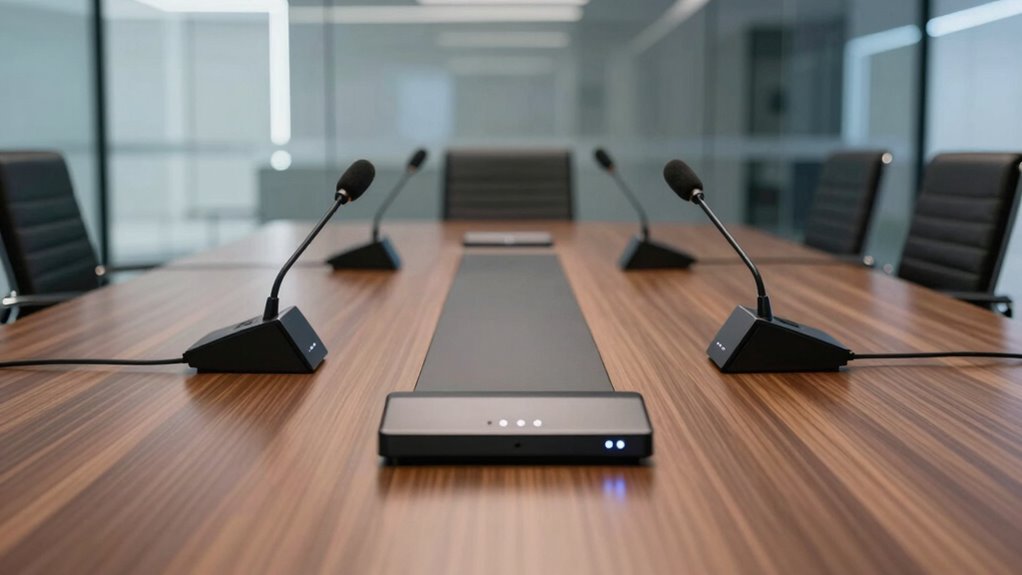
Choosing a tabletop microphone for a roundtable comes down to room size, connection type, and how evenly voices need to reach the recording or call. I’d start with the TONOR G11 for straightforward USB meetings, the Audio-Technica ATR4697-USB for flexible device compatibility, or the OM SYSTEM Olympus ME33 when daisy-chaining matters. Their differences are practical: USB models simplify setup, while the ME33 needs a separate recorder or audio input. The Movo MC1000 favors a broad but directional pickup area, and the SoundTech CM-1000 offers 360-degree coverage over an older 3.5 mm connection. I’ve ranked these by how well their stated pickup, connections, and expansion options fit shared-table discussions.

Prime made for students and young adults
- Fast, free delivery for dorm and study essentials
- Prime Video and Amazon Music included
- Member-only deals
Complete the kit

Key Takeaways
- The TONOR G11 is the simplest fit for small to medium USB meetings, with 360-degree pickup and an on-mic mute button.
- The OM SYSTEM Olympus ME33 is the lineup’s clearest choice for expandable coverage, but it requires a separate recorder or audio input.
- The Audio-Technica ATR4697-USB offers USB-C connectivity and a USB-A adapter, making it the most flexible pick across modern devices.
- The Movo MC1000’s 180-degree coverage favors a group seated in front of it rather than a full circle around the table.
- The SoundTech CM-1000 captures from all directions and lists echo cancellation, but its 3.5 mm plug may require more connection checking than USB.
| TONOR G11 USB Conference Microphone for PC & Mac |  | Best Overall for Small and Medium Roundtables | Connectivity: USB | Pickup pattern: Omnidirectional | Listed pickup distance: 11.5 ft | VIEW ON AMAZON | See Our Full Breakdown |
| Audio-Technica ATR4697-USB Omnidirectional Condenser Boundary Microphone |  | Best for Flexible Device Compatibility | Microphone type: Omnidirectional condenser boundary microphone | Pickup pattern: 360-degree omnidirectional | Connector: USB-C | VIEW ON AMAZON | See Our Full Breakdown |
| OM SYSTEM Olympus ME33 Tabletop Conference Omni-Directional Boundary Microphone with Daisy Chain Capability, Black and Silver |  | Best for Expandable Multi-Microphone Coverage | Connectivity: Auxiliary, 3.5 mm jack | Pickup pattern: Omnidirectional | Form factor: Boundary microphone | VIEW ON AMAZON | See Our Full Breakdown |
| Movo MC1000 Conference USB Microphone for Desktop and Laptop |  | Best for a Broad Front-Facing Seating Layout | Connectivity: USB | Polar pattern: Super cardioid | Listed pickup coverage: 20 ft radius, 180 degrees | VIEW ON AMAZON | See Our Full Breakdown |
| SoundTech CM-1000 Omnidirectional Conference Microphone |  | Best for Legacy 3.5 mm Setups | Connectivity: 3.5 mm auxiliary jack | Pickup pattern: Omnidirectional | Pickup coverage: 360 degrees | VIEW ON AMAZON | See Our Full Breakdown |
| tabletop boundary microphones for roundtable discussion | Connectivity | Pickup pattern | Cable length |
|---|---|---|---|
| TONOR G11 USB Conference Micro | USB | Omnidirectional | 1.8 m |
| Audio-Technica ATR4697-USB Omn | — | 360-degree omnidirectional | 1.5 m (4.9 ft) |
| OM SYSTEM Olympus ME33 Tableto | Auxiliary, 3.5 mm jack | Omnidirectional | — |
| Movo MC1000 Conference USB Mic | USB | — | 6.5 ft |
| SoundTech CM-1000 Omnidirectio | 3.5 mm auxiliary jack | Omnidirectional | — |
More Details on Our Top Picks
TONOR G11 USB Conference Microphone for PC & Mac
The TONOR G11 earns the top spot because it pairs 360-degree pickup with a direct USB connection and a physical mute button. That combination suits a small group seated around one table: participants can speak from different directions, and the host can mute the mic without searching through conferencing software. Its stated pickup distance of 11.5 feet gives a useful planning reference, though a quieter, closer arrangement is likely to produce more intelligible voices than seating everyone at the far edge of that range.
Compared with the Movo MC1000, the G11’s omnidirectional pattern is the more natural fit for a circle of participants; Movo covers a wider stated distance but only across 180 degrees. The Audio-Technica also offers omnidirectional pickup and broader device compatibility, but the G11’s listed mute indicator and USB setup make its meeting controls more explicit. The tradeoff is that it is only a microphone, not a speakerphone, and its USB cable is 1.8 meters, which may restrict placement unless the computer is nearby. I’d choose it for a compact roundtable, not a large room that needs multiple microphones.
Pros:- Omnidirectional pickup is suited to participants seated around the unit.
- USB plug-and-play setup for Windows and macOS.
- Mute button with an indicator light.
- Shielded 1.8 m cable and anti-slip base.
Cons:- Not a speaker or speakerphone; it captures audio only.
- The 1.8 m cable can limit tabletop placement.
- One microphone may not cover a large or acoustically challenging room evenly.
Best for: Small and medium groups who want one USB microphone with 360-degree pickup and an on-device mute control.
Not ideal for: Large conference rooms, setups needing speaker playback from the same device, or tables where the computer must sit far from the microphone.
- Connectivity:USB
- Pickup pattern:Omnidirectional
- Listed pickup distance:11.5 ft
- Cable length:1.8 m
- Mute control:Button with indicator light
- Compatible operating systems:Windows, macOS
- Weight:135 g
Our verdict“For a typical small roundtable, I’d pick the G11 for its combination of 360-degree pickup, direct USB setup, and easy mute control.”
Audio-Technica ATR4697-USB Omnidirectional Condenser Boundary Microphone
The Audio-Technica ATR4697-USB stands out for the range of devices it is described as supporting: computers, tablets, and smartphones. Its USB-C connector and included USB-A adapter give a roundtable organizer more ways to connect than the G11’s listed computer-focused compatibility. The omnidirectional boundary design is also a straightforward match for participants spread around a tabletop, while the rugged construction is a plus when the microphone moves between meeting spaces.
Compared with the TONOR G11, the ATR4697-USB puts more emphasis on connection flexibility and less on visible meeting controls: the provided details do not list a mute button, pickup distance, or monitoring jack. The Olympus ME33 can scale through daisy-chaining, a capability Audio-Technica does not list, but it also requires a separate recorder or input device. I’d favor this model when the same mic may need to connect to different personal devices. I would not choose it based on room coverage claims, since no pickup-distance figure is supplied, and the 1.5 m cable may call for a nearby host device.
Pros:- Omnidirectional pickup for voices from around the table.
- USB-C connection with USB-C to USB-A adapter included.
- Listed compatibility includes computers, tablets, and smartphones.
- Rugged construction for repeated handling.
Cons:- No pickup-distance specification is provided.
- The listed details do not include a mute or monitoring control.
- The 1.5 m cable may constrain placement.
Best for: People who want a compact boundary microphone that can connect to USB-C devices or USB-A ports through the included adapter.
Not ideal for: Buyers who need a specified pickup range, an on-mic mute button, or an expandable daisy-chain arrangement.
- Microphone type:Omnidirectional condenser boundary microphone
- Pickup pattern:360-degree omnidirectional
- Connector:USB-C
- Included adapter:USB-C to USB-A
- Cable length:1.5 m (4.9 ft)
- Compatible devices:Computers, tablets, smartphones, and other devices
- Construction:Rugged
Our verdict“I’d choose the ATR4697-USB when connecting across USB-C and USB-A devices matters more than having a published range or extra meeting controls.”
OM SYSTEM Olympus ME33 Tabletop Conference Omni-Directional Boundary Microphone with Daisy Chain Capability, Black and Silver
The OM SYSTEM Olympus ME33 is the most expandable option here. Its daisy-chain capability makes it a better fit than the single-microphone USB choices when a long table or larger meeting needs several pickup points. The omnidirectional boundary design can capture voices from different directions at each position, and its low-profile metal enclosure is suited to tabletop placement. For larger discussions, adding microphones can address the basic limitation of asking one unit to cover every seat.
That flexibility comes with a setup requirement: the ME33 needs a separate voice recorder or audio input device. The TONOR and Movo connect directly over USB, so they are simpler for a quick computer meeting. The ME33 instead makes sense when the organizer already has compatible recording equipment and values multi-unit coverage. Its corded 3.5 mm connection also limits placement freedom, and the supplied description gives no pickup-distance figure. I’d skip it for someone who wants a single, plug-and-play USB device; for a planned recording arrangement with multiple tabletop positions, its expansion path is the key distinction.
Pros:- Daisy-chain capability supports expanding coverage.
- Omnidirectional pickup suits voices around each microphone.
- Low-profile metal enclosure for tabletop use.
- 3.5 mm connection is listed as compatible with PC and Mac.
Cons:- Requires a separate recorder or audio input device.
- Corded connection limits placement flexibility.
- No pickup-distance specification is supplied.
Best for: Meeting organizers recording larger groups who already have a compatible recorder or input and may need multiple microphone positions.
Not ideal for: Anyone seeking a single USB mic that connects directly to a computer without separate audio equipment.
- Connectivity:Auxiliary, 3.5 mm jack
- Pickup pattern:Omnidirectional
- Form factor:Boundary microphone
- Expansion:Daisy-chain capability
- Power source:Corded electric
- Enclosure material:Metal
- Weight:0.18 kg
Our verdict“The ME33 is my pick for expandable table coverage when the recording system is already in place.”
Movo MC1000 Conference USB Microphone for Desktop and Laptop
The Movo MC1000 is a sensible option when participants sit along one side of a table or in a shallow arc facing the microphone. Its stated 20-foot pickup range and 180-degree coverage are its defining claims, and the headphone jack lets an operator monitor audio in real time. USB plug-and-play setup keeps it easy to connect to a Windows or Mac computer, while the mute function gives it a practical control for calls.
That half-circle coverage changes its suitability for roundtables. The TONOR G11 and Audio-Technica ATR4697-USB both list omnidirectional pickup, which better matches people seated all around a central microphone. Movo’s longer stated range may appeal for a broader front-facing group, but it does not make the pickup pattern a full-circle solution. It is also a single-channel mic, not a multi-speaker studio system, and its flat tabletop placement is required. I’d choose it for a wide group facing one end of the table, especially when monitoring matters; I’d choose an omnidirectional model for seats behind it.
Pros:- Listed 20-foot pickup range with 180-degree coverage.
- USB plug-and-play connection for Windows and Mac.
- Headphone jack supports real-time monitoring.
- Mute function and 6.5 ft cable.
Cons:- 180-degree coverage is less suited to a full circle than omnidirectional alternatives.
- Single-channel design does not separate speakers.
- Requires a flat tabletop surface for placement.
Best for: Groups arranged in front of the microphone that want USB setup, headphone monitoring, and a long stated pickup range.
Not ideal for: Roundtables with participants seated on every side, or studio recording that needs separate channels for speakers.
- Connectivity:USB
- Polar pattern:Super cardioid
- Listed pickup coverage:20 ft radius, 180 degrees
- Frequency range:50 Hz–20 kHz
- Signal-to-noise ratio:58 dB
- Cable length:6.5 ft
- Special features:Mute function, voice-activated recording, headphone monitoring jack
Our verdict“I’d place the MC1000 where a wide group faces the mic, but its directional coverage makes it less versatile for a true roundtable.”
SoundTech CM-1000 Omnidirectional Conference Microphone
The SoundTech CM-1000 offers 360-degree pickup, echo cancellation, and noise reduction in a low-profile conference microphone. Those features align with shared-table calls: an all-direction pattern suits participants around the mic, while echo and noise processing are intended to help manage less controlled meeting audio. It needs no external power, and the description lists compatibility with computers and portable recording devices.
Its main drawback compared with the USB-connected TONOR G11 and Movo MC1000 is the 3.5 mm plug. A computer or recording device must have a suitable input, and the product details do not promise a USB adapter. That makes the CM-1000 a better fit for an existing auxiliary-jack setup than for a buyer starting from scratch. It also lists one channel and a five-foot cord, which can constrain both recording separation and placement. I’d consider it when the connection matches existing equipment and built-in echo handling is useful; otherwise, the USB alternatives are simpler starting points.
Pros:- 360-degree omnidirectional pickup.
- Built-in echo cancellation and noise reduction.
- No external power required.
- Daisy-chaining is listed as a feature.
Cons:- Uses a wired 3.5 mm connection rather than USB.
- Single-channel design does not isolate speakers.
- Five-foot cord may limit placement.
Best for: Users with a compatible 3.5 mm input who want 360-degree tabletop pickup and listed echo cancellation.
Not ideal for: Buyers who need USB connectivity, longer placement reach, or separate audio channels for each participant.
- Connectivity:3.5 mm auxiliary jack
- Pickup pattern:Omnidirectional
- Pickup coverage:360 degrees
- Special features:Echo cancellation, noise reduction, daisy chaining
- Cord length:5 ft
- Power:No external power required
- Signal-to-noise ratio:75 dB
Our verdict“The CM-1000 fits an existing 3.5 mm meeting setup, but I’d choose a USB model for a less fussy computer connection.”

How We Picked
I ranked these microphones for voices shared around a table, not for solo podcasting or studio production. The details that matter most here are the stated pickup pattern and range, how easily the mic connects to common meeting devices, and whether a group can expand coverage when one tabletop unit is not enough. I also weighed useful meeting controls such as mute and monitoring, plus the practical limitations in each product description.
The order reflects different levels of roundtable convenience. A simple USB connection and omnidirectional pickup make the TONOR G11 a strong general-purpose starting point. The Audio-Technica follows for its device flexibility, while the Olympus ME33 earns a place for scalable setups despite needing separate recording equipment. Movo’s 20-foot claim is broad, but its 180-degree coverage is less suited to seats all around the unit. SoundTech’s 360-degree pattern and echo reduction are relevant, though its 3.5 mm connection is less direct than USB. Pickup range claims are manufacturer specifications; actual clarity depends on room acoustics, distance, and the connected system.
Factors to Consider When Choosing Tabletop Boundary Microphones For Roundtable Discussions
For roundtable audio, I’d match the microphone to the seating pattern and connection you can actually use. A pickup pattern that reaches every side of a table is only helpful if the mic can connect to the host system and sit close enough to the speakers.
Match the pickup pattern to the seating
An omnidirectional pattern is the natural starting point when participants sit around the microphone. The TONOR G11, Audio-Technica ATR4697-USB, Olympus ME33, and SoundTech CM-1000 list this pattern. The Movo MC1000 lists 180-degree coverage, making it a stronger fit for a row or arc facing the microphone. A stated range is not a guarantee of equally clear speech at every seat; distance, room reflections, and background noise all affect intelligibility.
Choose a connection that fits the meeting system
USB models such as the TONOR and Movo are direct choices for computer meetings. The Audio-Technica adds a USB-C connector and USB-A adapter, with compatibility described for tablets and smartphones as well. The SoundTech and Olympus ME33 use 3.5 mm auxiliary connections, so check the input on the intended device. In the ME33’s case, plan for a separate recorder or audio input instead of expecting a self-contained computer USB mic.
Decide whether one mic is enough
A single tabletop microphone is simplest for a small group, but long tables and large rooms may need more than one pickup point. The Olympus ME33 explicitly supports daisy-chaining, which gives it an expansion advantage over the products described as single microphones. The SoundTech listing also mentions daisy-chaining, though confirm how that feature works with the equipment you plan to use. For other models, do not assume that adding units will work as a coordinated system without checking the computer or conferencing software inputs.
Look for controls that help during a live discussion
A mute button is useful when a participant needs to cough, take a side conversation, or pause the room audio. The TONOR G11 and Movo MC1000 list mute functions; the G11 also has an indicator light. The Movo’s headphone jack supports monitoring, which can help an operator catch connection problems. The provided Audio-Technica and Olympus details do not list these controls, so prioritize those models for their connection flexibility or expansion rather than assuming they have equivalent on-mic features.
Account for table layout and cable reach
Place the microphone where voices can reach it without making it the centerpiece of the table. Check the listed cable length against the distance to the computer or recorder: the Movo has a 6.5-foot cable, the SoundTech a five-foot cord, the Audio-Technica a 1.5 m cable, and the TONOR a 1.8 m cable. The ME33’s corded design also affects placement. When the host device must sit farther away, plan a suitable extension or a different location before the meeting begins.
Frequently Asked Questions
Which of these microphones is best for people seated all around a table?
The TONOR G11 is my strongest general-purpose choice for a small or medium group seated around one unit: it lists omnidirectional pickup, USB connectivity, and an on-mic mute button. The Audio-Technica ATR4697-USB also lists 360-degree pickup and offers USB-C with a USB-A adapter. For a larger room, the Olympus ME33’s daisy-chain capability may matter more than either single-mic setup, provided you have the required recording equipment.
Is the Movo MC1000 suitable for a true roundtable?
It can work if the group sits within the microphone’s forward-facing coverage area, but its listed 180-degree pattern is less suited to participants seated behind it. For a circle around a central microphone, I’d favor an omnidirectional option such as the TONOR G11, Audio-Technica ATR4697-USB, or SoundTech CM-1000. Movo’s 20-foot pickup claim may suit a wider front-facing layout, but the pattern still matters.
Do any of these microphones include speakers for conference calls?
The TONOR G11 description explicitly says it is not a speaker or speakerphone; it captures audio only. The other supplied descriptions focus on microphone functions and do not establish that they provide audio playback. Plan on using the computer’s speakers, headphones, or a separate speakerphone for hearing remote participants, and check for echo when speakers are active near the microphone.
When should I choose a daisy-chain microphone?
A daisy-chain setup makes sense when one tabletop unit is unlikely to reach everyone clearly, such as along a long table or across a larger meeting room. The Olympus ME33 lists this capability and is designed to pair with a professional voice recorder, though it requires a separate recorder or audio input. The SoundTech listing also mentions daisy-chaining. Before choosing either, verify that the chain and recording input match your planned equipment.
What should I check before buying a 3.5 mm conference microphone?
Check whether the computer, recorder, or portable device has a compatible 3.5 mm microphone input, since an auxiliary headphone jack may not accept microphone audio as expected. The SoundTech CM-1000 and Olympus ME33 list 3.5 mm connections, and the ME33 requires separate recording or input equipment. If you want a simpler direct computer connection, compare them with USB options such as the TONOR G11 or Movo MC1000, or the Audio-Technica’s USB-C connection and included USB-A adapter.
Conclusion
For small roundtables and straightforward computer meetings, I’d choose the TONOR G11 for omnidirectional pickup and an on-mic mute. If your group uses several kinds of devices, the Audio-Technica ATR4697-USB is the flexible pick. For a larger room with planned recording equipment, the Olympus ME33 is the lineup’s expandable option. Choose the Movo MC1000 when everyone faces the microphone, and the SoundTech CM-1000 when its 3.5 mm connection fits equipment you already use. The right choice depends on where people sit and how the mic will connect, not on pickup range alone.
Halloween Picks
halloween
As an affiliate, we earn on qualifying purchases.