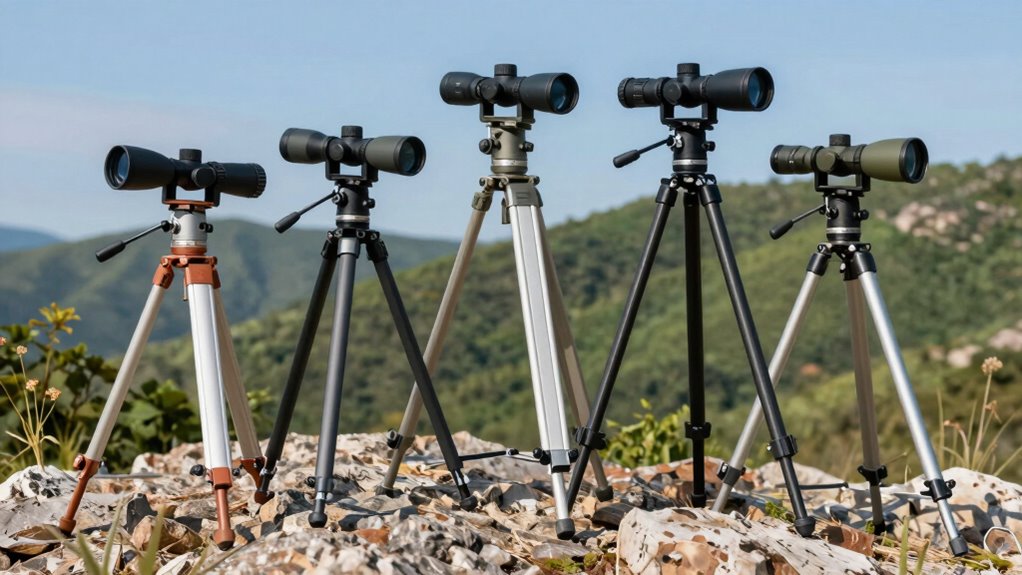
For field surveys, I’d start with the Celestron Heavy-Duty Alt-Azimuth Tripod as the best overall match because it is explicitly designed for spotting scopes and telescopes. The Vortex Mountain Pass Tripod Kit is a standout for buyers who want a purpose-branded kit, while the 69-inch tripod bundle offers a useful spread of included adapters and accessories. The main tradeoff is between an optics-focused setup and a taller, more versatile camera tripod that may bring extra bulk or less assured steadiness. I compare these options by their stated purpose, support features, portability cues, and included equipment—not by height or load claims alone. Read on for the full breakdown and help matching a tripod to your survey routine.

Prime made for students and young adults
- Fast, free delivery for dorm and study essentials
- Prime Video and Amazon Music included
- Member-only deals
Key Takeaways
Purpose-built support ranks ahead of headline height. The Celestron’s stated heavy-duty alt-azimuth design makes it the clearest fit for scope-led field work, while very tall camera-tripod options trade survey-specific focus for reach.
Included adapters can simplify a first setup. The 69-inch bundle lists a binocular adapter, two quick-release plates, a phone holder, and a carry bag; that makes it more ready-to-use than a tripod listing with fewer included accessories.
A high load rating is not a stability guarantee. The JOILCAN and 80/85-inch listings advertise a 35-pound load, but field buyers should still check how their mounted optic behaves at full extension.
Hybrid designs suit mixed tasks, not every survey. The 2-in-1 camera-and-hunting-stand options add flexibility, while a dedicated optics tripod is a more direct choice for repeated scope observations.
Portability and field readiness are separate strengths. A carry bag or mini tripod can help with transport or secondary setups, but neither replaces a stable, correctly matched main support for a spotting scope.
| 2 in 1 Camera Tripod & Hunting Stand Foldable, 68″ Ball Head Tripod |  | Best Hunting-to-Survey Convertible | Material: Aluminum | Maximum height: 68 inches | Minimum height: 16.5 inches | VIEW ON AMAZON | See Our Full Breakdown |
| 69” Tripod for Spotting Scopes, Binocular & Camera |  | Best Survey Starter Kit | Material: Aluminum | Maximum height: 69 inches | Maximum height with birding scope: 73 inches | VIEW ON AMAZON | See Our Full Breakdown |
| Lusweimi 72-Inch Aluminum Tripod for Binoculars, Spotting Scopes, Cameras, and Phones |  | Best Warranty Coverage | Material: Aluminum | Tripod height: 16.9–69 inches | Maximum shooting height: 72 inches | VIEW ON AMAZON | See Our Full Breakdown |
| JOILCAN Tripod for Camera, 81″ Camera Tripod Stand |  | Best for Tall Survey Positions | Material: Aluminum | Maximum height: 81 inches | Minimum working height: 23 inches | VIEW ON AMAZON | See Our Full Breakdown |
| 72.4-Inch Spotting Scope and Binoculars Tripod with Adapter and V-Yoke |  | Best for Smooth Scope Panning | Material: Aluminum | Maximum height: 72.4 inches | Minimum height: 24 inches | VIEW ON AMAZON | See Our Full Breakdown |
| Vortex Mountain Pass Tripod Kit |  | Best Compact Survey Tripod | Material: Aluminum | Maximum load: 22 pounds | Maximum height: 56 inches | VIEW ON AMAZON | See Our Full Breakdown |
| Bushnell Advanced Aluminum Tripod for Optics & Cameras, Black |  | Best Stationary Survey Base | Material: Aluminum | Load capacity: 11 pounds | Maximum height: 63 inches | VIEW ON AMAZON | See Our Full Breakdown |
| Nietoto 2-in-1 Camera Tripod and Hunting Stand, 68-Inch |  | Best High-Capacity Versatility | Material: Aluminum | Maximum load capacity: 33 pounds | Maximum height: 68 inches | VIEW ON AMAZON | See Our Full Breakdown |
| 2-Pack Tripod for Spotting Scope & Hunting – 68″ + 10″ Mini Tripods |  | Best Lightweight Two-Position Kit | Material: Aluminum | Maximum height: 62 inches | Minimum height: 18 inches | VIEW ON AMAZON | See Our Full Breakdown |
| Celestron Heavy-Duty Alt-Azimuth Tripod for Spotting Scopes & Telescopes |  | Best for Precision Tracking | Material: Aluminum | Maximum height: 45 inches | Minimum height: 32 inches | VIEW ON AMAZON | See Our Full Breakdown |
| 80/85 Inches Heavy Duty Tripod for Camera and Phone, DSLR Binoculars Spotting Scope Camcorders Video Stand, 360 Degree Ball Head, 35 lbs Loads, 85″ Camera Monopod |  | Best High-Reach Heavy-Duty Pick | Maximum load: 35 lbs | Extended height: Up to 85 inches with extension | Collapsed height: 18.5 inches | VIEW ON AMAZON | See Our Full Breakdown |
| K&F CONCEPT Spotting Scope Tripod with Binocular Adapter |  | Best Lightweight Travel Pick | Load capacity: 4 kg | Maximum height: 172 cm | Minimum height: 48 cm | VIEW ON AMAZON | See Our Full Breakdown |
| heavy duty spotting scope tripod for field survey | Material | Maximum height | Minimum height | Weight |
|---|---|---|---|---|
| 2 in 1 Camera Tripod & Hunting | Aluminum | 68 inches | 16.5 inches | 3.85 pounds |
| 69” Tripod for Spotting Scopes | Aluminum | 69 inches | 16.9 inches | — |
| Lusweimi 72-Inch Aluminum Trip | Aluminum | — | — | — |
| JOILCAN Tripod for Camera | Aluminum | 81 inches | — | 2.34 kg |
| 72.4-Inch Spotting Scope and B | Aluminum | 72.4 inches | 24 inches | — |
| Vortex Mountain Pass Tripod Ki | Aluminum | 56 inches | — | — |
| Bushnell Advanced Aluminum Tri | Aluminum | 63 inches | 18.3 inches | 5.5 pounds |
| Nietoto 2-in-1 Camera Tripod a | Aluminum | 68 inches | 16.5 inches | 3.85 pounds |
| 2-Pack Tripod for Spotting Sco | Aluminum | 62 inches | 18 inches | 2.2 pounds |
| Celestron Heavy-Duty Alt-Azimu | Aluminum | 45 inches | 32 inches | 7.8 pounds |
| 80/85 Inches Heavy Duty Tripod | Aluminum alloy | — | — | 3.7 lbs |
| K&F CONCEPT Spotting Scope Tri | Aluminum | 172 cm | 48 cm | 1,744 g |
More Details on Our Top Picks
2 in 1 Camera Tripod & Hunting Stand Foldable, 68″ Ball Head Tripod
I’d choose this model when a field survey may also call for a hunting rest: its removable V-yoke gives it a role the JOILCAN 81-inch tripod does not offer. For scope work, the 33-pound stated capacity, 26 mm legs, and 36 mm metal ball head provide a useful combination of load support and quick aiming adjustments. It folds to 16.5 inches and weighs 3.85 pounds, so carrying it between survey points is less burdensome than a bulkier support. The tradeoff is that a ball head can be less controlled for slow, steady scope panning than the fluid head on the 72.4-Inch Spotting Scope and Binoculars Tripod. Its maximum height is also below the JOILCAN’s 81 inches, and the listing does not claim water resistance.
Pros:- Removable 360-degree V-yoke adds a practical second use for hunting or shooting support.
- 33-pound stated load capacity and 26 mm aluminum legs suit a range of spotting scopes.
- 36 mm CNC metal ball head has separate controls and three bubble levels for positioning.
- Folds to 16.5 inches and weighs 3.85 pounds for easier field transport.
Cons:- Ball head offers less dedicated control for smooth scope panning than a fluid head.
- 68-inch maximum height is shorter than the JOILCAN tripod’s 81-inch reach.
- Not listed as water resistant, which limits confidence in wet survey conditions.
Best for: Field surveyors who also want a removable V-yoke for hunting or shooting support and need a compact tripod for transport between observation points.
Not ideal for: Surveyors who prioritize smooth, controlled panning or need maximum standing height; the 72.4-Inch Spotting Scope and Binoculars Tripod has a fluid head, while the JOILCAN extends higher.
- Material:Aluminum
- Maximum height:68 inches
- Minimum height:16.5 inches
- Folded length:16.5 inches
- Maximum load capacity:33 pounds
- Leg diameter:26 mm
- Head type:36 mm ball head
- Weight:3.85 pounds
Our verdict“Choose this convertible tripod if the V-yoke and compact carry size matter more than fluid-head panning or extra height.”
69” Tripod for Spotting Scopes, Binocular & Camera
I rank this as a ready-to-use starter kit because it arrives with a binocular adapter, phone holder, two quick-release plates, and a carry bag. That reduces the need to source small mounting pieces before taking a scope into the field. It reaches 69 inches and folds to 16.9 inches, close to the Lusweimi 72-Inch Aluminum Tripod’s stated working range, while a load-bearing hook gives surveyors a place to hang a pack for added stability. The rectangular aluminum legs have sheaths for grip, but the listing gives no load-capacity figure, making it harder to judge suitability for a heavy scope or accessories. Compared with the JOILCAN, it also lacks a stated leg diameter and the taller 81-inch reach. The binocular adapter requires a 1/4-inch threaded hole.
Pros:- Includes a binocular adapter, phone holder, two quick-release plates, and carry bag.
- 69-inch maximum height accommodates standing observation for many users.
- Load-bearing hook can accept a backpack to help stabilize the tripod.
- Folds to 16.9 inches for compact storage and transport.
Cons:- No maximum load capacity is provided, so suitability for heavier survey equipment is unclear.
- Binocular adapter only fits devices with a standard 1/4-inch threaded hole.
- No fluid head or published leg diameter for judging panning control and rigidity.
Best for: New field surveyors with a compatible 1/4-inch threaded binocular or spotting-scope setup who want mounting accessories and a bag in one package.
Not ideal for: Buyers mounting a heavy scope who need a published load rating, or users whose binoculars lack the required 1/4-inch threaded hole.
- Material:Aluminum
- Maximum height:69 inches
- Maximum height with birding scope:73 inches
- Minimum height:16.9 inches
- Folded length:16.9 inches
- Head type:Ball head
- Mounting thread:1/4 inch
- Included accessories:Binocular adapter, phone holder, two quick-release plates, carry bag
Our verdict“Pick this bundle for a first scope setup with compatible threading, but choose a tripod with a stated load rating for heavier survey gear.”
Lusweimi 72-Inch Aluminum Tripod for Binoculars, Spotting Scopes, Cameras, and Phones
The Lusweimi makes the most sense for surveyors who want a familiar, adjustable aluminum support with two-year warranty coverage stated in its product data. Its 16.9-to-69-inch adjustment range and 72-inch maximum shooting height are close to the 69” Tripod for Spotting Scopes, but the warranty gives this version a clearer support advantage. Four flip locks allow height changes without a complex setup, and the included adapter and two quick-release plates let users switch among compatible optics and cameras. A load-bearing hook can help add stability with a suspended pack. I would not rank it as a heavy-load specialist: no capacity figure is supplied, and binocular adapter fit depends on a 1/4-inch threaded hole whose depth can vary. For demanding, heavy scopes, the JOILCAN publishes a load figure, though its data conflicts.
Pros:- Two-year warranty is specified in the product data.
- Four flip locks make leg-height adjustments direct and straightforward.
- Includes binocular adapter, phone holder, two quick-release plates, and carry bag.
- Load-bearing hook offers a way to add weight for improved steadiness.
Cons:- No maximum load capacity is provided for evaluating heavy survey equipment.
- Binocular adapter requires a 1/4-inch threaded hole, and thread depth may affect fit.
- 72-inch maximum shooting height is only slightly above the 69-inch height of the comparable kit.
Best for: Surveyors who value a stated two-year warranty and need one adjustable tripod for compatible scopes, binoculars, cameras, and phones.
Not ideal for: Users with heavy spotting scopes who need a verified load limit, or binocular owners whose mounting threads do not fit the included adapter.
- Material:Aluminum
- Tripod height:16.9–69 inches
- Maximum shooting height:72 inches
- Folded height:16.9 inches
- Leg locks:Four flip locks
- Compatibility:Binoculars, spotting scopes, cameras, and phones
- Binocular adapter requirement:1/4-inch threaded hole
- Warranty:2 years
Our verdict“Choose the Lusweimi for its stated warranty and flexible accessory package, not for an unverified heavy-load rating.”
JOILCAN Tripod for Camera, 81″ Camera Tripod Stand
For surveyors who need to observe over brush, a vehicle, or uneven terrain, I favor the JOILCAN for its 81-inch maximum height and 30 mm leg tubes. It stands taller than the Nietoto 68-inch tripod and the 72.4-Inch Spotting Scope and Binoculars Tripod, while its three leg-angle settings can help level the support on irregular ground. The included second center column and detachable leg also allow conversion to a monopod, a useful option when a full tripod footprint is awkward. The tradeoff is a five-section design: extended upper sections can be less rigid than a simpler, thicker-legged setup. Load figures also conflict—the title says 35 pounds, while the detailed specifications list 25 pounds. I would use the lower figure when matching it to a scope.
Pros:- 81-inch maximum height gives more reach than the other tripods in this batch.
- 30 mm leg tubes offer substantial diameter for a travel-oriented design.
- Three independent leg-angle settings help accommodate uneven survey ground.
- Converts to a monopod and includes an extra center column and two quick-release plates.
Cons:- Capacity information conflicts: the title states 35 pounds, while detailed specifications list 25 pounds.
- Five-section legs may be less rigid when fully extended than designs with fewer sections.
- Not listed as water resistant for wet field conditions.
Best for: Field surveyors who need extra height for sightlines over obstacles and want a tripod that can convert to a monopod for tight locations.
Not ideal for: Buyers who need an unambiguous high load rating or maximum rigidity at full extension; the listed capacity is 25 pounds and the five-section legs add extension points.
- Material:Aluminum
- Maximum height:81 inches
- Minimum working height:23 inches
- Folded length:16.5 inches
- Maximum load capacity:25 pounds listed in detailed specifications
- Leg diameter:30 mm
- Leg sections:5
- Weight:2.34 kg
Our verdict“Choose the JOILCAN when tall reach is the priority, but size your scope to the detailed 25-pound capacity listing.”
72.4-Inch Spotting Scope and Binoculars Tripod with Adapter and V-Yoke
This is my pick for surveyors who spend long stretches tracking subjects across a landscape: the fluid head is better suited to controlled panning than the ball heads on the Nietoto and Lusweimi tripods. Its 22-pound capacity is clearly stated, giving buyers a useful limit when matching a scope and accessories, and the package includes both a binocular adapter and hunting V-yoke. At 72.4 inches, it provides more reach than the Nietoto’s 68-inch model, though it cannot match the JOILCAN’s 81-inch maximum. The five-section aluminum legs extend the working range but add more joints, and the 24-inch minimum height rules it out for low-level or tabletop survey positions. It also carries less stated load than the 33-pound Nietoto, so larger, heavier optical setups may be a better fit on that model.
Pros:- Fluid head supports smoother scope panning than the ball heads on several alternatives.
- 22-pound maximum load is clearly stated for matching equipment weight.
- Includes a binocular adapter, hunting V-yoke, and two quick-release plates.
- 72.4-inch maximum height exceeds the 68-inch Nietoto model.
Cons:- 24-inch minimum height limits low-angle and tabletop survey setups.
- 22-pound capacity is lower than the 33-pound rating of the Nietoto tripod.
- Five leg sections add joints that may reduce rigidity at full extension.
Best for: Surveyors tracking moving subjects who want fluid-head control, a published load limit, and both a binocular adapter and hunting V-yoke.
Not ideal for: Users working from low benches or mounting heavier equipment above 22 pounds; its minimum height is 24 inches and the Nietoto lists a higher capacity.
- Material:Aluminum
- Maximum height:72.4 inches
- Minimum height:24 inches
- Maximum load capacity:22 pounds
- Leg sections:5
- Maximum pipe diameter:29.5 mm
- Head type:Fluid head
- Included accessories:Binocular adapter, V-yoke, two quick-release plates, camouflage bands, storage bag
Our verdict“Choose this tripod for controlled panning and bundled mounting options, provided your setup stays within 22 pounds and does not need a low working height.”
Vortex Mountain Pass Tripod Kit
I rank the Vortex Mountain Pass as the compact option for surveyors who need a capable scope support without carrying a full-size base. Its 22-pound load limit gives it more stated capacity than the Bushnell Advanced Aluminum Tripod, while the Arca-Swiss-compatible release makes swapping compatible optics more straightforward. Independently adjustable legs and flip locks help adapt the stance to uneven ground. The tradeoff is reach: its 56-inch maximum height falls short of the 63-inch Bushnell and 68-inch Nietoto. It also lacks water resistance, which matters for work in wet field conditions. I’d choose it for mobile surveys with moderate-size optics, but not where extra height or weather protection is a priority.
Pros:- 22-pound maximum load capacity
- Arca-Swiss-compatible quick-release system
- Independently adjustable legs with flip-lever locks
- Compact 19 x 4-inch folded size
Cons:- Not water resistant
- 56-inch maximum height is lower than the Bushnell and Nietoto options
Best for: Field surveyors carrying compatible spotting scopes who value a compact folded profile and more load capacity than a basic travel tripod.
Not ideal for: Survey teams working in frequent rain or needing an eyepiece near standing eye level, because it is not water resistant and tops out at 56 inches.
- Material:Aluminum
- Maximum load:22 pounds
- Maximum height:56 inches
- Head type:Two-way pan-and-tilt
- Mount:Arca-Swiss compatible
- Leg diameter:0.75 inches
- Folded size:19 x 4 inches
- Item weight:0.45 kg
- Leg locks:Flip-lever locks
Our verdict“Choose the Vortex for a compact, higher-capacity tripod when portability matters more than maximum height or wet-weather protection.”
Bushnell Advanced Aluminum Tripod for Optics & Cameras, Black
For a survey station that stays set up, I favor the Bushnell Advanced Aluminum Tripod over the more travel-oriented Vortex Mountain Pass. Its 63-inch maximum height offers a taller working position than the Vortex’s 56 inches, and the three-way pan-and-tilt head provides separate movement axes for deliberate scope placement. The adjustable legs and center column also give more height options for a fixed viewing point. Capacity is the main limit: at 11 pounds, it supports less than the Vortex’s 22 pounds or the Nietoto’s 33. Its 5.5-pound weight, 26-inch folded length, and lack of spiked feet make it less appealing for long carries or loose, uneven ground. I’d use it for a planned survey site, not a lightweight mobile route.
Pros:- 63-inch maximum height with adjustable center column
- Three-way pan-and-tilt head for controlled positioning
- Aluminum construction with three leg sections
- Supports spotting scopes, binoculars, and cameras
Cons:- 11-pound load limit is below the Vortex and Nietoto capacities
- 5.5-pound weight and 26-inch folded length are less convenient for carrying
- No spiked feet for additional purchase on loose terrain
Best for: Surveyors setting up a camera or spotting scope at a repeatable observation point who want a taller stance and multi-axis head.
Not ideal for: Mobile field crews with heavy optics or frequent long walks, since its 11-pound capacity and 5.5-pound weight limit flexibility.
- Material:Aluminum
- Load capacity:11 pounds
- Maximum height:63 inches
- Maximum height without column:50.3 inches
- Minimum height:18.3 inches
- Folded length:26 inches
- Weight:5.5 pounds
- Head type:3-way pan/tilt
- Head mount thread:1/4-inch-20
Our verdict“Pick the Bushnell for a mostly stationary survey setup where adjustable height matters more than low carry weight or high load capacity.”
Nietoto 2-in-1 Camera Tripod and Hunting Stand, 68-Inch
The Nietoto 2-in-1 earns its place for surveyors who want a single support that can also serve as a monopod or hunting stick. Its 33-pound capacity is the highest stated here, exceeding both the Vortex Mountain Pass and Bushnell, and its 68-inch height gives a taller stance than either. A 16.5-inch folded length and 3.85-pound weight make that capability easier to carry than the Bushnell. The ball head allows quick repositioning, but it does not offer the Celestron’s slow-motion controls for fine tracking. There is also a balance caveat: long-axis telescopes and large camcorders may need an extra mounting ring. I’d choose it for changing field tasks and heavier compatible optics, but not for users who need precise, incremental pointing.
Pros:- 33-pound maximum load capacity
- 68-inch maximum height and 16.5-inch folded length
- Converts to a monopod or hunting stick
- Includes a ball head, V-yoke rest, and carry bag
Cons:- Long-axis telescopes and large camcorders may need an additional mounting ring
- Ball head lacks the Celestron’s slow-motion controls for fine tracking
Best for: Field surveyors who carry heavier compatible optics and want a support that can shift between tripod, monopod, and stick use.
Not ideal for: Users tracking targets with small, precise adjustments or mounting long-axis telescopes without a suitable balance ring.
- Material:Aluminum
- Maximum load capacity:33 pounds
- Maximum height:68 inches
- Minimum height:16.5 inches
- Folded length:16.5 inches
- Weight:3.85 pounds
- Head:36 mm ball head
- Leg sections:4
- Thread sizes:1/4 inch and 3/8 inch
Our verdict“Choose the Nietoto when high stated capacity and adaptable field use outweigh the need for slow, precise head adjustments.”
2-Pack Tripod for Spotting Scope & Hunting – 68″ + 10″ Mini Tripods
I see this two-tripod set as a practical choice for crews that want a full-height support plus a short option for a second station, vehicle-side use, or a low observation angle. The main tripod reaches 62 inches and folds to 18 inches, while the listed 2.2-pound weight makes it easier to carry than the 5.5-pound Bushnell. That portability comes with a clear capacity ceiling: its 11-pound limit is half the Vortex Mountain Pass’s rating and far below the Nietoto’s 33 pounds. The 360-degree head supports broad repositioning, but the supplied data gives conflicting head descriptions, so I would not buy it expecting a particular head mechanism. It is also not water resistant, and binocular adapter fit may vary. Best for lighter optics and paired field positions.
Pros:- Includes both a 62-inch tripod and a 10-inch mini tripod
- Listed weight of 2.2 pounds supports easier transport
- Aluminum construction
- 360-degree head rotation and compatibility with several device types
Cons:- 11-pound weight limit may not suit heavier survey optics
- Not water resistant
- Binocular adapter compatibility can vary with screw-hole depth
Best for: Survey teams using lighter spotting scopes or binoculars who want a portable main tripod and a separate mini support for another position.
Not ideal for: Crews with heavier optics, wet-weather fieldwork, or binoculars whose mounting-hole depth may not match the included adapter.
- Material:Aluminum
- Maximum height:62 inches
- Minimum height:18 inches
- Folded size:18 inches
- Weight:2.2 pounds
- Weight limit:11 pounds
- Head:Gimbal heads; 360-degree rotation
- Included mini tripod:10 inches
Our verdict“Choose this set for lightweight surveys that benefit from two support heights, but skip it if your optics approach the Vortex or Nietoto load limits.”
Celestron Heavy-Duty Alt-Azimuth Tripod for Spotting Scopes & Telescopes
For surveys that involve following a slowly moving subject, I’d put the Celestron Heavy-Duty Alt-Azimuth ahead of the ball-head Nietoto. Its two slow-motion control handles let the observer make small altitude and azimuth adjustments, a more deliberate approach than quick repositioning on the Nietoto’s ball head. The slotted 1/4-inch-20 mounting plate also allows fore-and-aft balancing, while the center brace and accessory tray suit a settled observation station. The tradeoff is limited reach: its 45-inch maximum height is shorter than every other full-size option here, and the 11-pound limit trails the Vortex and Nietoto. At 7.8 pounds, it is also a heavier carry than the two-tripod set. I’d choose it for controlled tracking, not for a tall or fast-moving survey route.
Pros:- Slow-motion controls for fine altitude and azimuth adjustments
- Slotted 1/4-inch-20 plate supports fore-and-aft balancing
- Center brace and metal accessory tray support a fixed observing setup
- Compatible with spotting scopes, binoculars, cameras, and small telescopes
Cons:- 45-inch maximum height is shorter than the other full-size tripods here
- 11-pound load limit is lower than the Vortex and Nietoto capacities
- 7.8-pound weight makes it a less convenient carry for mobile surveys
Best for: Observers tracking slow-moving land or sky targets from a stable survey station, especially with a compatible spotting scope or binocular mount.
Not ideal for: Surveyors who need a tall tripod, frequent repositioning, or a load capacity above 11 pounds.
- Material:Aluminum
- Maximum height:45 inches
- Minimum height:32 inches
- Load limit:11 pounds
- Weight:7.8 pounds
- Leg design:Two-section adjustable legs
- Head movement:Alt-azimuth with slow-motion controls
- Mounting thread:1/4-inch-20
- Warranty:2-year US warranty
Our verdict“Pick the Celestron for controlled, fine tracking at a fixed station, but choose a taller and lighter model for mobile field surveys.”
80/85 Inches Heavy Duty Tripod for Camera and Phone, DSLR Binoculars Spotting Scope Camcorders Video Stand, 360 Degree Ball Head, 35 lbs Loads, 85″ Camera Monopod
The 85-inch maximum height gives surveyors room to observe over low vegetation or work while standing, and its 35-pound load rating leaves more headroom for substantial optics than the K&F CONCEPT Spotting Scope Tripod with Binocular Adapter. The 360-degree ball head and quick-release plate help with repositioning between survey points, while the monopod conversion offers another way to carry or support gear. Its aluminum build weighs 3.7 pounds and folds to 18.5 inches, so it is more portable than its height suggests. The tradeoff is that the ball head may be less controlled for small elevation adjustments than the Celestron Heavy-Duty Alt-Azimuth Tripod. Setup may also take extra adjustment, and the tall extension is better suited to deliberate positioning than fast, frequent moves.
Pros:- 35-pound load rating accommodates heavier optics than the K&F CONCEPT model.
- Extends to 85 inches for elevated, standing-height observation.
- Converts to a monopod for flexible support options.
- Folds to 18.5 inches and weighs 3.7 pounds.
Cons:- Setup may require adjustment, which can slow first-time users.
- Ball-head control may be less precise for incremental scope elevation than an alt-azimuth design.
- Its height and support hardware are less suited to rapid repositioning on long field traverses.
Best for: Field surveyors using heavier spotting scopes who need extra height for standing observations and occasional monopod flexibility.
Not ideal for: Surveyors who hike long distances over rough ground or need quick, finely controlled scope elevation adjustments; the setup may take tuning and the ball head is less specialized than an alt-azimuth head.
- Maximum load:35 lbs
- Extended height:Up to 85 inches with extension
- Collapsed height:18.5 inches
- Material:Aluminum alloy
- Weight:3.7 lbs
- Leg sections:Four
- Head rotation:360 degrees
- Tilt range:+90/-70 degrees
Our verdict“Choose this tripod for heavy optics and elevated survey work, but skip it if compact, fast setup and fine elevation control matter more.”
K&F CONCEPT Spotting Scope Tripod with Binocular Adapter
At 1,744 grams, this K&F CONCEPT tripod is the easier carry for surveyors moving between sites with a compact scope or binoculars. Its height adjusts from 48 to 172 centimeters, giving it a useful standing-height range without the 85-inch reach of the 80/85 Inches Heavy Duty Tripod for Camera and Phone, DSLR Binoculars Spotting Scope Camcorders Video Stand, 360 Degree Ball Head, 35 lbs Loads, 85″ Camera Monopod. That lighter build comes with a clear limit: the 4-kilogram load capacity is a poor match for heavier optics or accessories that approach the first model’s 35-pound rating. Quick-lock legs and broad device compatibility suit changing survey setups, but the tripod is not water resistant. I’d favor it for dry-weather travel surveys, not exposed work in wet conditions or heavy wind.
Pros:- Lighter carry weight than the 80/85 Inches Heavy Duty Tripod.
- 172-centimeter maximum height supports standing-height observation.
- Quick-lock legs allow height changes between survey positions.
- Mounting compatibility includes cameras, smartphones, and spotting scopes.
Cons:- 4-kilogram capacity rules out many heavier scope-and-accessory setups.
- Not water resistant, limiting suitability for wet field conditions.
- Mounting options may not suit every scope or survey accessory.
Best for: Surveyors carrying a compact spotting scope or binoculars between dry-weather field sites who value lower carry weight and adjustable height.
Not ideal for: Users with heavy scopes, substantial accessories, or regular wet-weather survey work; its 4-kilogram capacity and lack of water resistance limit those uses.
- Load capacity:4 kg
- Maximum height:172 cm
- Minimum height:48 cm
- Weight:1,744 g
- Material:Aluminum
- Compatible devices:Camera, smartphone, spotting scope
- Water resistance:Not water resistant
- Color:Black
Our verdict“Pick this model for lighter optics and dry-weather surveys where easy transport matters more than heavy-rig capacity.”

How We Picked
I ranked these tripods for spotting-scope field surveys, not for general camera use. I gave more weight to an explicitly optics-focused design, stated head type or adapters, and a practical setup for aiming and repositioning a scope than to maximum height or broad compatibility claims. I also looked at transport cues and included accessories, since a survey tripod may need to move between observation points and work with more than one optic. I used the supplied product descriptions and specifications as the basis for comparison; I did not treat advertised load capacity as proof of stability.
That logic puts the Celestron Heavy-Duty Alt-Azimuth Tripod first for its direct match to scope use, with the Vortex Mountain Pass Tripod Kit next as a purpose-branded kit. The 69-inch accessory bundle and the Bushnell, K&F CONCEPT, and 72.4-inch V-yoke options follow for their stated optic-related fit or useful included interfaces. The Lusweimi and tall JOILCAN and 80/85-inch camera hybrids sit lower because their descriptions emphasize general-purpose or height claims more than survey-specific support. The 2-in-1 stands and two-tripod pack may fit specialized field routines, but their added flexibility does not make them the strongest single-tripod choice for steady scope work.
| heavy duty spotting scope tripod for field survey | Material |
|---|---|
| 2 in 1 Camera Tripod & Hunting | Aluminum |
| 69” Tripod for Spotting Scopes | Aluminum |
| Lusweimi 72-Inch Aluminum Trip | Aluminum |
| JOILCAN Tripod for Camera | Aluminum |
| 72.4-Inch Spotting Scope and B | Aluminum |
| Vortex Mountain Pass Tripod Ki | Aluminum |
| Bushnell Advanced Aluminum Tri | Aluminum |
| Nietoto 2-in-1 Camera Tripod a | Aluminum |
| 2-Pack Tripod for Spotting Sco | Aluminum |
| Celestron Heavy-Duty Alt-Azimu | Aluminum |
| 80/85 Inches Heavy Duty Tripod | Aluminum alloy |
| K&F CONCEPT Spotting Scope Tri | Aluminum |
Factors to Consider When Choosing Heavy Duty Spotting Scope Tripod For Field Surveys
Choosing a field-survey tripod is less about finding the biggest number on the box and more about matching the support to how you observe. I’d decide how often the scope will be moved, how much repositioning the survey requires, and whether the same tripod must support binoculars or a camera. These broader checks can reveal a poor fit even when a product title says “heavy duty.”
Match the Head to the Way You Scan
A tripod’s head affects how easily you can aim, follow a feature, and return to a known viewing direction. For surveys that involve frequent horizontal and vertical adjustments, a head designed for controlled scope movement may be more useful than a camera-style ball head. Ball heads can be flexible, but a loose adjustment may shift the scope more than intended when you release it. Check whether the head and mounting plate suit your scope before buying, rather than assuming a standard-looking connector will fit. If your work involves repeated, measured observations, prioritize predictable movement over the broadest range of motion. A quick-release system is handy, but confirm that its plate remains secure under your actual optic.
Treat Load Capacity as One Clue, Not the Verdict
A stated load rating describes a limit claimed by the maker; it does not tell you how steady the tripod will feel with a long scope mounted high above the ground. Long optics can magnify small vibrations, and extending the center column or leg sections often makes a setup more susceptible to movement. Compare the tripod’s stated capacity with the complete working load, including the scope, adapter, and any accessories. Leave a margin instead of matching the rating exactly, especially if you observe in wind or on uneven ground. A shorter, stiffer setup may serve surveys better than a taller one that reaches a preferred viewing height but wobbles. Look for clear details about leg construction and head support when the listing provides them.
Plan Around Survey Height and Terrain
Maximum height matters only if it helps you work from your usual observation position. A tall tripod can be useful over low vegetation or when standing, while a lower setup can be easier to stabilize and pack across rough ground. Check the minimum height too if you survey from a slope, sit to observe, or need to position the scope close to a feature. On uneven terrain, the ability to set each leg independently is often more useful than extra height. Avoid choosing a tripod by its maximum extension alone; ask whether you can reach your working height without relying on a fully extended center column. The best fit is the one that supports your usual posture and terrain without making setup cumbersome.
Count the Full Carry Kit
Field surveys often involve more than carrying a tripod from a vehicle to one observation point. A bag, adapters, spare plates, and phone holder can reduce the number of separate items you need to pack, but they also add pieces to track and maintain. Check whether an included adapter is intended for your optic type, rather than assuming that “binocular adapter” means compatibility with every scope. If your scope has a proprietary foot or plate, factor in the cost and availability of the correct interface without relying on a generic fit. A bundle can be a sensible value when its accessories match your workflow; unused add-ons do not make a better field kit. For long walks between survey points, folded size and carry weight deserve as much attention as the feature list.
Decide Whether One Tripod Must Do Every Job
A hybrid camera-and-hunting stand can appeal if you switch between observation, photography, and other field tasks. That flexibility may involve compromises in head control, setup speed, or carrying bulk compared with a tripod chosen mainly for a spotting scope. A second compact tripod can be useful for a separate station or backup, but it does not replace a dependable primary support. Before choosing a multi-use design, list the tasks you actually perform and rank them; the most frequent one should guide the purchase. If scope stability is the main need, put the optic interface and head behavior ahead of extra modes. If you regularly change equipment, favor a tripod with compatible plates and adapters rather than an assortment of features you rarely use.
Frequently Asked Questions
Is a tripod rated for 35 pounds automatically suitable for a heavy spotting scope?
No. A load rating is only one advertised specification and does not describe vibration control, head stiffness, or performance with a long optic at full height. Check the total mounted weight, including the scope and adapter, and leave a margin below the stated limit. Pay attention to whether you can use the tripod without fully extending its center column. For field surveys, stability in your working configuration matters more than the largest number in the product title.
Should I choose an alt-azimuth head or a ball head for survey work?
I’d favor an alt-azimuth design when you need controlled up-down and side-to-side aiming during repeated observations. A ball head can be more flexible for mixed camera use, but it may take more care to reposition a scope without shifting the view. The right choice depends on how often you scan and whether you need to return to specific directions. Check that the head’s mounting interface works with your scope before choosing by head style alone. If possible, prioritize a head that locks securely and is easy to adjust with your hands in the field.
Do I need a binocular adapter if I’m buying a tripod for a spotting scope?
Only if you plan to mount binoculars that need that adapter, or if the adapter is compatible with another part of your observation kit. A binocular adapter does not automatically mean the tripod will connect directly to every spotting scope. Check the scope’s mounting foot and the included plate or interface against the product details. Bundles such as the 69-inch option can reduce separate purchases when the included parts match your equipment. If you will use only one scope, a compatible direct mount may matter more than extra accessories.
Is an 80- or 85-inch tripod a good choice for field surveys?
It can help when you regularly need a high viewing position, such as looking over low obstacles. Extra height is less useful if you must extend every leg section or the center column to reach it, since a tall setup can be more susceptible to movement. Compare the maximum height with your normal observing posture and the ground where you work. Also check packed size and carrying demands if you move between survey points on foot. A more modest-height tripod that stays steady at your working height may serve better than the tallest option.
When does a two-tripod pack make sense for survey work?
A two-tripod pack can make sense if you have a real use for a second, smaller support, such as a separate station or a compact backup. It is less compelling if your main need is a single stable platform for a spotting scope, since the second tripod does not improve the primary setup. Check whether the full-size tripod alone has the head, height, and mount your scope needs. Consider how much extra equipment you are willing to carry between field locations. If the mini tripod would stay unused, choosing one better-matched main tripod is the simpler route.
Conclusion
For most scope-led surveys, I’d choose the Celestron Heavy-Duty Alt-Azimuth Tripod as the best overall because its stated design directly targets spotting scopes and telescopes. The 69-inch accessory bundle is my best-value pick for buyers who can use its listed adapter, plates, phone holder, and bag; it is also my easiest starting point for beginners who want several setup pieces together. For a premium, purpose-branded kit, I’d look at the Vortex Mountain Pass Tripod Kit. If you need a more specific fit, consider the 72.4-inch tripod with adapter and V-yoke for its stated optic-support accessories, or a 2-in-1 camera-and-hunting stand if mixed field tasks matter more than a dedicated scope setup. Choose a tall camera tripod such as the JOILCAN or 80/85-inch model only when extra reach is a regular need and its stability suits your mounted optic.
Fall Picks
fall essentials
As an affiliate, we earn on qualifying purchases.