For remote monitoring, I’d start with the TACTACAM REVEAL X 3.0 as the best overall pick, while the Moultrie EDGE 3 stands out for its fast trigger and high-resolution capture, and the MagicEagle 4G suits sites where solar-assisted power matters. The main choice is between a simpler camera focused on dependable image delivery and feature-heavy models offering live viewing, broad coverage, or solar support. Those extras can reduce trips to the site, but they also make cellular coverage, power setup, and plan details more important. A multi-camera kit may cover more ground, though it can add setup and management work. Continue reading for the full breakdown and guidance on matching a camera to your monitoring site.

Prime made for students and young adults
- Fast, free delivery for dorm and study essentials
- Prime Video and Amazon Music included
- Member-only deals
Key Takeaways
- Remote monitoring depends on more than image resolution: cellular coverage at the exact mounting location and the camera’s delivery setup matter more than a large megapixel claim alone.
- The standout options serve different priorities: REVEAL X 3.0 is the balanced pick, EDGE 3 emphasizes resolution and a fast trigger, and solar-equipped models focus on reducing battery maintenance.
- Pan-and-tilt and live-feed models change how you monitor: the 360-degree units can inspect a wider area remotely, but live viewing can increase power and data demands.
- Bundles make sense when one camera cannot cover the site: the Moultrie, SPYPOINT, dual-lens, and Cuddeback multi-camera options offer broader deployment, with more devices to position and maintain.
- Solar support is not a substitute for site planning: shade, seasonal daylight, cellular signal, and mounting angle can limit the usefulness of solar-equipped cameras.
| Wildgame Innovations Terra XT 3.0 32MP Cellular Trail Camera |  | Best for T-Post Mounting | Photo resolution: 32MP | Video resolution: 720p | Trigger speed: 0.5 seconds | VIEW ON AMAZON | See Our Full Breakdown |
| TACTACAM REVEAL X 3.0 Cellular Trail Camera |  | Best for Straightforward Setup | Cellular connectivity: LTE via AT&T or Verizon | Battery life: Manufacturer claim: up to 6+ months | GPS: Built-in | VIEW ON AMAZON | See Our Full Breakdown |
| Moultrie EDGE 3 Cellular Trail Camera, 40MP, 0.5-Second Trigger |  | Best Overall | Photo resolution: 40MP | Video resolution: 1080p HD | Trigger speed: 0.5 seconds | VIEW ON AMAZON | See Our Full Breakdown |
| Moultrie Edge 2 Cellular Trail Camera |  | Best for Built-In Storage | Photo resolution: 36MP | Video: 1080p HD with audio at 30 fps | Detection range: Up to 100 feet | VIEW ON AMAZON | See Our Full Breakdown |
| Moultrie Edge 3 Cellular Trail Camera, 2-Pack |  | Best for Monitoring Two Locations | Pack size: 2 cameras | Photo resolution: 40MP | Video resolution: 1080p HD | VIEW ON AMAZON | See Our Full Breakdown |
| 4G LTE Solar-Powered Trail Camera with 360° Pan and Live Streaming |  | Best for Remote Area Coverage | Included quantity: 2 cameras | Cellular connectivity: 4G LTE; compatible with Verizon, AT&T, and T-Mobile | Pan and tilt: 355° horizontal, 100° vertical | VIEW ON AMAZON | See Our Full Breakdown |
| SPYPOINT FLEX-M Twin Cellular Trail Camera with Night Vision and Free Photo Plan | 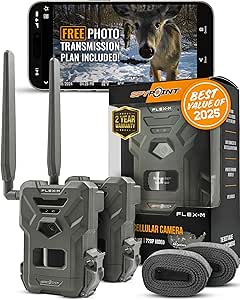 | Best for Low-Commitment Photo Monitoring | Connectivity: Cellular, cross-carrier coverage | Capture modes: Photo, video, time-lapse, time-lapse+ | Free photo plan: Up to 100 transmitted photos per month | VIEW ON AMAZON | See Our Full Breakdown |
| 4G LTE Dual-Lens Cellular Trail Camera, 2-Pack |  | Best for Color Night Coverage | Camera count: 2 | Resolution: 2K Ultra HD | Field of view: 360° | VIEW ON AMAZON | See Our Full Breakdown |
| Cuddeback Tracks Black Flash LTC-3A LTE Cellular Trail Camera, 2-Pack |  | Best for Discreet, Fixed-View Monitoring | Included quantity: 2 cameras | Connectivity: LTE; Verizon or AT&T | Night illumination: 940nm no-glow IR LEDs, up to 75 feet | VIEW ON AMAZON | See Our Full Breakdown |
| MagicEagle 4G Cellular Trail Camera with 13,000 mAh Battery and Solar Panel |  | Best for Extended Power Between Visits | Photo resolution: 5 MP | Video resolution: 2K | Motion trigger: 0.3 seconds | VIEW ON AMAZON | See Our Full Breakdown |
| SEHMUA 4G LTE Cellular Trail Camera with 360° View, 2K Live Feed, and Solar Panel |  | Best for Remote Camera Control | Connectivity: 4G LTE; built-in non-removable SIM; no Wi-Fi required | Compatible carriers: Verizon, AT&T, and T-Mobile in the U.S. | Video resolution: 2K | VIEW ON AMAZON | See Our Full Breakdown |
| CEYOMUR 4G LTE Solar Cellular Trail Camera with SIM Card |  | Best for Local Review Without Data | Connectivity: 4G LTE; SIM card included | Display: 2-inch IPS | Photo resolution: Up to 48MP locally; up to 8MP in 4G mode | VIEW ON AMAZON | See Our Full Breakdown |
| Oculview 4G LTE Solar Trail Camera with 2K Live Streaming |  | Best for Wide-Area Remote Coverage | Connectivity: 4G LTE; built-in non-removable SIM; U.S. use only | Video resolution: 2K live streaming | Pan and tilt: 350° horizontal; 100° vertical | VIEW ON AMAZON | See Our Full Breakdown |
| cellular trail camera for remote monitoring | Connectivity | Video resolution |
|---|---|---|
| Wildgame Innovations Terra XT | — | 720p |
| TACTACAM REVEAL X 3.0 Cellular | — | — |
| Moultrie EDGE 3 Cellular Trail | — | 1080p HD |
| Moultrie Edge 2 Cellular Trail | 4G LTE cellular, multi-carrier | — |
| Moultrie Edge 3 Cellular Trail | — | 1080p HD |
| 4G LTE Solar-Powered Trail Cam | — | — |
| SPYPOINT FLEX-M Twin Cellular | Cellular, cross-carrier coverage | — |
| 4G LTE Dual-Lens Cellular Trai | 4G LTE; compatible with Verizon, AT&T, and T-Mobile | — |
| Cuddeback Tracks Black Flash L | LTE; Verizon or AT&T | — |
| MagicEagle 4G Cellular Trail C | 4G cellular, wireless | 2K |
| SEHMUA 4G LTE Cellular Trail C | 4G LTE; built-in non-removable SIM; no Wi-Fi required | 2K |
| CEYOMUR 4G LTE Solar Cellular | 4G LTE; SIM card included | Up to 2K |
| Oculview 4G LTE Solar Trail Ca | 4G LTE; built-in non-removable SIM; U.S. use only | 2K live streaming |
More Details on Our Top Picks
Wildgame Innovations Terra XT 3.0 32MP Cellular Trail Camera
The Terra XT 3.0 is a practical pick for remote monitoring when mounting flexibility matters as much as image detail. Its included T-post bracket suits fence lines and field edges where a tree mount is not convenient, while the automatic Verizon or AT&T connection can give the camera a choice of networks. A 0.5-second trigger and 80-foot detection and flash range cover typical trail placements, and 32MP photos offer more detail than the REVEAL X 3.0’s listed specifications provide. The tradeoff is its 720p video, which is less defined than the 1080p footage from the Moultrie EDGE 3. It also needs eight AA batteries or a separate 12V source, and remote delivery still depends on cellular coverage at the site.
Pros:- Included T-post bracket adds a useful mounting option for fence lines and field edges.
- 32MP photos provide detailed still images for remote scouting.
- Automatic Verizon and AT&T network selection can help match available coverage.
- 0.5-second trigger and 80-foot detection and flash range suit common trail placements.
Cons:- 720p video is lower resolution than the 1080p video offered by the Moultrie EDGE 3 and Edge 2.
- Requires eight AA batteries or a separately supplied 12V DC power source.
- Cellular image delivery and remote control depend on usable coverage where the camera is mounted.
Best for: Landowners monitoring fence lines or open field edges who want a cellular camera with an included T-post bracket and detailed still photos.
Not ideal for: Buyers who prioritize 1080p video, longer-range detection, or a built-in power solution.
- Photo resolution:32MP
- Video resolution:720p
- Trigger speed:0.5 seconds
- Detection and flash range:80 feet
- Cellular connectivity:Automatic Verizon and AT&T network selection
- Compatible apps:HuntSmart and Command
- Power:8 AA batteries or 12V DC auxiliary power
- Mounting:Tree mount, 1/4-inch threaded mount, and included T-post bracket
- Dimensions:8 x 6 x 4 inches
Our verdict“Choose the Terra XT 3.0 if you need a T-post-ready cellular camera with detailed photos, but skip it if 1080p video is a priority.”
TACTACAM REVEAL X 3.0 Cellular Trail Camera
The REVEAL X 3.0 focuses on getting a remote camera online without a Wi-Fi connection or a separate memory card. Its pre-activated SIM and pre-installed antenna simplify setup, while built-in storage transfers photos to a phone. A sub-half-second trigger and three-shot burst mode give fast-moving animals more chances to appear in the captured sequence. Compared with the Terra XT 3.0, the REVEAL X has the clearest setup advantage, but the supplied details do not specify photo resolution, video resolution, or detection range, so buyers cannot compare image detail and coverage as confidently. Built-in GPS is useful for keeping track of deployed units; the claimed six-plus-month battery life is not a guarantee, and cellular monitoring still relies on available AT&T or Verizon service.
Pros:- Pre-installed antenna and pre-activated SIM reduce setup steps.
- LTE operation does not require Wi-Fi.
- Built-in storage avoids the need for a separate SD card.
- Sub-half-second trigger and three-shot burst can capture more of a passing animal.
Cons:- Product details do not specify photo resolution, video resolution, or detection range.
- The up-to-six-month battery life is a manufacturer claim and will vary with use and conditions.
- Remote alerts and photo transfers depend on AT&T or Verizon coverage at the camera location.
Best for: First-time cellular camera owners who want a pre-activated SIM, built-in storage, and a setup that does not require Wi-Fi or an SD card.
Not ideal for: Buyers who need published photo and video resolution, a specified detection range, or a battery-life figure they can treat as guaranteed.
- Cellular connectivity:LTE via AT&T or Verizon
- Battery life:Manufacturer claim: up to 6+ months
- GPS:Built-in
- Storage:Built-in; transfers photos to phone
- Trigger speed:Under 0.5 seconds
- Burst mode:3 shots per trigger event
- Setup:Pre-installed antenna and pre-activated SIM
- Wi-Fi required:No
Our verdict“Pick the REVEAL X 3.0 for a simpler cellular setup and built-in storage, but choose a camera with published image and range specs if those guide your placement.”
Moultrie EDGE 3 Cellular Trail Camera, 40MP, 0.5-Second Trigger
The EDGE 3 earns the broadest-use role here by combining 40MP photos, 1080p video, and a 100-foot detection range with automatic connection to four major U.S. networks. That network choice can help when one carrier is weak at a remote property, while live aiming and built-in GPS reduce guesswork when placing or locating the camera. Compared with the Moultrie Edge 2, the EDGE 3 adds AI buck detection and live aiming to a similarly strong image-and-range package; it also offers compatible battery packs and solar panels for buyers planning extended deployments. Those features come with dependencies: remote cellular access requires a service plan, and feeder control only works with a compatible Moultrie feeder. Buyers who need a straightforward camera without app-based scouting tools may find the Terra XT 3.0 simpler.
Pros:- 40MP photos and 1080p HD video provide detailed remote captures.
- Automatic connection to four major U.S. networks offers more carrier options than the Terra XT 3.0.
- 100-foot detection range and 0.5-second trigger suit broader, active trails.
- AI buck detection, live aiming, GPS, and compatible feeder controls add remote scouting tools.
Cons:- Remote cellular features require a service plan.
- Remote feeder controls require a compatible Moultrie feeder.
- Battery packs and solar panels are compatible power accessories rather than specified included components.
Best for: Remote land managers and hunters who want detailed images, broad carrier selection, GPS, and app-based scouting controls in one camera.
Not ideal for: Buyers who do not want an ongoing cellular plan or who expect remote feeder control to work with non-Moultrie equipment.
- Photo resolution:40MP
- Video resolution:1080p HD
- Trigger speed:0.5 seconds
- Detection range:100 feet
- Cellular connectivity:Automatic connection to four major U.S. networks
- Flash:Low-glow infrared
- Remote features:AI buck detection, live aiming, built-in GPS, and compatible feeder control
- Power options:Compatible EDGE Series lithium battery packs and solar panels
- Warranty:2 years from activation in the Moultrie Mobile app
Our verdict“Choose the EDGE 3 for a feature-rich remote scouting setup with strong image specifications and broad network selection, provided you are comfortable with cellular service and compatible accessories.”
Moultrie Edge 2 Cellular Trail Camera
The Edge 2 is a strong fit for remote monitoring when you want to avoid managing a separate SD card. Its 8GB of built-in memory and app cloud storage keep image handling within the Moultrie Mobile system, while 36MP photos, 1080p video with audio, and 100-foot detection cover both scouting stills and sound-bearing clips. Compared with the newer EDGE 3, it has a lower listed photo resolution and lacks the stated AI buck detection and live-aim features, but its built-in storage is a straightforward advantage for buyers who want fewer removable parts. Multi-carrier 4G LTE and remote alerts support off-site checks; however, cellular access requires a paid plan, and compatible power accessories are sold separately.
Pros:- 8GB of built-in memory removes the need for a separate SD card.
- 1080p video with audio adds sound to remote scouting clips.
- Multi-carrier 4G LTE supports remote viewing and alerts where service is available.
- 100-foot detection range and low-glow infrared support distant and nighttime monitoring.
Cons:- Cellular photo delivery and remote management require a paid data plan.
- Compatible power accessories are sold separately.
- Compared with the EDGE 3, it has a lower listed photo resolution and lacks the stated AI buck detection and live-aim features.
Best for: Remote camera owners who want built-in memory and cloud storage instead of handling a separate SD card, along with 1080p video that records audio.
Not ideal for: Buyers seeking AI buck detection, live camera aiming, or a setup that avoids cellular plan and accessory costs.
- Photo resolution:36MP
- Video:1080p HD with audio at 30 fps
- Detection range:Up to 100 feet
- Night flash:Low-glow infrared
- Connectivity:4G LTE cellular, multi-carrier
- Built-in memory:8GB
- Cloud storage:Unlimited through the Moultrie Mobile app
- Water resistance:IP65
- Dimensions and weight:4.2 x 3.6 x 5.5 inches; 1.1 lb
Our verdict“Pick the Edge 2 if built-in storage and audio-bearing HD video matter more than the EDGE 3’s newer scouting tools.”
Moultrie Edge 3 Cellular Trail Camera, 2-Pack
This two-camera bundle is for buyers who need remote coverage at two separate trails, gates, or food plots without mixing camera systems. Each unit shares the EDGE 3’s 40MP photos, 1080p video, 0.5-second trigger, and 100-foot detection range, along with four-network connectivity, GPS, and live aiming. Compared with buying one Moultrie EDGE 3, the bundle makes a multi-location setup easier to standardize, while the Edge 2 remains a better match for someone focused on built-in memory details. AI buck detection and instant alerts can help sort activity from multiple sites, but cellular plans are still required for remote delivery. Feeder control also depends on compatible Moultrie equipment, and the listed rechargeable packs and solar panels are power options rather than confirmed bundle inclusions.
Pros:- Two cameras make it easier to monitor separate sites with a consistent app and feature set.
- 40MP photos, 1080p video, and a 100-foot detection range support detailed remote scouting.
- Four-network automatic connection, GPS, and live aiming aid deployment across multiple locations.
- AI buck detection and instant alerts help flag activity without waiting for a site visit.
Cons:- Cellular plans are required for remote photo and video delivery.
- Remote feeder control works only with compatible Moultrie feeders.
- The product data lists compatible battery packs and solar panels but does not establish that they are included.
Best for: Hunters and land managers who need matching cellular cameras at two locations and want shared app-based monitoring tools.
Not ideal for: Buyers who only need one camera, want to avoid cellular plans, or use feeders outside Moultrie’s compatible range.
- Pack size:2 cameras
- Photo resolution:40MP
- Video resolution:1080p HD
- Trigger speed:0.5 seconds
- Detection range:100 feet
- Network connectivity:Automatic connection to four major U.S. carriers
- Remote features:AI buck detection, instant alerts, live aiming, built-in GPS, and compatible feeder control
- Power options:EDGE Series lithium battery packs and solar panels
- Warranty:2 years from activation in the Moultrie Mobile app
Our verdict“Choose the two-pack when you want consistent remote monitoring at two sites, but opt for a single camera if you have only one location to cover.”
4G LTE Solar-Powered Trail Camera with 360° Pan and Live Streaming
For monitoring a broad area from a remote site, this two-camera set stands out for 355° pan, 100° tilt, and 2.5K live streaming. I’d favor it when checking a clearing, feeder, or access point remotely matters more than keeping a fixed view. Its 4W solar panel and 7,800 mAh battery can reduce hands-on battery changes, while 4G LTE avoids dependence on nearby Wi-Fi. Compared with the SPYPOINT FLEX-M, this option offers live viewing and motorized camera movement, while SPYPOINT provides a defined monthly free photo allowance and more listed capture modes. The tradeoff is that ongoing service requires a subscription for each camera, and the included 100 MB is limited. A microSD card is also not included, and the listing gives conflicting IP66 and IP68 water-resistance ratings.
Pros:- 355° pan and 100° tilt allow remote repositioning across a broad scene
- 2.5K live streaming and 4K video capture provide detailed remote monitoring
- Solar panel and 7,800 mAh battery reduce routine battery replacement
- Two cameras are included, with motion alerts and local storage support
Cons:- Ongoing cellular service requires a paid subscription for each camera
- MicroSD cards are not included
- Water-resistance rating conflicts between the listed IP66 and claimed IP68
Best for: Landowners who need to remotely sweep a wide area and view live footage from a site without Wi-Fi
Not ideal for: Buyers who want predictable no-subscription operation or need a clearly stated water-resistance rating
- Included quantity:2 cameras
- Cellular connectivity:4G LTE; compatible with Verizon, AT&T, and T-Mobile
- Pan and tilt:355° horizontal, 100° vertical
- Streaming and capture:2.5K live streaming; 4K video capture
- Night vision range:Up to 65 feet
- Power:4W solar panel; 7,800 mAh battery
- Storage:MicroSD card up to 256 GB, not included; optional cloud storage
- Water resistance:IP66 listed; product description also claims IP68
Our verdict“Choose this set if remote live viewing and adjustable coverage matter more than subscription-free use or unambiguous weatherproofing.”
SPYPOINT FLEX-M Twin Cellular Trail Camera with Night Vision and Free Photo Plan
The FLEX-M twin set is the clearest fit here for hunters who want cellular photo delivery without committing to a paid plan right away: up to 100 transmitted photos per month are included. I like its range of photo, video, time-lapse, and time-lapse+ modes for tailoring how often a site is documented. Cross-carrier connectivity and app-based remote settings also make it easier to manage cameras without a Wi-Fi connection. Compared with the 4G LTE Solar-Powered Trail Camera with 360° Pan and Live Streaming, the FLEX-M is more focused on photo reports than live remote viewing, but its included photo allowance is easier to understand. The compromises are real: a microSD card is required but absent, solar power needs a separately purchased compatible panel, and exceeding the free monthly photo limit means choosing a paid plan.
Pros:- Free plan transmits up to 100 photos per month
- Photo, video, time-lapse, and time-lapse+ modes suit different monitoring patterns
- Cross-carrier connectivity removes manual carrier selection
- App supports remote settings and firmware updates without Wi-Fi
Cons:- MicroSD card is required but not included
- Compatible solar panels are sold separately
- More than 100 transmitted photos per month requires a paid plan
Best for: Hunters who want app-delivered cellular photos, several capture modes, and a modest included monthly photo allowance
Not ideal for: Remote-site managers who need live video, included solar power, or frequent photo transmission beyond the free plan
- Connectivity:Cellular, cross-carrier coverage
- Capture modes:Photo, video, time-lapse, time-lapse+
- Free photo plan:Up to 100 transmitted photos per month
- Storage:MicroSD card required; not included
- App features:Photo delivery, remote settings, firmware updates, maps, weather, BUCK TRACKER AI
- Solar compatibility:Compatible solar panels sold separately
Our verdict“Pick the FLEX-M twin set for app-based photo monitoring with a defined free allowance, not for live streaming or solar-ready operation out of the box.”
4G LTE Dual-Lens Cellular Trail Camera, 2-Pack
This two-camera set is aimed at buyers who want 360° coverage with color night vision, rather than the pan-and-tilt live-streaming approach of the 4G LTE Solar-Powered Trail Camera. Two 2K lenses cover around the camera, and two-way talk adds a way to communicate through the app when monitoring a property as well as wildlife. The 5W solar panel and 7,800 mAh battery can cut down on service visits, while cellular connectivity keeps the cameras usable beyond Wi-Fi range. The practical catch is that remote access is not free indefinitely: the included 100 MB lasts seven days, and ongoing cellular service is charged per camera. The CloudEye 365 app and SD-card storage give two ways to manage footage, but the card is not included. Solar performance also depends on receiving enough sunlight.
Pros:- Dual 2K lenses provide 360° coverage
- Color night vision helps distinguish nighttime activity
- Two-way talk supports remote communication as well as observation
- 5W solar panel and 7,800 mAh battery reduce routine power maintenance
Cons:- Ongoing cellular data requires a separate subscription for each camera
- Included 100 MB of data lasts only seven days
- Solar performance depends on sufficient sunlight
Best for: Property owners who want two cellular cameras with all-around coverage, color night viewing, and two-way audio
Not ideal for: Buyers seeking a long-term included data plan, a single-camera setup, or dependable solar charging in heavily shaded locations
- Camera count:2
- Resolution:2K Ultra HD
- Field of view:360°
- Connectivity:4G LTE; compatible with Verizon, AT&T, and T-Mobile
- Night vision:Color
- Power:5W solar panel and 7,800 mAh rechargeable battery
- Storage:MicroSD card up to 256 GB; optional cloud storage
- Included data:100 MB for 7 days
Our verdict“Choose this pair if color night coverage and two-way talk matter more than minimizing ongoing cellular costs.”
Cuddeback Tracks Black Flash LTC-3A LTE Cellular Trail Camera, 2-Pack
The Cuddeback Tracks LTC-3A is the more restrained pick for a fixed trail or travel route where quiet nighttime capture matters more than live video or movable coverage. Its 940nm no-glow infrared illumination is designed to avoid a visible flash, and the ¼-second trigger helps catch animals that pass quickly. Remote photo access and camera management through the app or web interface make it suitable for locations that are inconvenient to visit. Compared with the MagicEagle 4G Cellular Trail Camera, this set emphasizes discreet still-photo capture and a claimed long battery interval rather than live viewing, GPS, or solar compatibility. It runs on four D-cell batteries, which are not included; the SD card and cellular plan are extra as well. Buyers needing CuddeLink network integration should also look elsewhere, since this model does not connect to it.
Pros:- 940nm no-glow infrared illumination supports discreet nighttime monitoring
- ¼-second trigger is suited to fast-moving animals
- Remote photo access and management are available through an app or web interface
- Claimed battery life exceeds 10,000 photos or more than one year
Cons:- Four D-cell batteries and an SD card are sold separately
- Cellular use requires a data plan
- Does not connect to CuddeLink networks
Best for: Hunters monitoring established trails who value no-glow nighttime photos, a fast trigger, and remote camera management
Not ideal for: Buyers who need live streaming, solar power, CuddeLink networking, or a complete ready-to-install kit
- Included quantity:2 cameras
- Connectivity:LTE; Verizon or AT&T
- Night illumination:940nm no-glow IR LEDs, up to 75 feet
- Trigger speed:¼ second
- Battery:4 D-cell batteries
- Claimed battery life:Over 10,000 photos or more than 1 year
- SD card support:Up to 256 GB
- Control:Cuddeback app or web interface
Our verdict“Choose the LTC-3A pair for discreet, remote still-photo monitoring on fixed trails, but skip it if live viewing or solar power is a priority.”
MagicEagle 4G Cellular Trail Camera with 13,000 mAh Battery and Solar Panel
For a camera placed far from regular access, the MagicEagle’s 13,000 mAh battery is its defining advantage: the listing claims up to three months of standby time, and solar compatibility can help reduce service trips. It also combines 2K video, 5 MP images, app-based live viewing, and 940nm no-glow night vision, covering more than basic photo alerts. Compared with the Cuddeback Tracks LTC-3A, MagicEagle adds live viewing, GPS positioning, and a larger rechargeable battery, while Cuddeback offers a faster ¼-second trigger and a stated 75-foot infrared range. MagicEagle’s trigger is 0.3 seconds, so it is not the stronger choice for especially quick pass-throughs. Its AI recognition and data analysis depend on cloud features, and cellular use beyond the included free allowance requires a paid plan.
Pros:- 13,000 mAh battery supports extended operation between visits
- App-based live viewing adds remote observation beyond photo alerts
- 940nm no-glow infrared supports discreet nighttime monitoring
- A-GPS positioning and IP66 weather resistance add location and outdoor-use features
Cons:- Cellular data beyond the included free allowance requires a paid plan
- AI recognition and data analysis rely on cloud features
- 0.3-second trigger is slower than the Cuddeback LTC-3A’s ¼-second trigger
Best for: Remote-site owners who prioritize a high-capacity rechargeable battery, app-based live viewing, and GPS positioning
Not ideal for: Buyers focused on the fastest trigger, an independently stated night-vision range, or AI features that work without cloud services
- Photo resolution:5 MP
- Video resolution:2K
- Motion trigger:0.3 seconds
- Battery capacity:13,000 mAh
- Claimed standby time:Up to 3 months
- Night vision:940nm no-glow infrared
- Connectivity:4G cellular, wireless
- Tracking and weather resistance:A-GPS positioning; IP66
Our verdict“Choose MagicEagle when battery capacity, live viewing, and GPS outweigh the need for the quickest trigger or offline AI features.”
SEHMUA 4G LTE Cellular Trail Camera with 360° View, 2K Live Feed, and Solar Panel
The SEHMUA is a strong fit when remote monitoring means more than receiving motion photos: its 2K live feed and app-controlled pan and tilt let you check different parts of a property without visiting the camera. The 6W solar panel can also cut down on battery maintenance at a hard-to-reach location. Compared with the CEYOMUR, which has a built-in screen and supports local recording without an active data plan, the SEHMUA puts more emphasis on live cellular viewing than on reviewing footage at the camera. Its 0.2-second trigger and IP65 housing suit outdoor use, but remote access relies on a cell signal and a paid plan after the seven-day trial. The built-in SIM is limited to the U.S., and each camera needs its own plan.
Pros:- 2K live streaming and remote pan-and-tilt control support active monitoring from the app.
- 6W solar panel can reduce the need for frequent battery changes.
- 0.2-second motion trigger can send alerts soon after movement is detected.
- IP65-rated housing is suited to outdoor placement.
Cons:- A separate cellular plan is required for each camera after the seven-day trial.
- The built-in SIM is limited to U.S. use, and remote features depend on cellular signal.
- The camera does not offer the CEYOMUR’s built-in display for on-site review.
Best for: Property owners who need to check and reposition cameras remotely from a phone, especially at sites with reliable U.S. cellular coverage.
Not ideal for: Buyers who want to avoid recurring cellular costs, need service outside the U.S., or prefer a camera that can be reviewed locally without a data plan.
- Connectivity:4G LTE; built-in non-removable SIM; no Wi-Fi required
- Compatible carriers:Verizon, AT&T, and T-Mobile in the U.S.
- Video resolution:2K
- Pan and tilt:355° horizontal rotation; 100° vertical tilt
- Solar panel:6W
- Weather resistance:IP65
- Motion trigger:0.2 seconds; PIR detection
- Included data trial:7 days; continued use requires a separate plan per camera
- Unit count:2
Our verdict“Choose the SEHMUA if remote 2K viewing and camera movement matter more to you than plan-free local review.”
CEYOMUR 4G LTE Solar Cellular Trail Camera with SIM Card
The CEYOMUR suits buyers who want cellular alerts but also need useful footage when a data connection is unavailable. It can record to a TF card without internet or an active data plan, and its built-in 2-inch display makes field checks and settings changes easier than on the SEHMUA, which centers its offer on remote live viewing. That flexibility comes with a resolution distinction: the camera captures up to 48MP photos locally, but image resolution falls to up to 8MP in 4G mode. Its 3W solar panel and 5200mAh rechargeable battery support longer unattended placement, while the TF card is not included. Compared with the Oculview, it gives up remote pan-and-tilt control but offers an on-camera screen and a stated two-year warranty.
Pros:- Built-in 2-inch IPS display supports field review and settings changes.
- Local TF-card recording can continue without internet or an active data plan.
- 5200mAh rechargeable battery and 3W solar panel support outdoor monitoring.
- Includes a SIM card and offers smartphone motion alerts.
Cons:- TF card is sold separately, adding a required storage purchase for local recording.
- Photo resolution is limited to up to 8MP in 4G mode rather than the stated 48MP maximum.
- Cellular and cloud services may require ongoing paid plans.
Best for: Landowners who want phone alerts plus on-site playback and local recording when cellular data is unavailable or not active.
Not ideal for: Buyers who prioritize remote pan-and-tilt viewing, higher-resolution images sent over 4G, or a ready-to-use local storage setup without buying a TF card.
- Connectivity:4G LTE; SIM card included
- Display:2-inch IPS
- Photo resolution:Up to 48MP locally; up to 8MP in 4G mode
- Video resolution:Up to 2K
- Power:3W solar panel; 5200mAh rechargeable battery
- Storage:TF card up to 128GB, not included; cloud storage available
- Motion response:0.2 seconds
- Weather resistance:IP66
- Warranty:2 years
Our verdict“Pick the CEYOMUR if you want local playback and recording as a fallback, and can accept lower-resolution cellular images and separate storage.”
Oculview 4G LTE Solar Trail Camera with 2K Live Streaming
The Oculview is aimed at remote sites where a fixed camera angle may miss activity: 350° horizontal and 100° vertical pan-and-tilt let you redirect the view through the app, while 2K live streaming provides a way to check the scene without Wi-Fi. Its adjustable 6W solar panel and support for memory-card storage give it a practical off-grid setup. Compared with the CEYOMUR, Oculview favors remote camera movement and live access over a built-in display and local review controls. It also lists night vision up to 65 feet and a 120° motion-detection range. The tradeoffs are recurring per-camera cellular plans, U.S.-only built-in SIM service, and storage that is not ready out of the box: the card is not included, and cloud storage is optional.
Pros:- App-based pan and tilt can redirect the camera across a wide area without an on-site visit.
- 2K live streaming and motion alerts support remote checks without local Wi-Fi.
- Adjustable 6W solar panel supports off-grid placement.
- Offers both cloud and memory-card storage options.
Cons:- Each camera requires its own cellular data subscription for remote service.
- Built-in SIM is limited to the United States, and cellular features need signal coverage.
- Memory card is not included, and cloud storage may require a separate subscription.
Best for: U.S. property managers monitoring broad outdoor areas who want to change camera direction remotely and have dependable cellular coverage.
Not ideal for: Buyers who need international cellular service, want to avoid per-camera subscriptions, or prefer included memory-card storage and on-device viewing.
- Connectivity:4G LTE; built-in non-removable SIM; U.S. use only
- Video resolution:2K live streaming
- Pan and tilt:350° horizontal; 100° vertical
- Night vision:Infrared; range up to 65 ft
- Motion detection:0.2-second trigger; 120° detection range
- Power:Solar powered with adjustable 6W panel
- Storage:Cloud or memory card up to 128GB; card not included
- Weather resistance:IP65
- Included quantity:2 cameras
Our verdict“Choose the Oculview for remotely steerable coverage across a broad U.S. site, provided you are prepared for separate connectivity and storage costs.”

How We Picked
I compared these cameras for the practical demands of remote monitoring: cellular connectivity, the usefulness of images and live access, power demands, setup complexity, and suitability for a fixed or multi-camera site. I also weighed features such as trigger speed, field of view, night imaging, solar support, and bundled camera counts by asking what they change for someone who cannot regularly visit the location. Claims such as high resolution or 360-degree coverage only help when they support a clear monitoring need.
The ranking favors balanced, remotely useful setups over spec-sheet breadth alone. Cameras with a clear role—such as fast image capture, solar-assisted operation, or multi-location coverage—rank well for those needs, but their tradeoffs remain part of the recommendation. Models with live streaming or panoramic movement may be appealing, yet they are not automatically better for a remote site if power, signal, or data use is a concern. Since cellular service varies by location, I treat network compatibility and local signal checks as buyer responsibilities rather than assuming a camera will connect everywhere.
Factors to Consider When Choosing Cellular Trail Camera For Remote Monitoring
Choosing a cellular camera for a remote site is a system decision: the camera, signal, power source, placement, and image-delivery plan all affect whether monitoring works as intended. I’d settle those practical details before choosing between extra resolution, live viewing, or bundled units.
Check Cellular Coverage at the Mounting Spot
A phone showing service at the road does not prove a camera will connect from a low, wooded mounting point. Check coverage at the actual location and confirm which networks or SIM arrangements the camera supports before installation. Hills, dense vegetation, building materials, and the direction of the antenna can all affect signal. A camera that records locally but cannot send images may still miss the point of remote monitoring. If signal is marginal, choose a location with a clearer path to the network or plan a test before relying on alerts. Avoid assuming that an included SIM means service will be available or included indefinitely.
Match Power to Visit Frequency and Sun Exposure
For a camera that is hard to reach, battery life is an operational issue, not just a convenience. Solar panels can reduce battery changes, but they depend on useful daylight, panel placement, and manageable shade; winter conditions and canopy cover can undermine them. Live feeds, frequent transmissions, and heavy activity may draw more power than a quiet monitoring site. A remote property with consistent sunlight may benefit from solar support, while a shaded trail may be better served by a conservative capture schedule and accessible battery plan. Check whether the panel is included and how it connects rather than treating “solar-powered” as a guarantee of maintenance-free operation.
Choose Between Alerts, Photos, and Live Viewing
Remote monitoring can mean different things: receiving occasional evidence of activity, getting timely alerts, or checking a live view on demand. These goals place different demands on data, battery capacity, and network quality. A live feed is useful when you need to inspect a gate, feeder, or property entrance without driving out, but it may add complexity and power use. For wildlife documentation, scheduled or event-triggered photos may be enough. Decide what response you need from an alert before paying attention to features that make viewing more interactive.
Look Past Megapixels to Useful Capture
Resolution is only one part of identifying an animal, checking a boundary, or confirming activity. Trigger speed affects whether a moving subject is captured in frame, while detection range and field of view affect what the camera can see. Night images, flash type, and placement can matter more than extra pixels when most activity happens after dark. A wide-angle or 360-degree camera can cover more area, but broad coverage may make a distant subject smaller in the image. Match the camera’s capture style to the scene instead of choosing by the largest number on the spec sheet.
Plan for Data, App, and Service Requirements
Cellular cameras vary in how they handle SIM cards, carrier selection, photo plans, and app-based management. Confirm which service is required, what is included, and whether the camera lets you select a suitable network for your location. A free photo allowance or included SIM should be checked for limits and ongoing terms before it shapes the buying decision. More frequent image delivery can improve awareness but may use more data. If you are deploying several cameras, check whether one app can manage them together and whether each unit needs its own service arrangement.
Decide Whether One Camera or a Kit Fits the Site
A two-camera bundle can cover separate trails, entrances, or feeding areas, while a single camera is easier to place, test, and maintain. The right number depends on sightlines: one well-positioned camera may be more useful than two aimed at overlapping ground. Bundles also multiply batteries, mounts, connection checks, and device settings. For a large property, think through naming, placement records, and alert management before expanding. Start with the smallest setup that answers your monitoring question, then add cameras where coverage gaps remain.
Frequently Asked Questions
Will a cellular trail camera send images from a remote area with weak phone service?
It can only send images when it has a usable connection to a supported cellular network, so weak or absent service may prevent remote delivery. Check coverage at the camera’s planned mounting point rather than relying on a nearby road or town map. Terrain, tree cover, and antenna placement can change the result. If reliable delivery is necessary, test the connection before mounting the camera somewhere difficult to reach. A camera’s local recording can still be useful, but it does not replace cellular access for off-site monitoring.
Is a solar-powered model the best choice for a camera I cannot visit often?
Solar can reduce battery maintenance when the panel receives adequate light and the camera’s power use stays within what the setup can support. It is less dependable under dense canopy, extended shade, or seasonal low-light conditions. Frequent live viewing or heavy activity may also raise power demand. Check how the panel mounts, whether it is included, and whether the camera can still run on batteries when sunlight is limited. For a shaded site, a realistic battery plan may be more dependable than relying on solar alone.
Should I choose a live-streaming camera or one that sends event photos?
Choose based on what you need to know remotely. Event photos are often a better fit for wildlife activity or occasional property checks, while live viewing helps when you need to inspect a scene on demand. Live access depends on a strong enough connection and can place greater demands on power and data. If you only need to confirm that something passed through, live streaming may add complexity without improving the decision you need to make. For gates, equipment, or active sites, the extra visibility may be more useful.
Does a two-camera bundle make sense for monitoring one property?
A bundle can help when the property has separate entrances, long trails, or blind spots that one camera cannot cover. It is less useful when both cameras would point at the same activity area or when you cannot maintain multiple devices. Each unit adds placement, power, connection, and alert-management tasks. Before choosing a kit, sketch the areas you need to monitor and identify the gaps between likely camera positions. If the site’s layout is still uncertain, starting with one camera can reveal where additional coverage would help.
What should I verify before relying on a cellular camera for security alerts?
Confirm cellular coverage, alert timing, service requirements, and the camera’s ability to capture the area under both daytime and nighttime conditions. A wildlife camera is not automatically a real-time security system: signal delays, limited image frequency, and battery or data constraints can affect alerts. Place it to capture useful evidence without aiming it at irrelevant movement that generates constant notifications. Check local rules and respect neighboring properties when choosing a mounting angle. For high-stakes security, treat the camera as one part of a wider monitoring setup rather than the only safeguard.
Conclusion
For most remote sites, I’d choose the TACTACAM REVEAL X 3.0 as the best overall option because it is the lineup’s balanced choice for cellular image monitoring. The Moultrie EDGE 3 is my pick for buyers who prioritize a fast trigger and high-resolution capture, while the MagicEagle 4G is a better fit for people seeking solar-assisted power. Beginners should favor a straightforward single-camera setup and confirm local coverage before adding live-view or multi-camera features. For wider property coverage, consider the Moultrie EDGE 3 2-Pack or another bundle, but only when separate viewpoints justify the extra devices. If remote inspection is the main need, look closely at the solar 360-degree and live-streaming models; if you mainly need event photos, a simpler cellular camera may be easier to maintain.
Fall Picks
fall essentials
As an affiliate, we earn on qualifying purchases.