The best electronic math learning toys for kids make practice feel interactive without burying the math under extra features. I’d put the LeapFrog LeapStart first for its guided, preschool-friendly learning system, while the Educational Insights MathShark stands out for focused arithmetic practice and the LeapPad Academy for families seeking a broader tablet-style learning option. The main tradeoff is focus versus flexibility: handheld math games keep practice direct, while tablets and multi-subject systems offer more variety but can add distractions. Age range, reading ability, and the kind of math a child needs to practice matter as much as the device itself. Read on for the full breakdown and a guide to choosing a toy that fits your child’s learning stage.

Prime made for students and young adults
- Fast, free delivery for dorm and study essentials
- Prime Video and Amazon Music included
- Member-only deals
Key Takeaways
- Guided learning and drill practice serve different needs: LeapStart is the clearest fit for structured early learning, while MathShark is better suited to repeated arithmetic practice.
- Tablet versatility comes with a focus tradeoff: LeapPad Academy offers a broader learning format than dedicated math handhelds, but families seeking math-only practice may prefer a simpler device.
- Short, focused sessions favor handheld games: Math Slam, Math Whiz, and Multiplication Slam center practice around quick responses rather than a broad curriculum.
- Age labels do not replace skill fit: Options marketed across wide age ranges still need to match a child’s reading level, current math topics, and comfort with independent play.
- Portability is a recurring strength, not a guarantee of depth: Compact options such as the Aullsaty and alilo devices may suit on-the-go practice, while buyers should check whether their activity range fits the child’s needs.
| WOZADU Math Learning Tablet and LCD Writing Board for Kids, Blue |  | Best for Writing Practice | Brand and model: WOZADU ZH-S12 | Color and material: Blue; ABS | Math operations: Addition, subtraction, multiplication, and division | VIEW LATEST PRICE | See Our Full Breakdown |
| LeapFrog LeapStart Preschool Success Interactive Learning System, Green |  | Best for Preschool Learning Variety | Brand and model: LeapFrog 80-602170 | Color and material: Green; plastic | Recommended age: 2–7 years | VIEW LATEST PRICE | See Our Full Breakdown |
| JOVA MathBuddy Math and Logic Learning Toy for Kids |  | Best Screen-Free Pick for Early Learners | Brand and model: JOVA 52059 | Recommended age: 3 years and up | Games: Eight math games and four logic games | VIEW LATEST PRICE | See Our Full Breakdown |
| Educational Insights Multiplication Slam Handheld Math Game |  | Best for Multiplication Fluency | Age range: 8 years and up | Game modes: Five | Educational focus: Multiplication, multiples, missing factors, and factor pairs | VIEW LATEST PRICE | See Our Full Breakdown |
| Portable Math Games for Kids Ages 5–9, Kindergarten to 3rd Grade |  | Best for Tiered Arithmetic Practice | Brand and model: Vinkp KSJ001 | Recommended and target ages: Recommended age 3 years and up; target age range 5–9 years | Grade range: Kindergarten to 3rd grade | VIEW LATEST PRICE | See Our Full Breakdown |
| Aullsaty Portable Electronic Math Learning Toy for Kids Ages 4-12 |  | Best for Independent, Progressive Practice | Age range: 4–12 years | Math operations: Addition, subtraction, multiplication, and division | Practice levels: 24 | VIEW LATEST PRICE | See Our Full Breakdown |
| Educational Insights MathShark Electronic Math Game |  | Best for Broad Skill Coverage | Age range: 6–12 years | Math skills: Addition, subtraction, multiplication, division, fractions, decimals, and percentages | Difficulty levels: 8 per skill | VIEW LATEST PRICE | See Our Full Breakdown |
| Educational Insights Math Slam Electronic Math Game |  | Best for Early Number Skills | Recommended age: Manufacturer recommends 6–10 years; description says 5 and up | Skills: Number order, addition, subtraction, triple equations, and missing addends | Game modes: 5 | VIEW LATEST PRICE | See Our Full Breakdown |
| Educational Insights Math Whiz Electronic Math Game |  | Best for Straightforward Four-Operation Drills | Recommended age: 6–10 years | Math operations: Addition, subtraction, multiplication, and division | Modes: Drill, Challenge, and Calculator | VIEW LATEST PRICE | See Our Full Breakdown |
| SMILESSKIDDO Handheld Math Game for Kids |  | Best for Quick, Quiet Challenge Rounds | Recommended age: 6 years and up | Math operations: Addition, subtraction, multiplication, and division | Challenges: More than 1,300 | VIEW LATEST PRICE | See Our Full Breakdown |
| VTech Genio Bilingual JuniorBook Learning Laptop for Kids |  | Best for Bilingual, All-Subject Learning | Recommended age: 5 years and up | Activities: More than 80 | Vocabulary: More than 200 words | VIEW LATEST PRICE | See Our Full Breakdown |
| alilo Portable Math Games Toy for Kids |  | Best for Portable Math Drills | Model: KS-1 | Recommended age: 36 months–10 years | Math games: 19 | VIEW LATEST PRICE | See Our Full Breakdown |
| LeapFrog LeapPad Academy Kids’ Learning Tablet, Green |  | Best for App-Based Learning | Recommended age: 3–8 years | Screen: 7-inch shatter-safe display | Included learning apps: More than 20 educator-approved apps | VIEW LATEST PRICE | See Our Full Breakdown |
| electronic math learning toys for kid | Recommended age | Power |
|---|---|---|
| WOZADU Math Learning Tablet an | — | — |
| LeapFrog LeapStart Preschool S | 2–7 years | Two AA batteries; included |
| JOVA MathBuddy Math and Logic | 3 years and up | Batteries required; not included |
| Educational Insights Multiplic | — | Three AA batteries; not included |
| Portable Math Games for Kids A | — | — |
| Aullsaty Portable Electronic M | — | 3 AAA batteries; not included |
| Educational Insights MathShark | — | 2 AAA batteries; not included |
| Educational Insights Math Slam | Manufacturer recommends 6–10 years; description says 5 and up | 3 AA batteries; not included |
| Educational Insights Math Whiz | 6–10 years | 2 AAA batteries; not included |
| SMILESSKIDDO Handheld Math Gam | 6 years and up | — |
| VTech Genio Bilingual JuniorBo | 5 years and up | — |
| alilo Portable Math Games Toy | 36 months–10 years | — |
| LeapFrog LeapPad Academy Kids’ | 3–8 years | — |
More Details on Our Top Picks
WOZADU Math Learning Tablet and LCD Writing Board for Kids, Blue
The WOZADU combines electronic math games with an LCD board for working through answers or making quick notes. That two-part format gives it a different role from the screen-free JOVA MathBuddy, which emphasizes spoken prompts and logic games rather than writing. Five modes and progressive levels offer a clear path through practice, while coverage of all four operations gives it broader subject range than the multiplication-focused Educational Insights Multiplication Slam. The main limit is the math range: formulas stay within 1–10, so children ready for larger calculations may outgrow the exercises. It also uses answer sound effects, which may be disruptive in quiet settings. USB charging and up to 10 hours of use per charge make it a practical pick for portable practice without frequent battery swaps.
Pros:- Pairs math games with an LCD writing board for working out answers
- Covers addition, subtraction, multiplication, and division
- Offers five modes with progressive levels
- USB rechargeable, with up to 10 hours of use per charge
Cons:- Math formulas are limited to operations within 1–10
- Answer sound effects may be unsuitable for quiet settings
Best for: Children who benefit from writing or sketching answers alongside short practice sessions across all four basic operations
Not ideal for: Older or advanced learners who need calculations beyond 1–10, or families who want silent play without managing sound effects
- Brand and model:WOZADU ZH-S12
- Color and material:Blue; ABS
- Math operations:Addition, subtraction, multiplication, and division
- Game modes:Five modes; three number games with five levels and five questions per level
- Screen:LCD writing screen
- Battery life and charging:Up to 10 hours per full charge; USB charging
- Auto shutdown:After 10 minutes of inactivity
- Size:7.5 × 4.7 × 0.98 inches
- Included:Education toy, USB cable, pen, and manual
Our verdict“Choose the WOZADU for a child who wants a compact math device that also provides space to write, but skip it if practice needs to go beyond 1–10.”
LeapFrog LeapStart Preschool Success Interactive Learning System, Green
The LeapStart is the broadest early-learning choice here: its touch-and-talk books combine math with reading, puzzles, creative activities, and problem-solving. That makes it a better fit for a preschooler who needs varied learning prompts than the more math-centered WOZADU tablet or the arithmetic drills of Educational Insights Multiplication Slam. Activities with two levels can give a child another step within a familiar book, and the stylus is designed to encourage a comfortable writing grip. The tradeoff is that it is a book-based system rather than a simple grab-and-play math handheld: adding books requires a computer and internet access. It also runs on two AA batteries, unlike the USB-rechargeable WOZADU. Choose LeapStart for breadth and guided activities, not for focused, portable arithmetic practice alone.
Pros:- Mixes math activities with reading, puzzles, and creative challenges
- Recommended age range spans 2–7 years
- Some activities offer two levels for continued practice
- Stylus is designed to support a comfortable writing grip
Cons:- Downloading additional books requires a computer and internet access
- Requires two AA batteries, though batteries are included
Best for: Families with preschool to early-grade children who want math practice bundled with reading, puzzles, and problem-solving activities
Not ideal for: Buyers seeking a self-contained arithmetic handheld, or households without a computer and internet access for downloading additional books
- Brand and model:LeapFrog 80-602170
- Color and material:Green; plastic
- Recommended age:2–7 years
- Included books:Scout and Friends Math With Problem-Solving activity book and an additional activity book
- Included components:LeapStart system, two activity books, USB cable, and quick-start guide
- Power:Two AA batteries; included
- Additional book downloads:Computer and internet access required
- Warranty:90 days against manufacturer defects
Our verdict“Pick LeapStart when a young child will benefit from varied, book-based learning; choose a dedicated handheld such as the WOZADU for more direct math practice.”
JOVA MathBuddy Math and Logic Learning Toy for Kids
MathBuddy stands out for children who need questions read aloud: spoken prompts and voice feedback make it more accessible before independent reading, while the screen-free design avoids a tablet-style display. Its eight math games and four logic games give it more variety than the multiplication-only Educational Insights Multiplication Slam, and four difficulty levels can add challenge as skills grow. The WOZADU offers a writing surface and rechargeable power; MathBuddy instead leans on audio, portability, and a wrist strap. That means families should expect to supply batteries, and its timed rounds—set at five, 10, or 15 seconds—may put pressure on children who prefer an unhurried pace. Adjustable volume, including a gentle mode, helps tailor the sound for different settings.
Pros:- Combines eight math games with four logic games
- Spoken questions support play before independent reading
- Four difficulty levels unlock automatically
- Compact design includes a wrist strap and adjustable volume
Cons:- Batteries are required but not included
- Timed challenges may frustrate children who need more time
Best for: Children aged 3 and up who are not yet confident readers and want spoken math prompts plus logic games in a portable, screen-free toy
Not ideal for: Children who dislike timed challenges, or families who want rechargeable power and batteries included
- Brand and model:JOVA 52059
- Recommended age:3 years and up
- Games:Eight math games and four logic games
- Difficulty:Four levels that unlock automatically
- Timed challenges:Five, 10, and 15 seconds
- Audio features:Read-aloud times tables, spoken questions, voice feedback, and music mode
- Volume:Adjustable, with gentle mode
- Power:Batteries required; not included
- Portability:Compact design with wrist strap
Our verdict“Choose MathBuddy for screen-free, read-aloud practice with varied games; the WOZADU is a better match when a child wants to write answers or avoid timed play.”
Educational Insights Multiplication Slam Handheld Math Game
Multiplication Slam is the most focused option in this group: its five game modes target multiplication, multiples, missing factors, and factor pairs for children aged eight and up. That narrow focus can help a learner build fluency without the broader mix of arithmetic and logic found in JOVA MathBuddy. It also has an LCD window, LED number displays, and a built-in timer, giving practice a brisk, game-like structure; sound can be muted when quiet matters. The tradeoff is clear: it is not a general math toy, and children still learning addition or subtraction will get more range from the WOZADU or Vinkp handheld. Three AA batteries are required and not included. Choose this model when multiplication and related factor skills are the specific goal, rather than as a first all-purpose math device.
Pros:- Five modes cover multiplication, multiples, missing factors, and factor pairs
- LCD window and LED number displays make questions and responses visible
- Built-in timer supports independent practice
- Sound can be muted for quieter play
Cons:- Primarily focused on multiplication and related factor skills
- Requires three AA batteries, which are not included
Best for: Children aged 8 and up who already know basic arithmetic and need focused practice with multiplication and factor relationships
Not ideal for: Younger beginners or families seeking a toy that covers several operations and broader math skills
- Age range:8 years and up
- Game modes:Five
- Educational focus:Multiplication, multiples, missing factors, and factor pairs
- Display:LCD window and LED number displays
- Controls and form:Push-button; handheld
- Power:Three AA batteries; not included
- Features:Lights, sound with mute option, and built-in timer
- Material:Plastic
- Dimensions:3 × 13 × 8 inches
Our verdict“Pick Multiplication Slam for targeted multiplication practice after basic arithmetic is in place; choose MathBuddy or WOZADU for wider learning coverage.”
Portable Math Games for Kids Ages 5–9, Kindergarten to 3rd Grade
This Vinkp handheld is a strong fit for children who have moved beyond single-digit sums: its tiered practice extends from single-digit addition and subtraction to two-digit problems, then basic multiplication and division. An answer-review feature after arithmetic rounds can help a child revisit mistakes, while number memory, comparison, and pattern games add variety. Compared with the WOZADU, it has a broader stated range of arithmetic difficulty but no LCD writing board; compared with JOVA MathBuddy, its description specifies arithmetic tiers and mistake review rather than four automatically unlocking difficulty levels. The review bank applies only to the arithmetic module, so it should not be mistaken for feedback across every game. Three AAA batteries are not included. Its lanyard, soft-touch buttons, and adjustable volume suit portable practice, but it is not rechargeable.
Pros:- Tiered practice spans single- and two-digit addition and subtraction, plus basic multiplication and division
- Arithmetic rounds include answer review after play
- Adds number memory, comparison, and pattern games
- Portable design includes a lanyard, rounded edges, and adjustable volume
Cons:- Requires three AAA batteries, which are not included
- Mistake review applies only to the arithmetic module
Best for: Kindergarten-to-third-grade learners ready to progress from single-digit sums to two-digit addition and subtraction, with introductory multiplication and division
Not ideal for: Families who want a rechargeable toy, a writing surface for working out answers, or feedback on every game mode
- Brand and model:Vinkp KSJ001
- Recommended and target ages:Recommended age 3 years and up; target age range 5–9 years
- Grade range:Kindergarten to 3rd grade
- Games:Number Memory, Number Comparison, and Number Patterns
- Math topics:Addition, subtraction, multiplication, and division
- Learning levels:Single-digit addition and subtraction; two-digit addition and subtraction; basic multiplication and division
- Dimensions:5.5 × 2.7 inches
- Volume:Three adjustable levels
- Power and included components:Three AAA batteries, not included; math games device and lanyard
Our verdict“Choose Vinkp for portable arithmetic that progresses beyond single-digit work, but choose WOZADU if writing space and rechargeable power matter more.”
Aullsaty Portable Electronic Math Learning Toy for Kids Ages 4-12
Twenty-four progressive levels and four practice modes give the Aullsaty more structure than the simpler, focused sessions on the Math Slam. Its coverage of addition, subtraction, multiplication, and division makes it a flexible choice as a child advances, while timed settings and automatic answer checking support independent sessions. The screen-free handheld format also suits travel or a break from larger learning devices. Its advertised question bank exceeds three million, though the supplied details do not explain how questions are organized or adapted to a learner. The tradeoff is the compact build: at 5.5 inches long, it may feel awkward for younger children to hold. It also needs three AAA batteries, which are not included, so the Math Whiz may be a more straightforward alternative for families who want fewer stated layers of practice.
Pros:- Twenty-four levels provide a clear progression across practice.
- Four modes and adjustable timed settings offer more than one way to work.
- Automatic answer checking supports independent use.
- Lightweight ABS body with silicone keys is suited to portable play.
Cons:- Requires three AAA batteries, which are not included.
- Small dimensions may be uncomfortable for younger children to hold.
Best for: Families seeking a portable, screen-free device with staged practice for children moving through all four basic operations.
Not ideal for: Younger children who need a larger grip, or families who want included batteries and clearer detail about how practice adapts.
- Age range:4–12 years
- Math operations:Addition, subtraction, multiplication, and division
- Practice levels:24
- Question count:More than 3 million
- Modes:4
- Materials:ABS with silicone keys
- Dimensions:5.5 × 2.5 × 0.1 inches
- Power:3 AAA batteries; not included
Our verdict“Choose the Aullsaty for portable, staged practice across four operations, but skip it if a small handheld device will frustrate your child.”
Educational Insights MathShark Electronic Math Game
Seven areas of math set the MathShark apart from the Math Whiz, which stays with the four basic operations. Alongside addition, subtraction, multiplication, and division, this handheld covers fractions, decimals, and percentages, making it the strongest fit here for children ready to extend beyond whole-number arithmetic. Eight difficulty levels per skill allow practice to move from easier to harder work, while horizontal and vertical problem displays offer different ways to read an exercise. A calculator mode adds practical utility, though it also makes the game less exclusively focused on mental practice than a dedicated drill toy. Timed exercises can create momentum for children who enjoy a challenge, but may put off learners who need unhurried practice. Two AAA batteries are required and not supplied.
Pros:- Covers seven math skills, including fractions, decimals, and percentages.
- Eight difficulty levels are provided for each skill.
- Problems can be displayed horizontally or vertically.
- Calculator mode adds a practical function beyond game exercises.
Cons:- Timed exercises may not suit learners who need more thinking time.
- Two AAA batteries are required and not included.
Best for: Parents of children aged 6–12 who are ready to practice fractions, decimals, and percentages as well as the four basic operations.
Not ideal for: Younger beginners or children who find timed exercises stressful and need untimed, narrowly focused practice.
- Age range:6–12 years
- Math skills:Addition, subtraction, multiplication, division, fractions, decimals, and percentages
- Difficulty levels:8 per skill
- Display:LCD with horizontal and vertical problem displays
- Modes:Timed exercises and full-function calculator mode
- Power:2 AAA batteries; not included
- Model:8494
Our verdict“Pick the MathShark when your child is ready for math beyond the four basic operations, and choose the Math Whiz for a simpler core-skills focus.”
Educational Insights Math Slam Electronic Math Game
For a child still building number sense, the Math Slam keeps its scope tighter than the MathShark: it focuses on number order, addition, subtraction, and introductory equation work rather than adding fractions, decimals, and percentages. Its five game modes include triple equations and missing addends, giving young learners several ways to revisit foundational skills. The LCD window, LED number displays, lights, and sounds make feedback more immediate than the Math Whiz’s LCD-only setup, and the sound can be muted for quieter settings. A built-in timer suits children who like brisk rounds, but can be a poor match for those who need to work at their own pace. The age guidance varies between 5 and up in the description and 6–10 in the listed recommendation, so it may not be an obvious fit for every preschooler.
Pros:- Five modes revisit foundational number and equation skills in different formats.
- LCD and LED displays provide more visual feedback than the Math Whiz’s LCD alone.
- Sound can be muted for quieter play.
- Portable handheld design works for practice at home or on the go.
Cons:- Does not cover multiplication or division.
- Built-in timer may frustrate children who prefer untimed practice.
- Requires three AA batteries, which are not included.
Best for: Families looking for a portable game to reinforce number order, addition, subtraction, and early equation skills.
Not ideal for: Children ready for multiplication, division, fractions, or untimed practice; this game focuses on foundational skills and includes a timer.
- Recommended age:Manufacturer recommends 6–10 years; description says 5 and up
- Skills:Number order, addition, subtraction, triple equations, and missing addends
- Game modes:5
- Display:LCD window and LED number displays
- Sound:Sound effects; can be muted
- Timer:Built-in
- Power:3 AA batteries; not included
- Model:8432
Our verdict“Choose Math Slam for varied, visual practice with early number skills, not for a child who needs a wider range of operations.”
Educational Insights Math Whiz Electronic Math Game
The Math Whiz is a focused alternative to the broader MathShark: it sticks to addition, subtraction, multiplication, and division, with eight Drill levels per operation. That makes it a sensible pick when a child needs repeated practice with core arithmetic rather than fractions, decimals, or percentages. Drill, Challenge, and Calculator modes also let families switch between structured repetition, a more game-like round, and calculation support without navigating a larger feature set. Compared with the Math Slam, it reaches multiplication and division but gives up the Slam’s lights, sounds, and number-order focus. Its LCD and handheld format are simple, though the listed details do not specify a timer, adjustable pace, or other feedback features. Two AAA batteries are not included.
Pros:- Practices all four basic operations.
- Eight Drill difficulty levels are available for each operation.
- Drill, Challenge, and Calculator modes provide distinct uses.
- Compact handheld format is convenient for travel.
Cons:- Does not cover fractions, decimals, or percentages like the MathShark.
- Requires two AAA batteries, which are not included.
Best for: Families seeking a compact, uncomplicated arithmetic game for children aged 6–10 who are practicing all four basic operations.
Not ideal for: Children who need fractions, decimals, percentages, early number-order work, or sensory feedback such as lights and sounds.
- Recommended age:6–10 years
- Math operations:Addition, subtraction, multiplication, and division
- Modes:Drill, Challenge, and Calculator
- Drill difficulty:8 levels per operation
- Display:LCD
- Power:2 AAA batteries; not included
- Model:EI-8897
Our verdict“Choose the Math Whiz for focused practice across four operations, and opt for MathShark if your child is ready for broader math topics.”
SMILESSKIDDO Handheld Math Game for Kids
The SMILESSKIDDO takes a more game-like route than the Math Whiz: it pairs four basic operations with Classic 24, Trophy, and timed modes, plus a silent setting for quieter play. Its 1,300-plus challenges and three patterns offer variety, while four difficulty levels give children a few steps up without the deeper progression of the Aullsaty’s 24 levels or the MathShark’s eight levels per skill. That makes it easier to approach as a quick handheld activity, but less suited to families seeking a detailed progression system. The timed mode can add friendly competition, yet may discourage children who dislike being rushed. Its focus remains math practice, so it is not a broad entertainment device for kids who want several kinds of games.
Pros:- Practices addition, subtraction, multiplication, and division.
- More than 1,300 challenges and three patterns provide practice variety.
- Silent mode supports quieter play.
- Classic 24, Trophy, and timed modes offer different styles of play.
Cons:- Four difficulty levels provide less listed progression than the Aullsaty or MathShark.
- Timed mode may not suit children who prefer an unhurried pace.
- Math-centered play may have limited appeal to children seeking varied game types.
Best for: Families wanting a portable arithmetic game with short challenge rounds, a silent setting, and optional timed play for children aged 6 and up.
Not ideal for: Children who dislike timed competition, or families looking for deep skill-by-skill progression or varied non-math games.
- Recommended age:6 years and up
- Math operations:Addition, subtraction, multiplication, and division
- Challenges:More than 1,300
- Patterns:3
- Difficulty levels:4
- Game modes:Classic 24, Trophy, and timed mode
- Model:QHS805
Our verdict“Choose SMILESSKIDDO for short, quiet-friendly arithmetic challenges, but favor the Aullsaty or MathShark for more extensive level progression.”
VTech Genio Bilingual JuniorBook Learning Laptop for Kids
The Genio Bilingual JuniorBook makes the most sense for families who want math practice as part of a broader learning routine. Its 80-plus preloaded activities cover math alongside science, reading, spelling, music, and Spanish, while the English-and-Spanish options add language practice that focused devices such as the alilo Portable Math Games Toy do not offer. A full-size QWERTY keyboard and cursor controller also give children a chance to practice basic computer navigation without needing internet access. The tradeoff is that math is only one part of a wide subject mix, so children seeking repeated arithmetic drills may get more targeted practice from alilo’s math-focused games. It also relies on four AA batteries, and the included batteries are for demonstration rather than ongoing use.
Pros:- More than 80 preloaded activities span math and several other school subjects.
- English and Spanish content offers bilingual practice.
- Full-size QWERTY keyboard and cursor controller support early computer skills.
- Works offline, so activities do not depend on an internet connection.
Cons:- Math is one part of a broad curriculum rather than the central focus.
- Requires four AA batteries, and new batteries are recommended for regular use.
Best for: Families with children aged five and up who want offline math practice combined with bilingual language, science, and computer-skill activities.
Not ideal for: Parents seeking a dedicated arithmetic-drill device or a rechargeable toy; math shares space with several other subjects, and the laptop needs four AA batteries.
- Recommended age:5 years and up
- Activities:More than 80
- Vocabulary:More than 200 words
- Languages:English and Spanish
- Keyboard:Full-size QWERTY
- Internet:Not required; activities are preloaded
- Battery requirements:4 AA batteries
- Dimensions:11.26 × 7.48 × 1.4 inches
Our verdict“Choose the Genio JuniorBook if you want bilingual, offline learning across subjects; choose the alilo instead for more concentrated math practice.”
alilo Portable Math Games Toy for Kids
The alilo KS-1 is the most math-focused pick here: its 19 games cover arithmetic, number logic, and patterns, with stated support for addition, subtraction, multiplication, and division. Voice feedback, error correction, and star rewards can help a child keep practicing without an adult correcting every answer. Compared with the VTech Genio Bilingual JuniorBook, it gives up keyboard practice, bilingual subject breadth, and a laptop-style format in favor of a compact device built for math anywhere. Its adjustable volume and silent mode suit travel or quieter settings, while the drop-resistant design and belt add portability. The main caveat is its timed play: some challenges allow only five or ten seconds, which may frustrate children who need more time. The listed age range also differs from the title’s age claim, so check fit for your child.
Pros:- Nineteen games address arithmetic, number logic, and math patterns.
- Voice feedback and error correction provide guidance during solo practice.
- Drop-resistant compact design includes a belt for carrying.
- Adjustable volume and silent mode suit shared spaces and travel.
Cons:- Some timed challenges allow only five or ten seconds, which can pressure slower responders.
- The listed age range is 36 months to 10 years, while the product title describes ages 5–12.
Best for: Families wanting a compact, math-only practice toy for a child who can benefit from voice prompts, answer correction, and portable play.
Not ideal for: Children who dislike timed questions, need a larger screen or keyboard, or fall outside the stated recommended age range of 36 months to 10 years.
- Model:KS-1
- Recommended age:36 months–10 years
- Math games:19
- Math questions:50,000
- Game modes:5
- Math operations:Addition, subtraction, multiplication, and division
- Players:1
- Features:Adjustable volume, silent mode, error correction, voice encouragement, star rewards, and timed challenges
- Size:2.9 inches
Our verdict“Pick the alilo for portable, focused arithmetic and number games, but choose the VTech JuniorBook for broader bilingual learning.”
LeapFrog LeapPad Academy Kids’ Learning Tablet, Green
The LeapPad Academy suits families who want math to sit alongside reading, coding, and creative activities in a tablet format. It comes with more than 20 educator-approved apps, parental controls, and a stylus, giving children more varied ways to interact than the self-contained math games on the alilo Portable Math Games Toy. A 7-inch shatter-safe screen and bumper with kickstand make the tablet easier to handle during seated play, and its rechargeable battery avoids the AA replacement routine of the VTech JuniorBook. The tradeoff is that app-based breadth can bring ongoing content costs: additional games and media are sold separately, and the Academy access is a three-month trial. This is a stronger fit for supervised tablet learning than for families seeking a simple, dedicated math toy with no Wi-Fi or content decisions.
Pros:- More than 20 educator-approved apps cover math and other learning areas.
- Shatter-safe screen and removable bumper with kickstand support child-friendly handling.
- Parental controls allow app management and time limits.
- Rechargeable battery and included stylus support repeated tablet use.
Cons:- Additional games, videos, music, and eBooks are sold separately.
- The LeapFrog Academy subscription access is limited to a three-month trial.
Best for: Caregivers of children aged 3–8 who want a protected, rechargeable tablet with math apps alongside reading, coding, and creative learning.
Not ideal for: Families who want a dedicated math device, fully offline use, or a large library of included content without subscriptions or separate purchases.
- Recommended age:3–8 years
- Screen:7-inch shatter-safe display
- Included learning apps:More than 20 educator-approved apps
- Operating system:Android 10
- Connectivity:Wi-Fi and USB
- Battery:Rechargeable lithium-ion
- Included accessories:Stylus, removable silicone bumper with kickstand, USB Type-C cable, and wall adapter
- Included subscription trial:3 months of LeapFrog Academy
- Dimensions:8.5 × 5.9 × 0.6 inches
Our verdict“Choose the LeapPad Academy for a supervised, multi-subject learning tablet, but pick the alilo for simpler, dedicated math practice.”
How We Picked
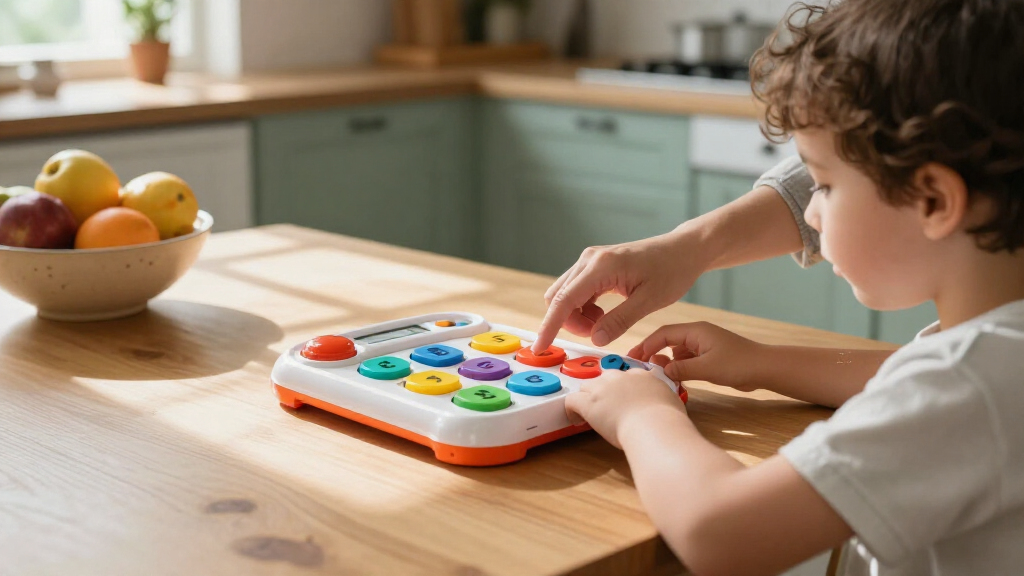
I compared these 13 electronic learning toys by how directly they support math practice, how easily a child can use them, and whether the activity style fits a particular age or learning goal. I gave weight to clear practice formats, useful feedback, portability, and versatility, while also looking at whether a product is centered on math or shares attention with broader learning activities. A wide age claim alone did not earn a higher place; a toy needs an appropriate level and a practical way for a child to engage with it.
The ranking reflects how well each option serves a distinct buyer, not a claim that every child needs the same kind of device. Focused handheld games rank well for targeted arithmetic practice, while systems such as LeapStart and LeapPad Academy offer a different kind of value through guided or broader learning. I also weighed tradeoffs: extra subjects can mean less math focus, and a simple game may be engaging without offering the range a child needs as skills grow. Since the lineup spans different formats and age stages, buyers should use each pick’s role as a starting point, then match it to the child’s current abilities.
Factors to Consider When Choosing Electronic Math Learning Toys For Kids
Before choosing, start with the kind of practice your child needs, not the number of buttons, games, or advertised age levels. The right toy should make it easy to begin and keep math as the main activity when that is the goal. These broader checks can help narrow the field beyond the individual product differences above.
Match the device to the skill, not just the age label
Age ranges are rough signals, not a reliable placement test. A child may be ready for addition but still need adult help reading prompts, while another may be comfortable with written directions and want multiplication drills. Check what the toy asks the child to do: recognize numbers, solve equations, read instructions, or respond under time pressure. A mismatch can make a device feel either frustrating or too easy, even if the stated age appears right. When possible, choose a level that supports the next small step rather than jumping several skills ahead. That usually gives a child room to build confidence without turning play into a test.
Choose focused practice or a wider learning system
A dedicated math game can be easier to use when a child needs repetition in a specific area. A broader learning system may offer more variety, which can help sustain interest, but it may also divide time between math and other activities. Think about the role the toy will play: a short daily arithmetic routine calls for a different format than a shared device for several learning subjects. Avoid paying extra attention to the number of activities alone; variety matters only if the child will use it. If math is the main goal, look for a clear path to math practice rather than assuming a general learning device will provide enough of it.
Decide how much adult support is realistic
Some children can start a handheld game independently, while book-based or multi-feature systems may take more help at first. Consider whether an adult will be available to explain setup, read prompts, or guide a child toward suitable activities. A device that looks simple to an adult may still require menu navigation or reading skills that a younger learner has not developed. If independent use is a priority, favor clear controls and a narrow activity flow over a long menu of choices. If shared learning is the goal, a more guided format can make adult-child practice easier to organize. The best match is the one that fits your household’s actual routine.
Treat screen format as a learning tradeoff
Electronic toys vary in how much they resemble a traditional screen-based device. A writing board can support working out answers, while a handheld game may favor quick mental responses; a tablet-style option can offer a wider range of activities. Neither format is automatically better, so consider whether your child benefits from writing, spoken prompts, or fast feedback. Families trying to limit recreational screen use may prefer a focused device with a clear learning purpose. Also check whether the child will be expected to use the toy for long sessions; short practice is often easier to fit into a routine. Choose the format that supports the learning behavior you want to encourage.
Check portability and everyday handling
A portable toy is useful only if it is easy to bring along and simple to manage during real travel or downtime. Look at the overall form, controls, and whether the activity works well in short sessions rather than assuming a product labeled portable will suit every bag or setting. A compact handheld can be convenient for a car ride, but a child may still need quiet and enough attention to solve problems. Think about where the toy will be stored and whether multiple children will share it. For shared use, straightforward controls and a clear turn-taking pattern can matter more than having many game modes. These practical details often decide whether a learning toy becomes part of the routine or stays on a shelf.
Pay for useful growth, not an impressive feature count
Extra modes and subjects can extend a toy’s usefulness, but they do not automatically make it a better math tool. Pay more when the added format solves a real need, such as supporting several learners or offering a broader learning routine. A focused game may be the better choice when the child needs regular practice in a small set of skills. Before choosing, consider how quickly the child might outgrow the activity level and whether the product can still hold attention as math becomes harder. Avoid treating a broad age span as proof of long-term value; the content needs to remain relevant to the child’s level. The best value is a device the child can use consistently for the kind of practice they need.
Frequently Asked Questions
Should I choose a math-only handheld or a general learning tablet?
Choose a math-focused handheld when the main goal is regular practice with arithmetic and you want fewer competing activities. A broader tablet-style device makes more sense when your child will use several learning subjects and benefits from a flexible format. Consider how easily your child stays on task, since extra options can help maintain interest or pull attention away from math. Also think about whether you already have another device for general learning. The better choice is the one that supports the routine you expect your child to follow.
Are these toys suitable for a child who is not reading yet?
Some learning formats are more accessible to early learners than others, but a product’s age label does not tell the whole story. Check whether activities rely on written instructions, spoken cues, pictures, or adult guidance. A child who cannot read yet may still solve math problems but need help understanding what an activity is asking. Guided systems can suit shared practice, while a simple game may work if its controls and prompts are clear. If independent play matters, reading demands should be part of your decision before you buy.
Can a handheld math game help with schoolwork, or is it mainly for play?
A handheld game can reinforce skills through repetition, but it should not be treated as a full replacement for classroom teaching or a child’s regular school materials. Its value depends on whether the activities match what the child is learning and offer practice at an appropriate level. Short sessions may help make review feel manageable, especially when a child needs more arithmetic repetition. For a specific school challenge, check the toy’s math focus rather than assuming every game covers the same topics. Pairing play with conversation or written work can help connect quick answers to deeper understanding.
Is a toy with a wide advertised age range a better long-term choice?
Not necessarily; a broad range can suggest flexibility, but it does not confirm that activities will stay challenging or engaging as a child develops. Look for a clear progression in skills or modes, and consider whether the child can use them without constant adult help. A narrower, well-matched activity may be more useful now than a device with features that are too advanced or too basic. Think about how quickly your child is likely to move through the current math topics. Choose based on realistic growth, not the largest age span printed on the package.
What should I prioritize if my child gets frustrated by timed questions?
Look for an activity style that lets the child focus on solving rather than racing to answer. Timed challenges can motivate some learners, but they may add pressure for children who need extra thinking time or are still building confidence. A writing-friendly format or guided activity may give them more room to work through a problem. Check whether the toy offers different game types or difficulty settings rather than assuming every activity uses the same pace. The goal is regular math engagement, so choose a format that encourages another try instead of making mistakes feel like failure.
Conclusion
For most families seeking a clear starting point, I’d choose the LeapFrog LeapStart as the best overall pick for guided early learning. The Educational Insights MathShark is my choice for focused arithmetic practice and a strong value among dedicated math games, while the LeapPad Academy is the best premium-style option for families who want a broader learning tablet. For beginners, start with a format that offers accessible prompts and does not depend on fast responses; LeapStart is the strongest fit in this lineup. For specific needs, consider Multiplication Slam for multiplication-focused practice, Math Slam or Math Whiz for short handheld sessions, and portable options such as Aullsaty or alilo when taking a compact activity along matters. Match the device to your child’s current skills and preferred way to learn, rather than choosing by feature count alone.