
TL;DR

Prime made for students and young adults
- Fast, free delivery for dorm and study essentials
- Prime Video and Amazon Music included
- Member-only deals
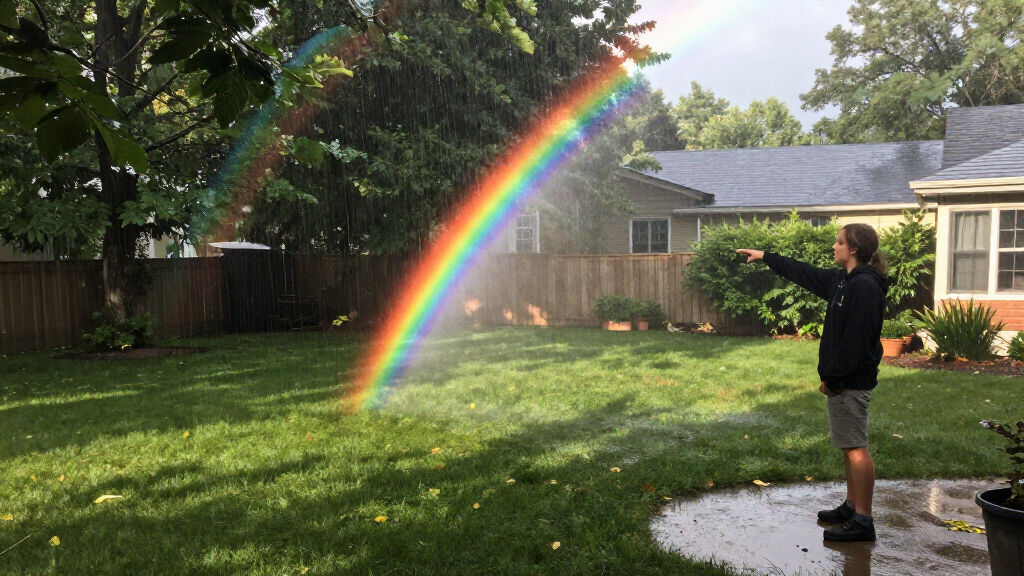
NASA’s Astronomy Picture of the Day for October 4, 2026, features a photograph of multiple supernumerary rainbows over the New Jersey shore after the remnants of Hurricane Florence passed in 2018. The image captured at least five bands, a wave-interference effect that forms when raindrops are nearly uniform in size.
NASA’s Astronomy Picture of the Day for October 4, 2026, features a photograph of at least five supernumerary rainbows seen over the New Jersey shore after the remnants of Hurricane Florence passed in 2018. The display, captured by photographer John Entwistle, shows closely spaced extra bands beside a primary rainbow, a phenomenon NASA explains as the result of light waves interacting after passing through similarly sized raindrops.
The NASA Science explanation says the photograph was made after Florence’s remnants moved over the Jersey Shore in 2018. The Sun appeared in one direction while the rainbow display formed in the opposite direction. Entwistle and his daughter watched the rainbows fade in and out over roughly half an hour; the featured image records at least five of the extra bands at once.
NASA describes supernumerary rainbows as forming when falling raindrops are nearly the same size, typically less than a millimeter across. Light reflects inside the droplets and also behaves as a wave, producing interference. That interaction creates additional pale or vivid bands close to the main rainbow. The APOD explanation compares the wave behavior to ripples on a pond after a stone is thrown in.
The image is the day’s featured astronomy photograph, not a newly reported storm or a new observation from 2026. NASA credits John Entwistle for the image and copyright, with the APOD explanation credited to editors and authors Robert Nemiroff, Jerry Bonnell, Cecilia Chirenti and Keighley Rockcliffe. The feature places an atmospheric optical effect within NASA’s daily series about the cosmos and related science.
A Rainbow That Shows Light’s Wave Behavior
The photograph makes a wave phenomenon visible in an everyday setting. Most rainbows are explained through sunlight refracting and reflecting inside water droplets; the closely spaced extra bands require accounting for interference between light waves. The bands therefore provide a striking illustration of a principle of optics without specialized equipment: sunlight, rain and droplets with a sufficiently narrow range of sizes can produce the effect.
NASA’s explanation also connects the observation to the history of science. It says the existence of supernumerary rainbows, noted in the early 1800s, was considered early evidence for the wave nature of light. The image offers a concrete example of why a seemingly familiar weather feature can carry scientific significance. It does not, by itself, establish a new finding; its value is as a documented display paired with a concise explanation of the physics.
For readers, the main takeaway is that the extra arcs are not separate rainbows produced by a different source. They arise from the same sunlight and droplets as the primary rainbow, but their formation depends on wave interference. Their appearance can offer a visible clue about the size consistency of the droplets along the line of sight.
Popular right now

iRobot Roomba Max 715 Pet Robot Vacuum with AutoEmpty Dock

De'Longhi Linea Classic Espresso Machine with Adjustable Milk Frother

LG C2 Series 65-Inch OLED evo 4K Smart TV (OLED65C2PUA, 2022)
As an affiliate, we earn on qualifying purchases.
The 2018 Storm and the APOD Feature
The image dates to the aftermath of Hurricane Florence, whose remnants passed over the Jersey Shore in 2018. NASA’s description gives the weather sequence: the rain had moved through, sunlight returned in one direction, and the rainbow display appeared opposite it. The report does not provide a precise date, location beyond the Jersey Shore, or additional camera details.
NASA’s Astronomy Picture of the Day presents a different image or photograph each day with an explanation written by a professional astronomer, according to the service description included with this feature. The October 4, 2026, entry revisits Entwistle’s earlier photograph rather than documenting a rainbow event on that date. APOD is provided through NASA’s Goddard Space Flight Center and partner organizations, including Michigan Technological University.
The optical effect depends on droplet conditions. NASA says the droplets must be nearly uniform in size, and are typically under one millimeter across. When their sizes vary more, the interference bands may be less clearly visible. The explanation describes the underlying process but does not report measurements of the droplets in this specific New Jersey scene.
Details Not Given About the Photograph
NASA’s feature does not specify the exact date or precise site of the 2018 photograph, the camera or lens used, or the measured sizes of the droplets. It reports that at least five supernumerary bands were captured and that the display lasted about half an hour, but gives no instrumental measurements or independent analysis of the image.
The report also does not identify the specific characteristics of the droplets that produced the visible interference in this instance. NASA presents the general conditions associated with supernumerary rainbows; it does not claim that droplet sizes were measured at the scene. No new rainbow observation is reported for October 4, 2026.
The Daily Astronomy Picture Continues
NASA’s APOD schedule continues with another featured image and explanation on the following day. The October 4 page lists the next picture as “open space,” without additional detail in the supplied report. The New Jersey rainbow image remains a retrospective feature, and NASA’s entry does not announce further analysis, new measurements or follow-up observations.
Readers interested in the photograph can consult the APOD page for the image, its credit and the accompanying explanation. Any further specifics about where and when it was taken, or about the droplets involved, would require information beyond the published feature.
Key Questions
What did NASA feature on October 4, 2026?
NASA’s Astronomy Picture of the Day featured John Entwistle’s photograph of at least five supernumerary rainbows over the New Jersey shore. The image was taken after the remnants of Hurricane Florence passed in 2018.
What are supernumerary rainbows?
They are extra bands that appear close to a primary rainbow. NASA explains that they form when light waves interfere after sunlight passes through raindrops that are nearly uniform in size.
How long did the rainbow display last?
NASA’s account says the bands faded in and out over about half an hour. The photograph captured at least five of them at one time.
Was the photograph taken in 2026?
No. The APOD was published on October 4, 2026, but the photograph shows a scene from 2018, after Hurricane Florence’s remnants passed over the Jersey Shore.
Did NASA measure the raindrops in the photograph?
The published explanation does not report measurements from this scene. It gives the general conditions for the effect: droplets are typically less than a millimeter across and nearly the same size.
Source: primary