
TL;DR

Prime made for students and young adults
- Fast, free delivery for dorm and study essentials
- Prime Video and Amazon Music included
- Member-only deals
Educational science experiment kits bundle materials and instructions for hands-on activities in subjects such as chemistry, physics, biology, electronics, and robotics. Choose one that fits the learner’s age and interests, explains the science behind each activity, and includes clear safety guidance; the best learning happens when you pause to predict, observe, and discuss the results.
Match the kit to the learner’s interests, reading level, fine-motor skills, and supervision needs.
Check for clear explanations, safety instructions, required household supplies, and refill options before buying.
Compare reusable parts and the variety of investigations, not just the number printed on the box.
Ask for a prediction before each test, then discuss what changed and why the result may have surprised you.
Follow the kit’s instructions for protective equipment, supervision, material handling, and disposal.
What educational science experiment kits actually teach
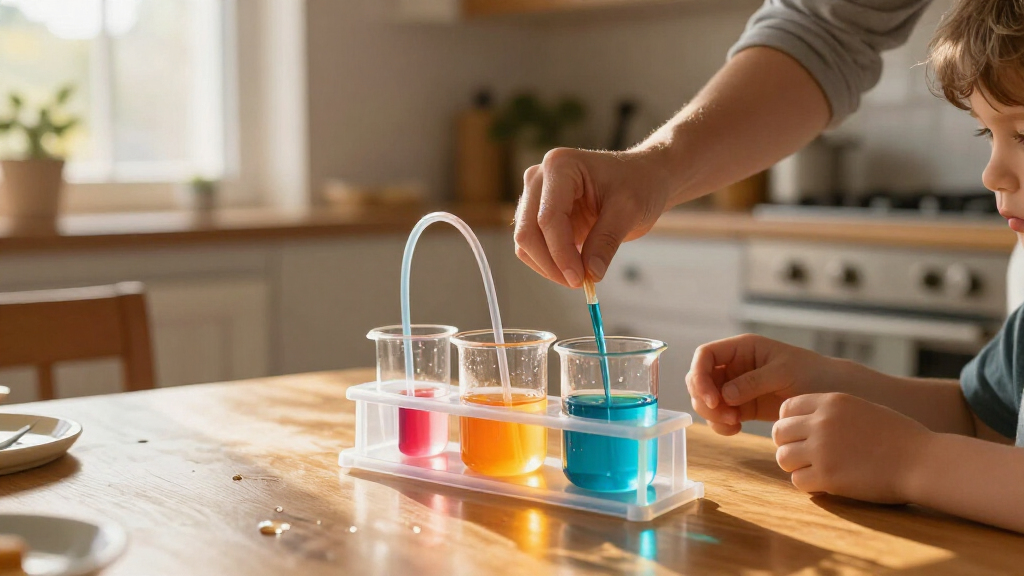
Educational science experiment kits bundle materials and instructions for hands-on activities in subjects such as chemistry, physics, biology, electronics, robotics, and earth science. They give you a ready starting point: a circuit to assemble, seeds to observe, or a reaction to test. What happens next depends on how you use the kit. A kit can make an abstract idea feel solid. For example, when a learner connects a battery, wires, and a small bulb, the glow gives them something visible to link to a circuit diagram. Asking what might happen if they reverse a connection turns that glow into a question worth testing. That shift matters because remembering a result is different from understanding the conditions that produced it. When learners can explain why a change happened, they are better prepared to recognize the same idea in a new activity. The activity alone does not guarantee understanding. A child can enjoy a dramatic color change without knowing what caused it; asking them to describe what changed and compare it with their prediction helps connect the result to the science. It also gives adults a useful way to see where confusion remains: a learner may describe the color accurately but still need help connecting it to the materials or steps. Think of a kit as a **launchpad for questions**, not a box that delivers learning by itself.Choose a kit that fits the learner and the room
The right kit matches the learner’s age, reading skills, interests, and need for adult help, while also fitting the space and time you have. Check the maker’s age guidance, but read beyond the number: small parts, detailed instructions, or a need for steady hands may change how much support an activity takes. A kit that is too demanding can leave an adult doing the work; one that is too simple may hold attention briefly but offer little room to grow. Imagine buying a robotics set for a curious eight-year-old who loves building but gets frustrated by dense text. A kit with labeled pieces, clear diagrams, and short challenges may suit them better than one with more components and a long manual. The tradeoff is that a guided set may offer fewer open-ended choices at first, but it can help the learner gain confidence before tackling more complex builds. In a classroom, you’ll also want to know whether the quantities support groups or only one learner at a time, since sharing one set can turn a hands-on activity into a watching exercise. Use this checklist before you buy:- Match the interest: Choose topics the learner already talks about, such as plants, space, or machines. Familiar interests can make it easier to stay curious when an experiment takes patience.
- Check the learning purpose: Look for activities that explain what learners can observe and invite them to make a prediction. That gives them a reason to think about the result instead of simply completing steps.
- Read the safety guidance: Note required supervision, protective equipment, and instructions for handling materials. These requirements affect whether an activity fits your setting and how much adult time it needs.
- Check what’s included: Find out which household supplies you’ll need and whether consumables can be replaced. Missing supplies or unavailable refills can cut an apparently large kit short.
- Look for room to explore: Favor activities that let learners change a variable or ask a follow-up question. This helps a kit remain useful after the learner has mastered its first demonstration.
Compare the real value, not just the number of experiments
A kit with fewer activities can offer better value if its components are reusable, its instructions teach clearly, and its activities leave room for further questions. A big activity count may look impressive on the box, but some projects use up materials quickly or repeat the same basic task. The useful comparison is how much meaningful activity a learner can do, not how many items the packaging calls separate experiments. | What to compare | What to check | Why it matters | |—|—|—| | Activity count | How many distinct investigations are there? | Repeated variations may count as separate projects. | | Reusable parts | Which tools and components work again? | Reusable pieces can support future experiments. | | Consumables | What gets used up, and are refills available? | Refill costs affect how long the kit stays useful. | | Instructions | Do they explain results and help with troubleshooting? | Clear explanations make it easier to learn from a surprising outcome. | | Extra supplies | Does the activity need water, paper, or kitchen items? | A complete list helps you prepare before opening the box. | For instance, an electronics kit with reusable wires and a small motor may invite several different builds, while a single-use activity pack may run out after one afternoon. The reusable set may cost more upfront, yet its components can support practice and new designs over time. The activity pack can still be the better fit when a gift needs to be simple or a class needs a short, self-contained lesson. Neither format is automatically better: compare the total cost and likely use with the learner’s setting, rather than assuming that the larger box or lower price is the better value.Make every experiment teach more than a quick trick
You can get more learning from a kit by pausing before the instructions reveal the result, then asking the learner to compare what happened with what they expected. That simple routine turns “press this and watch” into a small investigation: predict, test, observe, and explain. It matters because the learner has to connect an idea to evidence; even an incorrect prediction becomes useful if they can work out what the result suggests. Suppose a learner plants seeds in two cups and puts one by a sunny window. Before watering them, ask which seed they expect to sprout first and why. A few days later, they can describe changes in height, color, and soil moisture; if the results surprise them, you have a real question to explore together. For a fair comparison, keep the cups alike in other ways, such as seed type and watering, and note any difference in conditions. Otherwise, several factors may have changed at once, making it hard to tell what caused the result. Try these prompts during an activity:- Before: “What do you think will happen, and what makes you think that?”
- During: “What changed? What stayed the same?”
- After: “How did the result compare with your guess?”
- For a follow-up: “What is one thing we could change and test next?”
Keep the fun safe with a few checks before you start
Follow the kit’s own age guidance and safety instructions, and provide adult supervision whenever the maker calls for it. Activities involving heat, sharp tools, small parts, electricity, or chemicals may need closer attention than a simple observation project. These details shape which kits are practical: an activity that requires continuous adult help may work well as a shared weekend project but be a poor fit for independent play or a busy classroom rotation. Before opening the materials, clear a work surface away from food and young children. Lay out any protective equipment the instructions require, check whether you need household supplies, and read how to handle or dispose of leftovers. Don’t swap in other materials unless the activity says they are suitable. Following the stated steps keeps the experiment within the conditions the kit’s guidance addresses; a substitution can make the result unpredictable and may introduce a hazard the instructions do not cover. For example, if a chemistry activity calls for a specific measured amount, use the stated material and amount instead of guessing or substituting something from the cupboard. If you’re unsure what an instruction means, stop and check the kit guidance before continuing. A tidy table, a read-through, and a nearby adult can keep a promising experiment from turning into a scramble.Know what current kit trends can—and can’t—tell you
Many educational kits now combine subjects, add digital extras, or invite more open-ended exploration, but these broad directions do not describe every product or prove that a particular kit teaches better. Treat claims about learning outcomes or product features as claims to check against the activities and materials you can actually inspect. A trend can help you find a topic to explore, but the quality of the instructions and the learner’s chance to think still determine what the experience offers. For example, a robotics set may combine building, coding, and basic physics, while a biology kit might include printable worksheets alongside physical materials. Some makers also offer refill packs or reusable components, but availability and packaging vary. If a listing promises an app or refill service, check what it includes and whether it is needed for the core activities. Digital guidance can make steps clearer, but it may also require a device or account; that extra setup is useful only if it fits the household or classroom. A useful rule: judge a kit by the experience it gives your learner, not by how many subjects or digital extras appear on its packaging. One well-explained experiment that sparks a follow-up question can outlast a screen full of bonus content.Frequently Asked Questions
What age is a science experiment kit suitable for?
It depends on the activity’s reading level, small parts, fine-motor demands, and supervision needs. Use the maker’s age guidance as a starting point, then check whether the learner can follow the instructions with the support available.Are science kits safe for children?
Many kits are designed for children, but safety requirements vary. Read the warnings, follow the instructions, and provide the adult supervision and protective equipment the maker specifies.Do kits teach real science or just provide entertainment?
They can teach scientific ideas when learners predict what will happen, observe the result, and discuss why it happened. A dramatic fizz or bright color is fun, but the result alone does not show that the learner understood it.What should I buy for a beginner?
Pick a kit with clear steps, a suitable age range, manageable activities, and explanations of the ideas behind them. A topic the learner already enjoys—such as plants, circuits, or rocks—can make it easier to get started.Are experiment kits reusable?
Some kits include reusable tools or components, while others use materials that run out during activities. Check the contents and whether refill supplies are available before you buy.Conclusion
Choose a kit that gives the learner something to test, a clear way to stay safe, and room to ask what happens next. Then keep the best part of the experiment alive: the moment someone looks at the result and says, “What if we try it this way?”Evergreen bestsellers Picks
bestsellers
As an affiliate, we earn on qualifying purchases.