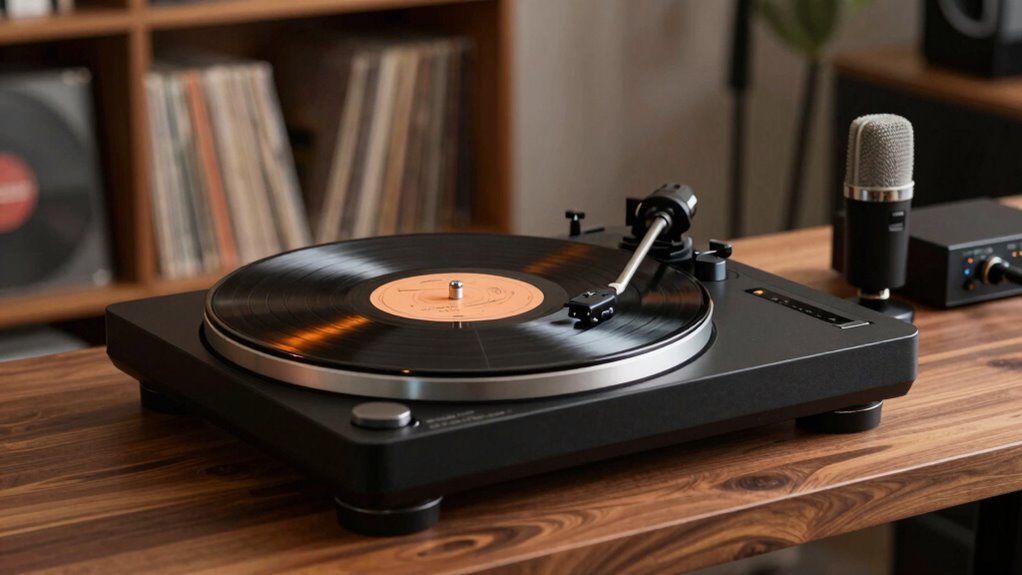

For digitizing vinyl oral history recordings, I’d choose a turntable with a direct USB connection, stable playback, and controls that suit careful transfers. The Audio-Technica AT-LP120XUSB-BK is my best overall pick for its direct-drive design and USB output, while the Reloop RP-2000 MK2 stands out for hands-on control and the AT-LP60XBT-USB-BK for simpler automatic operation. The main tradeoff is between manual control and ease of use, with bundled speakers or Bluetooth offering convenience that may matter less during archival capture. A turntable alone also cannot restore damaged recordings or replace a clean, consistent recording workflow. Read on for how these seven options compare and which fits your transfer setup.

Prime made for students and young adults
- Fast, free delivery for dorm and study essentials
- Prime Video and Amazon Music included
- Member-only deals
Key Takeaways
- The AT-LP120XUSB-BK is the strongest all-around fit in this group because it pairs direct drive with USB conversion and manual controls.
- The Reloop RP-2000 MK2 favors hands-on operation, while buyers should check the exact connection and capture workflow in the listing before treating it as a direct USB solution.
- The AT-LP60XBT-USB-BK is the easiest path for beginners who value automatic operation, though it gives up some manual adjustment.
- The bundled AT-LP120XUSB package can simplify setup with monitors and record-care items, but those extras do not replace a careful capture process.
- Bluetooth and built-in speakers suit casual listening more than archival work; USB output and a stable, repeatable playback setup matter more for oral history transfers.


| turntable for digitizing vinyl oral history recording | Drive type | Connectivity | Speeds | Cartridge |
|---|---|---|---|---|
| Reloop RP-2000 MK2 Professiona | Direct drive | USB audio output | 33 1/3 and 45 RPM | — |
| XJ-HOME Vinyl Record Player wi | — | Bluetooth 5.0, USB, aux-in, RCA | 33 and 45 RPM | AT-3600L moving magnet |
| Audio-Technica AT-LP120XBT-USB | Direct drive, DC servo motor | Bluetooth aptX Adaptive, USB, dual RCA | 33 1/3, 45, and 78 RPM | AT-VM95E dual moving magnet |
| Audio-Technica AT-LP120XUSB-BK | Direct drive, DC servo motor | USB and dual RCA output | 33, 45, and 78 RPM | — |
| Pioneer DJ PLX-500 Direct-Driv | Direct drive | USB | — | — |
| Audio-Technica AT-LP120XUSB Di | Direct drive | — | — | AT-VM95E Dual Magnet with elliptical stylus |
| Audio-Technica AT-LP60XBT-USB- | Belt drive | Bluetooth, USB, and analog RCA | — | Integral Dual Moving Magnet (ATN3600L) |
More Details on Our Top Picks
Reloop RP-2000 MK2 Professional Direct Drive USB Turntable
The quartz-driven direct-drive motor and die-cast aluminum platter make the Reloop a strong fit when steady playback matters for spoken-word archives. Its USB output and built-in phono preamp give me a straightforward path to recording on a computer or connecting to a separate audio system. Compared with the Audio-Technica AT-LP120XUSB-BK, the Reloop offers fewer listed speed and tonearm adjustments, so it is a more focused transfer deck than a flexible all-rounder. Its reinforced housing and metal top panel suit a permanent home setup, though that professional-grade construction makes it less convenient to move. The ±8% pitch control is useful for adjustment, but it gives less range than a deck with broader variable-pitch control. I would pair it with dedicated speakers or headphones for careful voice monitoring.
Pros:- USB audio output supports direct computer recording
- Quartz-driven motor and aluminum platter support steady playback
- Built-in phono preamp simplifies connection to line-level equipment
- Reinforced housing and metal top panel suit regular home use
Cons:- Professional-grade construction may be cumbersome to move
- Pitch adjustment is limited to ±8%
- No 78 RPM speed is listed
Best for: Archivists and family historians who want stable, computer-ready transfers in a fixed home recording setup
Not ideal for: Buyers who need a portable, lightweight deck or want broader speed options and pitch adjustment
- Drive type:Direct drive
- Motor:Quartz-driven
- Speeds:33 1/3 and 45 RPM
- Pitch control:±8%
- Platter:Die-cast aluminum
- Tonearm:Statically balanced S-shaped with hydraulic lift
- Connectivity:USB audio output
- Preamp:Built-in phono preamp
Our verdict“Choose the Reloop for a sturdy, direct-drive transfer setup when playback stability matters more than portability or extensive speed options.”
XJ-HOME Vinyl Record Player with Built-in Speakers, Bluetooth 5.0, AT-3600L Cartridge, USB Recording, and 33/45 RPM Speed
The XJ-HOME combines USB recording, built-in speakers, and Bluetooth, making it the simplest route here from a record to a computer file and casual listening. Its AT-3600L magnetic cartridge and phono/line outputs give it more connection flexibility than a basic suitcase player. Compared with the Audio-Technica AT-LP120XUSB-BK, it asks less of a buyer’s existing setup because the speakers are already built in, but it lacks that model’s listed 78 RPM speed and dedicated anti-skate adjustment. For oral-history work, the integrated speakers are handy for a quick playback check; they are less suited to close listening for surface noise or quiet speech. I would also account for the 3.5 g tracking-force adjustment before recording. This is a convenience-first choice, with monitoring quality the main tradeoff.
Pros:- USB recording supports vinyl capture to MP3 on a PC
- Built-in speakers allow playback without separate audio equipment
- Bluetooth 5.0 supports wireless audio streaming
- Phono and line outputs allow connection to other audio systems
Cons:- Built-in speakers are less suited to detailed voice and noise monitoring than a separate system
- Counterweight requires manual adjustment to the specified 3.5 g tracking force
- Only 33 and 45 RPM speeds are listed
Best for: First-time digitizers who want to record records to a PC and listen at home without buying separate speakers
Not ideal for: Archivists who need detailed monitoring, 78 RPM playback, or more tonearm adjustment options
- Cartridge:AT-3600L moving magnet
- Speeds:33 and 45 RPM
- Connectivity:Bluetooth 5.0, USB, aux-in, RCA
- Speakers:2 × 4-inch bass and 2 × 2-inch treble
- Outputs:Phono and line
- Materials:Wood and metal
- Recommended tracking force:3.5 g
Our verdict“Pick the XJ-HOME if you want a simple speaker-equipped player for casual listening and basic computer recording.”
Audio-Technica AT-LP120XBT-USB-BK Wireless Direct-Drive Turntable
The AT-LP120XBT-USB-BK is the most flexible archival pick in this group: USB and dual RCA cover computer capture and wired systems, while Bluetooth adds a convenient listening route. Its 33, 45, and 78 RPM speeds make it more adaptable than the Reloop RP-2000 MK2 or XJ-HOME, although the supplied data does not identify a stylus specifically for 78 RPM records. The AT-VM95E elliptical stylus, adjustable anti-skate, and switchable preamp give buyers useful setup control for records that need careful playback. This is a fully manual deck, so placing and lifting the tonearm takes more involvement than an automatic model. That control can suit archival work, but it adds a learning step for beginners. The external power adapter also means another cable to manage.
Pros:- USB, dual RCA, and Bluetooth support several recording and listening setups
- Three listed speeds include 78 RPM
- AT-VM95E elliptical stylus and adjustable anti-skate offer useful playback controls
- Switchable phono/line preamp supports different audio connections
Cons:- Fully manual operation requires hands-on tonearm placement and lifting
- External power adapter adds another cable
- The listed cartridge is not specified as a 78 RPM stylus
Best for: Home archivists who need USB capture, wired playback, and three playback speeds in one manual deck
Not ideal for: Beginners who want automatic tonearm operation or buyers who need a plug-in-and-play speaker system
- Drive type:Direct drive, DC servo motor
- Operation:Fully manual
- Speeds:33 1/3, 45, and 78 RPM
- Connectivity:Bluetooth aptX Adaptive, USB, dual RCA
- Cartridge:AT-VM95E dual moving magnet
- Stylus:0.3 × 0.7 mil elliptical
- Tonearm:Balanced S-shaped with hydraulic lift
- Preamp:Built-in switchable phono/line
Our verdict“Choose this Audio-Technica when you want the broadest listed speed and connection options and are comfortable operating a manual turntable.”
Audio-Technica AT-LP120XUSB-BK Direct-Drive Turntable (Analog & USB), Fully Manual, Hi-Fi, 3 Speed, Convert Vinyl to Digital, Anti-Skate and Variable Pitch Control, Black
The AT-LP120XUSB-BK keeps the useful manual controls and USB conversion path of the Bluetooth-equipped AT-LP120XBT-USB-BK, while its listed connection details focus on USB and analog output. That makes it a sensible fit when the goal is capturing oral-history records to a computer and monitoring through a wired system. Its 33, 45, and 78 RPM speeds, adjustable anti-skate, and quartz speed lock give it more playback flexibility than the Reloop RP-2000 MK2, whose listed speeds stop at 45 RPM. The product details describe conversion using Audacity or other recording software, so computer capture still requires a software setup. Fully manual operation offers direct control but may take practice; buyers seeking built-in speakers or wireless listening should look at the XJ-HOME or the Bluetooth AT-LP120XBT instead.
Pros:- USB connection supports computer-based vinyl recording
- 33, 45, and 78 RPM speed selection broadens record compatibility
- Adjustable anti-skate and quartz speed lock support controlled playback
- Includes a detachable RCA cable and removable hinged dust cover
Cons:- Fully manual operation requires hands-on tonearm control
- Digital capture requires recording software on the computer
- No Bluetooth or built-in speakers are listed
Best for: Digitizers who plan to record through USB and monitor through a wired audio setup, including owners of records in multiple listed speeds
Not ideal for: Buyers who want built-in speakers, Bluetooth playback, or automatic tonearm operation
- Drive type:Direct drive, DC servo motor
- Operation:Fully manual
- Speeds:33, 45, and 78 RPM
- Connectivity:USB and dual RCA output
- Tonearm:Balanced S-shaped with hydraulically damped lift
- Controls:Adjustable dynamic anti-skate, variable pitch, quartz speed lock
- Included accessories:USB cable, RCA cable, AC adapter, 45 RPM adapter, counterweight, felt mat, dust cover
- Recording software:Compatible with Audacity or software of choice
Our verdict“Choose the AT-LP120XUSB-BK for controlled USB transfers and wired monitoring when wireless features are not a priority.”
Pioneer DJ PLX-500 Direct-Drive Turntable
The Pioneer DJ PLX-500 brings a club-style direct-drive layout to a home transfer setup, with USB output for digitizing records and phono/line output for connection to speakers or monitors. Its familiar DJ controls may appeal to someone who also wants to learn deck handling, while a dedicated transfer buyer may find more explicit archival detail in the Audio-Technica AT-LP120XUSB-BK, whose supplied information names its three speeds, anti-skate, and quartz speed lock. Pioneer’s description says it includes starter accessories, but does not specify a cartridge, speed options, or tonearm controls in the supplied data. That makes it harder to judge fit for a varied oral-history collection from these details alone. I would shortlist it for its DJ-oriented setup and USB route, then confirm the playback specifications needed for the records on hand.
Pros:- Direct-drive mechanism offers a DJ-style control layout
- USB output supports vinyl digitization
- Phono/line output supports connection to speakers or monitors
- Starter accessories are included
Cons:- Supplied product details do not list speed options
- Cartridge and tonearm specifications are not provided
- The white color may not suit buyers seeking a black finish
Best for: Home digitizers who also want a DJ-style direct-drive layout and plan to connect external speakers or monitors
Not ideal for: Archivists who need clearly documented speed, cartridge, and tonearm specifications before choosing a transfer deck
- Drive type:Direct drive
- Connectivity:USB
- Output:Phono/line
- Color:White
- Included accessories:Starter accessories
- Intended setup:Home listening and beginner DJ use
Our verdict“Consider the PLX-500 if DJ-style controls matter alongside USB recording, but verify its playback details against your record collection.”
Audio-Technica AT-LP120XUSB Direct-Drive USB Turntable Bundle with Studio Monitors and Record Care Kit
For an oral history collection that includes shellac discs, the AT-LP120XUSB bundle stands apart from the AT-LP60XBT-USB-BK by supporting 78 RPM playback alongside 33-1/3 and 45 RPM. Its USB output connects to a computer for transfers, while the switchable phono or line output gives more flexibility when setting up monitoring. The included PreSonus Eris E3.5 monitors and record care kit make this a more complete work area than a turntable-only option. The tradeoff is its fully manual operation: you control the tonearm, so each recording takes more hands-on attention. Its 29.6 lb weight and large footprint also make it better suited to a dedicated transfer station than a compact listening corner.
Pros:- Plays 33-1/3, 45, and 78 RPM records, covering a wider range of archival media than the AT-LP60XBT-USB-BK.
- USB connection supports direct computer transfers.
- Switchable phono or line-level output offers flexible connection options.
- Includes studio monitors and record cleaning supplies for a more complete transfer setup.
Cons:- Fully manual tonearm operation calls for hands-on control during playback.
- The bundle’s 29.6 lb weight and 23.8 × 18.4 × 18.6 in dimensions require substantial space.
- The supplied cartridge is specified, but the product data does not detail dedicated restoration or recording software.
Best for: Archivists and family historians digitizing a mixed collection that includes 78 RPM records and who want monitors included for checking transfers.
Not ideal for: Beginners seeking push-button playback, or anyone digitizing only 33-1/3 and 45 RPM records in a space-constrained setup.
- Drive type:Direct drive
- Operation:Fully manual
- Playback speeds:33-1/3, 45, and 78 RPM
- Cartridge:AT-VM95E Dual Magnet with elliptical stylus
- Output:USB; switchable phono or line-level
- Signal-to-noise ratio:60 dB
- Bundle contents:Turntable, PreSonus Eris E3.5 studio monitor pair, vinyl record cleaning kit, and 2 fl oz (60 ml) record care solution
- Weight:29.6 lb
Our verdict“Choose this bundle for a spacious archive workstation that needs 78 RPM playback, computer transfer, and included monitors.”
Audio-Technica AT-LP60XBT-USB-BK Fully Automatic Belt-Drive Stereo Turntable with Bluetooth and USB
The AT-LP60XBT-USB-BK suits listeners who want a straightforward path from standard vinyl to a computer file: its USB connection supports digitization, and fully automatic operation starts and returns the tonearm for you. That ease can help when working through a stack of familiar 33-1/3 and 45 RPM records. Bluetooth adds a wireless listening option, though it does not replace the wired USB connection needed for a computer transfer. Compared with the AT-LP120XUSB bundle, this model is simpler to operate but cannot play 78 RPM records and does not include studio monitors or cleaning supplies. Its belt drive may need belt replacement over time, and the supplied details do not confirm a built-in preamp for connection to non-phono inputs.
Pros:- Fully automatic operation reduces hands-on tonearm handling.
- USB connectivity supports computer-based vinyl digitization.
- Bluetooth offers wireless playback for listening outside the transfer setup.
- Replaceable diamond stylus provides a stated replacement path for the stylus.
Cons:- Playback is limited to 33-1/3 and 45 RPM, unlike the AT-LP120XUSB bundle’s 78 RPM support.
- Belt-drive design may require occasional belt replacement.
- Product data does not specify a built-in preamp for direct connection to non-phono inputs.
Best for: First-time digitizers transferring mostly 33-1/3 or 45 RPM family records who value automatic tonearm operation and Bluetooth listening.
Not ideal for: Oral history archivists with 78 RPM discs, or buyers who need an included monitor setup and confirmed line-level output.
- Drive type:Belt drive
- Operation:Fully automatic
- Playback speeds:33-1/3 and 45 RPM
- Connectivity:Bluetooth, USB, and analog RCA
- Cartridge:Integral Dual Moving Magnet (ATN3600L)
- Stylus:Replaceable diamond stylus
- Color:Black
- Included accessories:Dust cover, felt mat, platter, 45 RPM adapter, RCA cable, AC adapter, and USB cable
Our verdict“Pick this model for convenient, automatic USB transfers of standard-speed records when 78 RPM playback and included monitors are unnecessary.”

How We Picked
I ranked these models for the specific job of transferring spoken-word records: steady playback, a clear route to a computer or recording device, manageable setup, and useful control over the transfer. Direct-drive models with USB capture and adjustable controls scored well because they make it easier to repeat a setup across multiple records. Automatic operation earned credit for reducing handling and simplifying single-sided or occasional transfers. Speakers, wireless playback, bundles, and other convenience features counted when they helped a particular buyer, but did not outweigh the recording path.
The order reflects fit for this task, not a claim that every listing has identical accessories or connection options. The Audio-Technica AT-LP120XUSB models lead on a practical balance of capture and control; the bundled version serves buyers who also need monitoring gear. The Pioneer DJ and Reloop options appeal to people who value manual, DJ-style handling, while the XJ-HOME model emphasizes an all-in-one listening setup. The AT-LP60XBT-USB-BK ranks as a straightforward entry point, with less hands-on flexibility than the leading manual models.
| turntable for digitizing vinyl oral history recording | Drive type | Connectivity | Cartridge | Operation |
|---|---|---|---|---|
| Reloop RP-2000 MK2 Professiona | Direct drive | USB audio output | — | — |
| XJ-HOME Vinyl Record Player wi | — | Bluetooth 5.0, USB, aux-in, RCA | AT-3600L moving magnet | — |
| Audio-Technica AT-LP120XBT-USB | Direct drive, DC servo motor | Bluetooth aptX Adaptive, USB, dual RCA | AT-VM95E dual moving magnet | Fully manual |
| Audio-Technica AT-LP120XUSB-BK | Direct drive, DC servo motor | USB and dual RCA output | — | Fully manual |
| Pioneer DJ PLX-500 Direct-Driv | Direct drive | USB | — | — |
| Audio-Technica AT-LP120XUSB Di | Direct drive | — | AT-VM95E Dual Magnet with elliptical stylus | Fully manual |
| Audio-Technica AT-LP60XBT-USB- | Belt drive | Bluetooth, USB, and analog RCA | Integral Dual Moving Magnet (ATN3600L) | Fully automatic |
Factors to Consider When Choosing Turntable For Digitizing Vinyl Oral History Recordings
For oral history, the turntable is one part of a transfer chain that includes the stylus, record condition, USB or audio interface, computer, and recording software. I’d choose around the person doing the work and the number of discs to capture, then confirm the exact inputs and outputs in the product listing. These points can prevent a convenient-looking setup from becoming awkward once recording begins.
Choose a capture path before choosing convenience features
Decide whether you want the turntable to connect directly to a computer by USB or to feed a separate audio interface. Direct USB can reduce setup steps, which helps when transfers are occasional or handled by volunteers. An interface can offer more control over levels and connections, but it adds equipment and configuration. Do not assume that Bluetooth provides a suitable recording path just because a model supports wireless playback. Check whether the USB connection carries the record signal to your intended computer and whether the required recording software works with it. This small compatibility check can save more time than choosing between speaker features.
Prioritize stable playback and record condition
Speech reveals speed changes, rumble, clicks, and surface noise more clearly than many buyers expect. A stable turntable helps keep voices natural, but it cannot fix a warped disc, groove wear, or a worn stylus. Clean records gently and inspect the stylus before a long transfer session. Avoid aggressive cleaning methods or repeated playback of fragile discs without checking the condition of the cartridge and stylus. For an archive, consistent handling from record to record often matters as much as a more elaborate feature list. Keep notes on any audible defects so later listeners can distinguish source damage from recording problems.
Match the controls to the person making the transfers
Manual turntables give the operator control over cueing and playback, which can help when a record has multiple oral history segments or a fragile lead-in. That control also asks for a steadier hand and a repeatable routine. Automatic models reduce the number of handling steps and may suit a shared home or volunteer setup where simplicity matters most. Before deciding, consider how often the same operator will work with the equipment and whether they need to pause, restart, or capture particular sections. A familiar workflow can lower the chance of missed beginnings and inconsistent files. If several people will use the deck, simple written instructions may be more valuable than extra controls.
Separate monitoring from the final digital file
Built-in speakers and Bluetooth make a turntable more flexible for listening, but they do not automatically improve the file being recorded. Speakers can make it easy to check that a record plays, while headphones or suitable monitors can reveal hum, clipping, and surface noise more clearly. If a bundle includes monitors, check their connections and whether they suit the room and computer setup. Avoid setting recording levels by listening only to loud playback from nearby speakers. Make a short test capture and listen back through headphones before digitizing an entire side. That step can catch a muted input, poor level, or channel problem early.
Plan for file handling and preservation
A successful transfer is more than pressing record: you need clear filenames, useful metadata, and a backup plan. Decide in advance how to label the speaker, interview date, side, track, and source record while respecting any privacy restrictions attached to the material. Keep an unedited preservation copy before trimming gaps or reducing noise, then create a separate listening copy if needed. Choose a capture format your archive or family can retain and open later, and confirm the software records both channels as expected. Store a second copy on a separate drive or trusted archive system. These habits protect the oral history if the original disc deteriorates or equipment changes.
Frequently Asked Questions
Do I need a turntable with USB to digitize oral history records?
No, but a built-in USB output can make the signal path simpler by connecting the turntable to a computer. A turntable without USB may still work through a phono preamp and audio interface, which can offer more control but needs extra gear. Check whether the turntable has a phono preamp or requires an external one; this affects what can connect directly to your computer. USB convenience does not guarantee a good transfer if the record is dirty, the stylus is worn, or the recording level is wrong. Choose the route you can set up consistently.
Is an automatic turntable a good choice for transferring fragile records?
It can be, especially if automatic operation helps the person doing the transfer avoid awkward cueing or repeated handling. Automatic mechanisms do not guarantee safer playback, so inspect the stylus and follow the maker’s guidance for record care. A manual model gives more direct control over cueing and stopping, which can help with specific sections, but it requires careful operation. Consider who will use the deck and whether the workflow can be practiced on a less valuable record first. For a fragile disc, careful handling and a clean playback surface remain central whichever mechanism you choose.
Should I record oral histories in real time, or can I speed up playback?
Capture the record at its intended speed; changing playback speed changes voices and can compromise the source transfer. The turntables in this roundup offer different control and convenience features, but speed selection should match the disc’s label and condition. If you are unsure whether a record is 33 or 45 RPM, inspect the label and test a short passage before recording the full side. Preserve an unaltered capture, then make a separate working copy for any pitch correction or cleanup. Document any processing so future listeners can identify the original transfer.
Will a USB turntable remove clicks, hiss, or old recording noise?
No. USB sends the playback signal to a computer, but it does not repair scratches, groove wear, or hiss already present on the record. Cleaning the disc and using a suitable, well-maintained stylus can reduce some avoidable noise before capture. Software can help with limited restoration, yet aggressive noise reduction may also blur consonants and quiet speech. Keep an untouched preservation file and apply restoration only to a separate copy. For oral history, retaining the character of the source may be more valuable than removing every audible defect.
Do I need speakers included with a turntable to make a digital transfer?
No. Speakers are useful for casual listening and a quick playback check, but the recording signal typically follows the turntable’s USB or audio output path. Headphones can make it easier to hear hum, clipping, and channel imbalance during a test capture. A speaker bundle may suit someone who wants a complete listening setup alongside digitizing, while a transfer-focused buyer can put more attention on the signal path and record care. Confirm how the included speakers connect and whether they play from the same source you plan to record. Always listen back to a short test file before capturing a full side.
Conclusion
For most people digitizing oral history records, I’d start with the Audio-Technica AT-LP120XUSB-BK as the best overall balance of USB capture, direct-drive playback, and manual control. The standard AT-LP120XUSB-BK is also the best value-minded pick when the turntable itself is the priority, while the bundled version suits buyers who need monitors and record-care accessories in one setup. Beginners who prefer automatic operation should look at the AT-LP60XBT-USB-BK, accepting less hands-on control. For a DJ-style manual workflow, compare the Reloop RP-2000 MK2 and Pioneer DJ PLX-500, confirming the exact computer connection before purchase. Choose the XJ-HOME if built-in listening features matter alongside USB recording, but focus on a dedicated capture path if archival transfers are the main job.