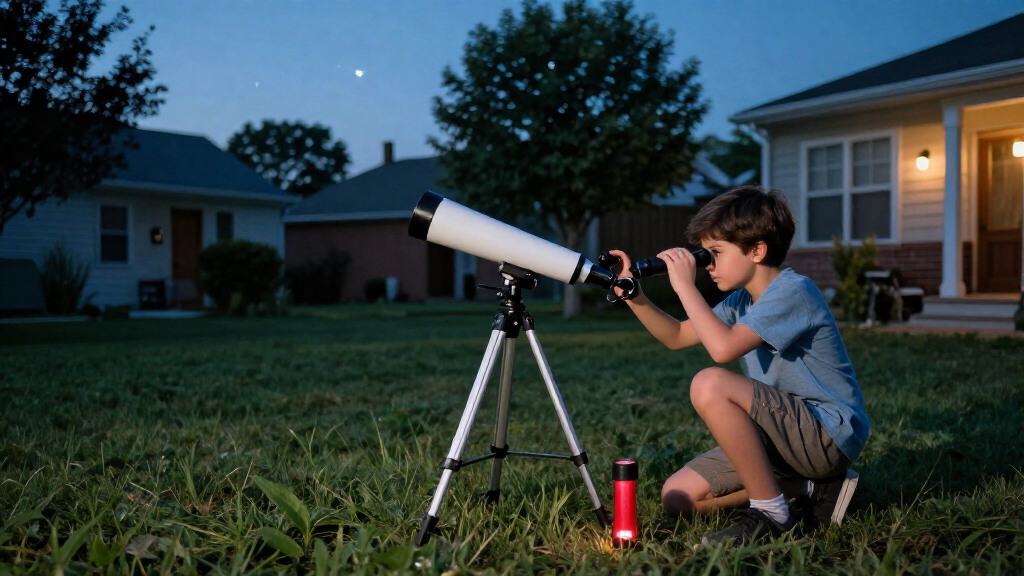

For astronomy telescopes for beginners, my best overall pick is the Celestron StarSense Explorer LT 114AZ, whose smartphone-guided sky navigation can make finding objects less frustrating. The Celestron AstroMaster 70AZ is a simpler alternative from an established telescope line, while the Celestron Travel Scope 70 suits buyers who put portability first. Across these models, the main tradeoff is between easier object finding, larger optics, and a setup that stays light and straightforward. A phone adapter can help share views, but it does not replace a stable mount or good sky conditions. Read on for the full breakdown and a guide to choosing by your observing habits.

Prime made for students and young adults
- Fast, free delivery for dorm and study essentials
- Prime Video and Amazon Music included
- Member-only deals
Key Takeaways
- Guidance separates the leading pick: The StarSense Explorer LT 114AZ stands apart from the mostly basic refractors because its smartphone-guided approach helps beginners locate celestial targets.
- Aperture alone does not decide the winner: Several 80mm and 90mm refractors collect more light than the 70mm options, but mount stability, optical quality, and ease of pointing still shape the viewing experience.
- Portability brings a real compromise: The Celestron Travel Scope 70 and the EACONN 80mm with backpack emphasize carrying convenience, while larger or longer telescopes may be less convenient to transport and set up.
- Short focal length and high magnification claims need context: The ToyerBee 70mm/300mm and the other 300mm model advertise broad magnification ranges, but extra magnification cannot add detail the aperture and conditions cannot support.
- Phone features serve different purposes: A smartphone adapter is mainly for capturing or sharing an eyepiece view; the YOTOMIGUO‘s integrated 4K camera is a different approach, but app or camera features do not guarantee easier visual observing.




| astronomy telescopes for beginner | Focal length | Aperture | Eyepieces | Included accessories |
|---|---|---|---|---|
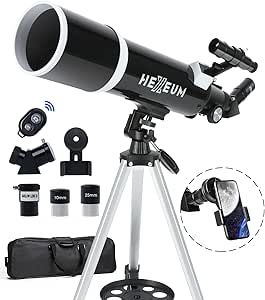
| Vvnonix 70/500 Refractor Teles | 500 mm | 70 mm | H20 mm, H12 mm, H6 mm | Moon filter, smartphone adapter, tripod, backpack |
| NASA Lunar Telescope for Kids | — | — | Low-power and high-power | — |
| Gskyer 70mm Refractor Telescop | 400 mm (f/5.7) | — | 25 mm (16×) and 10 mm (40×) | 3× Barlow lens, carry bag, smartphone adapter, wireless camera remote |
| Fuoibl 70mm Refracting Telesco | 300 mm | 70 mm | 6 mm and 20 mm | — |
| Celestron StarSense Explorer L | 1000 mm | 114 mm (4.5 inches) | 25 mm and 10 mm | — |
| EACONN 80mm Aperture | 600 mm | 80 mm | K20mm and K9mm | Adjustable tripod, smartphone adapter, backpack |
| YOTOMIGUO Smart Refractor Tele | 300 mm | 80 mm | — | — |
| 70mm Aperture 500mm Refractor | 500 mm | 70 mm | 6 mm, 12 mm, 20 mm | 3× Barlow, 1.25-inch Moon filter, smartphone adapter, travel backpack |
| Dianfan 90mm Aperture | 800 mm | — | — | Stainless steel tripod, phone adapter, carry bag, 45° zenith mirror |
| Koolpte 80mm Aperture | 600 mm | 80 mm | 25mm and 10mm Kellner | 3× Barlow, phone adapter, adjustable aluminum tripod, wireless remote, carrying bag |
| Uonol 90mm Aperture Refractor | 800 mm | 90 mm | 25 mm and 10 mm | Zenith mirror, accessory tray, carrying bag, smartphone adapter |
| ToyerBee 70mm Refractor Telesc | 300 mm | — | — | Tripod, smartphone adapter, wireless camera remote, star chart |
| Celestron Travel Scope 70 Port | 400 mm | 70 mm | 20 mm and 10 mm | Full-height tripod, finderscope, star diagonal, backpack |
| Celestron AstroMaster 70AZ 70m | 900 mm | 70 mm (2.8 in) | — | Erect image diagonal, astronomy software download |
| 70mm Aperture Refractor Telesc | 300 mm | 70 mm | — | — |
More Details on Our Top Picks
Vvnonix 70/500 Refractor Telescope with Smartphone Adapter and Tripod
The Vvnonix combines a 70 mm aperture with a 500 mm focal length, giving beginners a portable setup for lunar viewing and casual looks at brighter targets. Its included backpack, moon filter, and three eyepieces make it a more self-contained travel kit than the Fuoibl 70 mm, which includes phone accessories but no stated storage bag or moon filter. A smartphone adapter adds a way to share eyepiece views, though it does not make the telescope track objects automatically. The tradeoff is a fully manual setup: you adjust focus and aim by hand, and the product details do not state a magnification range. I’d choose it for accessory coverage and portability, not for shoppers who want clearly documented magnification or hands-free tracking.
Pros:- 70 mm aperture and multi-coated glass optics suit beginner views of the Moon and bright targets.
- Three eyepieces and two Barlow lenses offer several viewing combinations.
- Includes a moon filter, smartphone adapter, tripod, and storage backpack.
- 5×24 finder scope helps with initial aiming.
Cons:- Manual focus and manual aiming require ongoing adjustment by the user.
- The product data does not specify a magnification range, making eyepiece options harder to compare.
- A smartphone adapter supports image capture but does not provide guided alignment.
Best for: Beginners who want a portable lunar-viewing kit with a backpack, moon filter, multiple eyepieces, and a phone adapter.
Not ideal for: Buyers who need a stated magnification range or want motorized tracking and automatic focusing.
- Aperture:70 mm
- Focal length:500 mm
- Optics:Multi-coated glass
- Mount:Altazimuth
- Finder scope:5×24
- Eyepieces:H20 mm, H12 mm, H6 mm
- Included lenses:3× and 1.5× Barlow lenses
- Included accessories:Moon filter, smartphone adapter, tripod, backpack
Our verdict“Choose the Vvnonix if you want a portable, accessory-rich starter kit; pick the Gskyer instead if a stated magnification range matters more.”
NASA Lunar Telescope for Kids with Tripod and Finder Scope
This Blue Marble telescope is the most age-specific choice here: it is designed for children 8 and up and centers the experience on finding and scanning the Moon. The included learning guide, finder scope, and two power options give a young beginner a simple route from setup to lunar observation. Compared with the Celestron StarSense Explorer LT 114AZ, it has no smartphone-guided sky-finding system or larger 114 mm aperture; its appeal is a child-focused learning package rather than broader observing potential. The tabletop tripod also limits where it can be used, since a steady table or similar surface is needed. Its listed 25 mm objective is much smaller than the 70 mm apertures on the Vvnonix and Gskyer, so I’d keep expectations focused on introductory Moon viewing rather than a general-purpose astronomy setup.
Pros:- Designed for children ages 8 and up, with an educational learning guide included.
- Low- and high-power eyepieces let beginners change viewing scale.
- Finder scope supports locating the Moon before viewing through the eyepiece.
- Smooth mount is intended to help scan across the lunar surface.
Cons:- The tabletop tripod needs a stable raised surface for use.
- The 25 mm objective is substantially smaller than the 70 mm apertures on several other picks.
- The narrow listed 0.85-degree field of view gives less sky context while aiming.
Best for: Children ages 8 and up who want a guided first telescope experience centered on the Moon and a learning guide.
Not ideal for: Families seeking a full-height tripod, wider observing ambitions, or an aperture comparable to the 70 mm beginner refractors.
- Age range:8 years and up
- Objective lens diameter:25 mm
- Magnification:90×
- Eyepieces:Low-power and high-power
- Finder scope:Straight-through
- Mount:Equatorial
- Field of view:0.85 degrees
- Included items:Tabletop tripod, two eyepieces, lens dust cap, educational learning guide
Our verdict“This is the child-focused pick for introductory Moon viewing, while adults or families wanting broader capability should look at the Vvnonix or Celestron StarSense.”
Gskyer 70mm Refractor Telescope with Tripod, Carry Bag, Phone Adapter, and Wireless Remote
The Gskyer is a straightforward portable refractor for beginners who want to observe and occasionally capture a phone image. Its 70 mm aperture, two eyepieces, 3× Barlow lens, and stated magnifications make its viewing options easier to compare than the Vvnonix, whose magnification range is not listed. The erecting BAK4 prism also supports terrestrial viewing, while the adjustable tripod and carry bag suit outings away from home. The phone adapter and wireless remote can help reduce shake when taking a picture, but they do not replace a guided alignment app like the one included with the Celestron StarSense Explorer LT 114AZ. Manual focus and hand-guided tracking remain part of the experience, so this fits casual observing better than users seeking automated object finding or long-exposure astrophotography.
Pros:- 70 mm aperture and fully coated optics provide a practical entry point for bright celestial targets.
- Two eyepieces and a 3× Barlow lens give a stated range of magnification options.
- Erecting BAK4 prism supports terrestrial viewing as well as astronomy.
- Carry bag, adjustable tripod, phone adapter, and wireless remote suit portable use.
Cons:- Manual focus and altazimuth aiming require the user to keep adjusting the telescope.
- A smartphone remote helps with capture but does not guide users to celestial objects.
- The product warns against aiming at or near the Sun, requiring careful handling.
Best for: Beginners who want a portable 70 mm refractor for Moon and landscape viewing, with basic phone photography accessories.
Not ideal for: Buyers who want app-guided object locating, automatic tracking, or a telescope designed for long-exposure astrophotography.
- Type:Refractor
- Objective lens:70 mm
- Focal length:400 mm (f/5.7)
- Eyepieces:25 mm (16×) and 10 mm (40×)
- Maximum magnification:120×
- Finderscope:5×24 with crosshair lines
- Mount:Altazimuth
- Included accessories:3× Barlow lens, carry bag, smartphone adapter, wireless camera remote
Our verdict“Choose the Gskyer for a portable refractor with clearly stated eyepiece magnifications and phone accessories, rather than the more app-guided Celestron StarSense.”
Fuoibl 70mm Refracting Telescope with Phone Adapter
The Fuoibl pairs a 70 mm aperture with a short 300 mm focal length and a listed 15×–150× magnification range, making its intended viewing options clear for a first-time buyer. Its phone holder and wireless remote add a simple way to capture or share a view, while the tripod adjusts up to 45 inches. Compared with the Gskyer, it has a shorter focal length and a stated higher maximum magnification, but the Gskyer supplies an erecting prism and a carry bag. The Fuoibl’s 5×24 finderscope shows an inverted image, which can make aiming less intuitive for someone learning the sky. Manual focus is another hands-on step, and the magnification figures should not be mistaken for a guarantee of sharp detail at every setting.
Pros:- 70 mm aperture and fully multi-coated optics suit bright lunar and terrestrial viewing.
- Two eyepieces and a 3× Barlow lens provide multiple magnification combinations.
- Tripod height adjusts up to 45 inches for standing use.
- Phone holder and wireless remote support simple image capture.
Cons:- The finderscope displays an inverted image, which can complicate aiming for beginners.
- Manual focus and manual altazimuth movement require hands-on adjustment.
- No carry bag is listed among the included accessories.
Best for: New observers who want a short, portable 70 mm refractor with stated magnification options and phone-photo accessories.
Not ideal for: Beginners who prefer an upright finder view or want a storage bag and a more fully specified optical setup.
- Aperture:70 mm
- Focal length:300 mm
- Magnification:15×–150×
- Eyepieces:6 mm and 20 mm
- Barlow lens:3×
- Optics:Fully multi-coated
- Mount and focus:Altazimuth mount; manual focus
- Tripod height:Adjustable up to 45 inches
Our verdict“Pick the Fuoibl for its stated magnification range and phone accessories, but choose the Gskyer if an upright terrestrial view and carry bag matter more.”
Celestron StarSense Explorer LT 114AZ Newtonian Smartphone Guided Telescope
The Celestron StarSense Explorer LT 114AZ earns the strongest beginner fit in this group because its 114 mm Newtonian aperture is paired with smartphone-guided object finding. The app’s on-screen arrows address a common first-telescope hurdle: knowing where to point. Compared with the 70 mm refractors from Gskyer and Vvnonix, its larger aperture is better suited to gathering light, while its 1000 mm focal length and included 25 mm and 10 mm eyepieces serve a different, less travel-focused setup. The altazimuth mount has a slow-motion altitude adjustment, but it is still manual: there is no motorized tracking, and users need a compatible modern smartphone for the guided system. This is the most capable learning platform here, though it is not the pick for hands-free tracking or long-exposure astrophotography.
Pros:- 114 mm Newtonian aperture offers more light-gathering capacity than the 70 mm refractors in this batch.
- Smartphone app provides on-screen guidance to stars, planets, and deep-sky objects.
- Slow-motion altitude adjustment supports controlled manual movement.
- Includes 25 mm and 10 mm eyepieces, red-dot finder, tripod, and dedicated phone dock.
Cons:- Guided alignment depends on having a compatible modern smartphone.
- Manual focus and manual tracking require continued user input.
- Altazimuth tracking limits suitability for long-exposure astrophotography.
Best for: Beginners who want app-guided help locating celestial targets and a larger-aperture telescope for broader observing than a small refractor offers.
Not ideal for: Travel-first buyers, users without a compatible modern smartphone, or anyone seeking motorized tracking and long-exposure astrophotography.
- Optical design:Newtonian reflector
- Aperture:114 mm (4.5 inches)
- Focal length:1000 mm
- Mount:Altazimuth with slow-motion altitude adjustment
- Eyepieces:25 mm and 10 mm
- Finderscope:Red-dot reflex finder
- Field of view:2.04 degrees
- Coating:Aluminum and SiO₂-coated glass mirrors
Our verdict“Choose the Celestron if guided object finding and a larger aperture matter more than portability or automated tracking.”
EACONN 80mm Aperture, 600mm Refractor Telescope with Backpack
The EACONN pairs an 80mm aperture with a 600mm focal length, giving beginners a useful middle ground for lunar viewing and daytime targets. Its included backpack makes it easier to carry than the longer Dianfan 90mm, while the larger aperture and included K20mm and K9mm eyepieces offer a step up from smaller 70mm kits such as the 70mm Aperture 500mm Refractor. The smartphone adapter adds a simple route to taking viewing-session photos, though it does not turn the telescope into a dedicated imaging system.
The tradeoff is the manual altazimuth mount: rough positioning can make it harder to keep an object centered, especially at higher magnification. I’d choose it for portability and mixed daytime-nighttime use, not for the steadiest high-power viewing. Its 30x–66x range is more modest than the Dianfan’s stated range, but that can make the basic setup less fussy for a beginner.
Pros:- 80mm aperture and fully multi-coated optics suit brighter lunar and daytime views.
- Two eyepieces and a 5×24 finder provide a straightforward starting set.
- Smartphone adapter supports casual phone photography.
- Backpack helps keep the telescope and accessories together for transport.
Cons:- Manual focus and rough mount adjustments take practice to position and hold targets.
- Listed 30x–66x magnification is narrower than the Dianfan 90mm’s stated range.
Best for: Beginners and families who want one portable telescope for Moon viewing, casual daytime observations, and occasional smartphone photos.
Not ideal for: Buyers focused on high-magnification planetary viewing or a stable mount, since its manual positioning is described as rough and its listed magnification tops out at 66x.
- Aperture:80 mm
- Focal length:600 mm
- Eyepieces:K20mm and K9mm
- Magnification:30x–66x
- Finderscope:5×24 with crosshair
- Mount and focus:Manual altazimuth
- Optics coating:Fully multi-coated
- Included accessories:Adjustable tripod, smartphone adapter, backpack
Our verdict“Choose the EACONN if portability and all-purpose beginner viewing matter more to you than a steadier mount or higher listed magnification.”
YOTOMIGUO Smart Refractor Telescope with 4K Camera
The YOTOMIGUO takes a different route from the manual refractors in this group: its foldable 3-inch screen and one-touch 4K capture make viewing and recording the central experience. That can suit families who would rather look at a shared display than take turns at an eyepiece, and the included 64 GB card means storage is ready from the start. Compared with the Koolpte 80mm, which relies on eyepieces and a phone adapter, this model is more self-contained for recording.
Its 80mm aperture is paired with a 300mm focal length, shorter than the 600mm EACONN and Koolpte. The key tradeoff is not just optics: the description does not confirm that a tripod or mount is included, so buyers may need to plan for support separately. I would not choose it as the simplest conventional telescope kit until that point is clarified. The stated 350X maximum magnification also should not be treated as a promise of useful detail.
Pros:- Foldable 3-inch display allows direct screen viewing without an external device.
- One-touch 4K photo and video capture makes recording straightforward.
- Includes a 64 GB memory card and supports external storage up to 512 GB.
- Adjustable diopter and built-in sunshade support more comfortable viewing.
Cons:- Tripod or mount inclusion is not specified, leaving a key setup question unanswered.
- Its 300mm focal length is shorter than the 600mm EACONN and Koolpte models.
- The listed 350X maximum does not by itself indicate how much useful detail the telescope can show.
Best for: Families and beginner observers who prioritize viewing on a built-in screen and saving photos or videos without relying on a separate phone.
Not ideal for: First-time buyers seeking a complete conventional telescope setup, because the listing does not specify whether a tripod or mount is included.
- Telescope type:Refractor
- Aperture:80 mm
- Focal length:300 mm
- Display:Foldable 3-inch screen
- Camera:4K photo and video
- Focus:Autofocus
- Storage:64 GB card included; supports up to 512 GB external storage
- Maximum magnification:350X (as stated)
Our verdict“Pick the YOTOMIGUO if a built-in display and easy recording matter most, but verify support equipment before buying.”
70mm Aperture 500mm Refractor Telescope for Adults and Astronomy Beginners
This 70mm refractor earns its place through a broad starter bundle: three eyepieces, a 3× Barlow, a Moon filter, and a 5×24 finderscope. That gives a beginner several ways to adjust the view without immediately shopping for extras. The adjustable 16–51-inch tripod and backpack also make it easier to share between seated and standing observers than a fixed-height setup. Compared with the EACONN 80mm, it offers more included viewing accessories, but its smaller aperture gathers less light.
The stated 20x–200x range comes from the eyepieces and Barlow, not a guarantee that the highest setting will deliver a sharp, steady image. Its manual altazimuth mount may be harder to hold steady at higher magnifications, and the 70mm aperture is a limiting factor for faint deep-sky targets. I’d treat it as a portable Moon-and-planet starter kit, rather than a route to detailed views of dim objects.
Pros:- Three eyepieces and a 3× Barlow provide multiple magnification combinations.
- Included Moon filter is useful for reducing lunar brightness.
- Tripod adjusts from 16 to 51 inches to suit different viewing positions.
- Backpack and smartphone adapter support transport and casual imaging.
Cons:- 70mm aperture gathers less light than the 80mm EACONN and 90mm Dianfan.
- Manual altazimuth adjustments may be unsteady at higher magnifications.
- The advertised 200x upper range should not be mistaken for reliably sharp views.
Best for: Beginners or families who want a portable kit with several eyepiece options, a Moon filter, and a tripod that adjusts across a wide height range.
Not ideal for: Observers who want to prioritize faint deep-sky objects or expect stable, detailed views at the top of the advertised magnification range.
- Aperture:70 mm
- Focal length:500 mm
- Eyepieces:6 mm, 12 mm, 20 mm
- Magnification range:20x–200x with eyepieces and 3× Barlow
- Finderscope:5×24
- Mount and focus:Manual altazimuth
- Tripod height:16–51 in (40–130 cm)
- Included accessories:3× Barlow, 1.25-inch Moon filter, smartphone adapter, travel backpack
Our verdict“Choose this kit for its plentiful starter accessories and adjustable tripod, not for faint-object performance or high-power steadiness.”
Dianfan 90mm Aperture, 800mm Refractor Telescope with Tripod, Phone Adapter, and Carry Bag
The Dianfan stands out here for its 90mm objective and 800mm focal length, the largest aperture and longest focal length among these five products. Its greater light-gathering aperture gives it an advantage over the 70mm starter kit for brighter views, while the longer focal length pairs well with its eyepieces and 3× Barlow for closer-looking targets. The included 45° zenith mirror also makes upright terrestrial viewing more practical than on a night-sky-focused setup.
That capability brings a more substantial package: at 4.7 kg, it is heavier than the 7 lb EACONN, and its 80cm tube is less compact to carry. It also asks beginners to handle manual focus and roughly 15 minutes of assembly. The stated 32×–240× range offers flexibility, but the manual altazimuth mount can make the upper end challenging to manage. I’d favor it over the Koolpte when aperture is the priority, while accepting the extra setup and carrying effort.
Pros:- 90mm objective is larger than the apertures on the other four products in this batch.
- 800mm focal length and included eyepieces with 3× Barlow offer a broad stated magnification range.
- 45° zenith mirror provides upright views for terrestrial observations.
- Stainless steel tripod, phone adapter, and carry bag are included.
Cons:- At 4.7 kg with an 80cm tube, it is less convenient to carry than the EACONN.
- Manual focus and roughly 15-minute assembly add setup work for beginners.
- Manual altazimuth positioning can be difficult to keep steady at the upper stated magnifications.
Best for: Beginners who want a larger-aperture refractor for the Moon, planets, and daytime viewing, and are comfortable assembling and carrying a longer telescope.
Not ideal for: Travelers seeking a light, compact kit or beginners who want minimal setup and easy tracking at higher magnifications.
- Optical design:Refractor
- Objective diameter:90 mm
- Focal length:800 mm
- Magnification:32×–240×
- Eyepiece type:Kellner
- Mount and focus:Manual altazimuth
- Weight:4.7 kg
- Included accessories:Stainless steel tripod, phone adapter, carry bag, 45° zenith mirror
Our verdict“Choose the Dianfan if a larger aperture and terrestrial viewing matter more to you than compact carrying and quick setup.”
Koolpte 80mm Aperture, 600mm AZ Refractor Telescope
The Koolpte is a practical choice for beginners who want a familiar manual refractor without a complicated setup. Its tool-free assembly, 80mm aperture, and 600mm focal length put it in similar territory to the EACONN, while the Koolpte adds a 3× Barlow and wireless remote. The remote can help reduce phone movement when taking pictures through the included adapter, and the carrying bag gives the kit a portable home between observing sessions.
Its two Kellner eyepieces provide 24x and 60x, with higher stated settings available using the Barlow. As with the 70mm Aperture 500mm model, a bigger advertised maximum does not promise a steady or detailed image; this telescope still uses a manual altazimuth mount and manual focus. The aluminum tripod is adjustable, but the supplied information gives no stability details. I’d favor the Koolpte over the EACONN for the remote and Barlow, while choosing the EACONN if a backpack and simpler stated magnification range appeal more.
Pros:- Tool-free setup reduces assembly steps for beginners.
- 80mm aperture, fully multi-coated optics, and 600mm focal length suit general beginner viewing.
- Two eyepieces and a 3× Barlow provide several stated magnification options.
- Phone adapter and wireless remote support casual smartphone photography.
Cons:- Manual focus and altazimuth positioning require hands-on adjustments.
- The aluminum tripod’s stability is not specified, which matters at higher magnifications.
- The remote and Barlow add flexibility but do not provide automatic tracking.
Best for: First-time observers who want quick setup, an 80mm refractor, and a phone adapter with remote control for casual imaging.
Not ideal for: Buyers seeking automatic tracking, a powered focus system, or a documented heavy-duty tripod for high-magnification viewing.
- Telescope type:Refractor
- Aperture:80 mm
- Focal length:600 mm
- Focal ratio:f/6.7
- Eyepieces:25mm and 10mm Kellner
- Magnification:24x and 60x; up to 72x and 180x with 3× Barlow
- Mount and focus:Manual altazimuth
- Included accessories:3× Barlow, phone adapter, adjustable aluminum tripod, wireless remote, carrying bag
Our verdict“Pick the Koolpte if quick setup and remote-assisted phone photos matter more than automatic tracking or a verified stable mount.”
Uonol 90mm Aperture Refractor Telescope, 800mm Focal Length
The 90mm aperture gives this Uonol more light-gathering capacity than the 70mm refractors in this group, including the Celestron AstroMaster 70AZ. That makes it the stronger fit for beginners who want to explore the Moon, planets, and brighter deep-sky targets rather than focus mainly on portability. Its 800mm focal length and included eyepieces offer a useful range, though the advertised upper magnification depends on viewing conditions and should not be treated as a routine setting. The altazimuth mount keeps pointing straightforward, but it requires hand adjustments to follow objects as they move. The tripod’s 19.7–43.3-inch height range may also feel short for some adults. I’d choose it over the smaller-aperture options for brighter views, but not for hassle-free tracking or a particularly tall setup.
Pros:- 90mm aperture collects more light than the 70mm models in this group.
- Two eyepieces and a 3x Barlow provide several magnification combinations.
- Fully multi-coated optics help limit reflections.
- Includes a smartphone adapter and carrying bag.
Cons:- The tripod height tops out at 43.3 inches, which may be low for standing observers.
- The manual altazimuth mount requires frequent repositioning to track celestial objects.
Best for: Beginners who prioritize a larger aperture for Moon and planet viewing and are comfortable pointing a telescope manually.
Not ideal for: Adults who need a tall observing position or beginners seeking motorized tracking and minimal manual adjustment.
- Telescope type:Refractor
- Aperture:90 mm
- Focal length:800 mm
- Stated magnification range:32x–240x
- Eyepieces:25 mm and 10 mm
- Barlow lens:3x
- Finderscope:5×24
- Mount and tripod height:Altazimuth; 19.7–43.3 in
- Included accessories:Zenith mirror, accessory tray, carrying bag, smartphone adapter
Our verdict“Choose the Uonol if a larger aperture matters more to you than a taller tripod or automatic tracking.”
ToyerBee 70mm Refractor Telescope, 300mm Focal Length, 15x–150x Magnification
The ToyerBee’s 300mm focal length and 70mm aperture make it a flexible starter for daytime subjects and broad views of the night sky. Its short focal length gives it a different feel from the Celestron AstroMaster 70AZ, whose 900mm focal length is better suited to narrower views at higher magnification. ToyerBee includes two eyepieces, a Barlow, a star chart, and a wireless camera remote, so a first-time owner gets several ways to explore and take phone photos. The stated 15x–150x range is broad, but the upper end may not provide clear views in ordinary conditions; magnification alone does not guarantee useful detail. Manual focusing and a tripod described as less convenient to transport temper its beginner-friendly setup. I’d favor it for mixed daytime and casual astronomy, not as a dedicated high-magnification planetary scope.
Pros:- Short 300mm focal length suits wide-field and daytime viewing.
- Fully multi-coated optics are specified for celestial and terrestrial use.
- Includes a 5×24 finderscope, star chart, and wireless camera remote.
- Two eyepieces and a 3x Barlow offer multiple magnification combinations.
Cons:- Manual focusing requires hands-on adjustment while viewing.
- The included tripod may be less convenient to transport than the telescope.
- The advertised 150x maximum may not yield useful detail under typical viewing conditions.
Best for: First-time observers who want one short-focal-length telescope for wildlife, daytime viewing, and casual looks at the Moon.
Not ideal for: Beginners whose main goal is higher-magnification planetary observing or who want a particularly easy-to-carry tripod.
- Model:HT001
- Telescope type:Refractor
- Objective lens diameter:70 mm
- Focal length:300 mm
- Stated magnification range:15x–150x
- Eyepieces and Barlow lens:20 mm and 6 mm eyepieces; 3x Barlow
- Finderscope and focus:5×24; manual focus
- Weight:3.5 lb
- Included accessories:Tripod, smartphone adapter, wireless camera remote, star chart
Our verdict“Pick the ToyerBee for a beginner-friendly mix of daytime viewing and casual stargazing, rather than specialized planetary observation.”
Celestron Travel Scope 70 Portable Refractor Telescope with Backpack
The Travel Scope 70 earns its place through portability and tool-free setup, not a larger aperture or elaborate magnification kit. Its included backpack makes it easier to store and carry than the Celestron AstroMaster 70AZ, which is a better match for a more settled observing spot and a longer 900mm focal length. With a 70mm aperture and 400mm focal length, this model can serve for beginner stargazing and daytime viewing, while its two eyepieces let owners try different views without adding accessories. The tradeoff is a manual altazimuth setup: you point and refocus by hand, and there is no motorized tracking. Its beginner-oriented design also leaves less room for advanced observing than a larger-aperture option such as the Uonol 90mm. I’d choose this Celestron when easy transport matters more than collecting light or pursuing fine detail.
Pros:- Backpack supports storage and transport.
- Tool-free setup lowers the effort required to get started.
- Includes two eyepieces, a finderscope, and a star diagonal.
- Suitable for both beginner stargazing and daytime viewing.
Cons:- Manual focusing and pointing require ongoing hands-on adjustments.
- Its 70mm aperture gathers less light than the Uonol 90mm.
- Beginner-focused design may not satisfy observers seeking more advanced capabilities.
Best for: Beginners who want a grab-and-go telescope for trips, camping, or occasional daytime and night-sky viewing.
Not ideal for: Observers prioritizing greater light gathering, advanced observing, or hands-free tracking.
- Telescope type:Refractor
- Aperture:70 mm
- Focal length:400 mm
- Mount:Altazimuth
- Focus:Manual
- Eyepieces:20 mm and 10 mm
- Field of view:1.43 degrees
- Included accessories:Full-height tripod, finderscope, star diagonal, backpack
- Setup and warranty:No tools required; 2-year US warranty
Our verdict“Choose the Travel Scope 70 if a backpackable, quick-to-set-up telescope matters more than a larger aperture or advanced observing.”
Celestron AstroMaster 70AZ 70mm Refractor Telescope
The AstroMaster 70AZ takes a more focused approach than the portable Celestron Travel Scope 70: its 900mm focal length and included 45x and 90x eyepiece views suit beginners who want to point at the Moon, planets, and star clusters from a regular observing spot. A manual altazimuth mount with panhandle control keeps basic pointing direct, while the red dot StarPointer helps aim at targets. Unlike the ToyerBee 70mm, it does not include a Barlow lens or phone camera remote, so the accessory setup is less geared toward experimenting with magnification or photography. That simplicity is a plus for a buyer who wants a defined starting setup, but a limitation for someone seeking a broad accessory bundle. Its 10.8-pound assembled weight and manual tracking also make it less appealing for frequent transport or effortless following of moving targets.
Pros:- 900mm focal length provides a longer-viewing setup than the Travel Scope 70.
- Panhandle-controlled altazimuth mount keeps manual pointing straightforward.
- Includes a red dot finder, two eyepieces, and an erect image diagonal.
- Full-height adjustable tripod suits a stationary observing setup.
Cons:- Manual pointing and tracking require frequent adjustments.
- The listed 45x and 90x magnifications are limited to the included eyepieces.
- At 10.8 lb assembled, it is less convenient to carry than the Travel Scope 70.
Best for: Beginners with a regular observing spot who want a simple manual telescope for the Moon, planets, and star clusters.
Not ideal for: Travel-focused buyers or beginners who want a broad magnification kit, phone photography accessories, or automatic tracking.
- Optical design:Achromatic refractor
- Aperture:70 mm (2.8 in)
- Focal length:900 mm
- Mount:Manual altazimuth with panhandle control
- Eyepieces and magnification:20 mm and 10 mm; 45x and 90x
- Finderscope:StarPointer red dot
- Tripod:Adjustable, full-height
- Assembled weight:10.8 lb (4.9 kg)
- Included accessories:Erect image diagonal, astronomy software download
Our verdict“Choose the AstroMaster 70AZ for a simple, longer-focal-length starter setup at home, not for travel or accessory-rich phone photography.”
70mm Aperture Refractor Telescope for Kids and Adults – 15x-150x Zoom, FMC Optics, 300mm Focal Length, Phone Adapter Included
This 70mm refractor is aimed at families who want to pair beginner observing with phone-based photo capture. The included phone adapter and wireless remote give it a more photography-ready package than the Celestron AstroMaster 70AZ, which instead emphasizes a longer 900mm focal length and a simple manual pointing setup. Its 300mm focal length and 15x–150x stated range suit wide views and general daytime use, while the included eyepieces and Barlow offer several combinations. The headline maximum magnification should be treated as a limit, not a promise of sharp views in every condition. A manual mount means the user must keep aiming and tracking by hand, and the inverted finder image may confuse a first-time observer. I’d put this ahead of the AstroMaster for phone-assisted family sessions, but behind it for buyers seeking a longer-focal-length beginner setup.
Pros:- Includes a phone adapter and wireless remote for smartphone photo attempts.
- Fully multi-coated 70mm objective is specified for bright, high-contrast views.
- Tool-free assembly and included tripod support a simple start.
- Multiple eyepiece and Barlow combinations provide a range of viewing options.
Cons:- The finder scope’s inverted image may be confusing for beginners.
- Manual operation means the user must point and track targets by hand.
- The stated 150x maximum may be difficult to use when atmospheric conditions are poor.
Best for: Families and first-time observers who want a 70mm telescope with a phone adapter and remote for casual viewing and photo attempts.
Not ideal for: Beginners who want motorized tracking, an intuitive finder image, or a telescope primarily for higher-magnification planetary viewing.
- Telescope type:Refractor
- Aperture:70 mm
- Focal length:300 mm
- Stated magnification range:15x–150x
- Eyepieces and lenses:20 mm and 6 mm eyepieces; 1.5x erecting lens; 3x Barlow
- Finderscope:5×24, inverted image
- Focus and tripod:Manual focus; tripod included
- Phone accessories:Phone adapter and wireless remote
- Dimensions:11.8 × 21 × 3.5 in
Our verdict“Choose this model for casual family viewing with phone-photo accessories, but skip it if you want tracking or a finder that is easier to interpret.”

How We Picked
I compared these 15 telescopes through the needs of a first-time visual observer: how approachable the setup appears, how much useful aperture the design offers, whether the mount and included accessories support steady viewing, and how easy the telescope is to carry and store. I also separated features that help locate objects from features that mainly help record or share a view. Product names and listed specifications provide useful clues, but claims such as maximum magnification do not by themselves establish what a telescope can show.
The ranking favors options that reduce early friction while retaining room to learn, which puts the smartphone-guided StarSense Explorer LT 114AZ at the top. Models with familiar, straightforward refractor layouts and practical portability follow, while choices with less distinctive guidance, broad magnification claims, or unclear positioning rank lower for a general beginner audience. That does not make the lower-ranked telescopes unsuitable: a lightweight travel scope, a child-oriented package, or a camera-forward design can be a better match for a specific household than the overall pick.
Factors to Consider When Choosing Astronomy Telescopes For Beginners
Before choosing from these models, match the telescope to where and how you expect to observe. A beginner’s first months often involve learning to point, focus, steady the view, and recognize bright targets—not chasing the largest magnification number. These broader factors can help you avoid a setup that looks capable on paper but does not suit your routine.
Choose Aperture for the Targets You Want
Aperture is the diameter of the telescope’s main lens or mirror, and it affects how much light the instrument gathers. A larger aperture can help reveal dimmer objects and more detail, but the benefit depends on optical quality, a steady mount, and a reasonably dark sky. For a first telescope aimed at the Moon and bright planets, a modest aperture can still be satisfying. If deep-sky objects are a priority, be realistic: light pollution can limit what any beginner instrument reveals. Do not choose by aperture alone; think about whether you can store, carry, and set up the complete telescope with ease.
Treat Magnification as a Result, Not a Promise
Magnification comes from the telescope’s focal length and the eyepiece, so it is not a fixed measure of image quality. Very high power can make a target look larger while also making it dimmer, softer, and harder to keep centered. Atmospheric turbulence often limits useful magnification before a telescope reaches the largest figure printed in a listing. Beginners are usually better served by clear low- and medium-power views than by a package centered on a dramatic maximum number. Check which eyepieces are included and whether the mount can hold a focused image steady.
Prioritize the Mount and Controls
The mount determines how smoothly you can aim and whether the view stays still after you touch a control. A lightweight tripod may make transport easier, but it can shake in a breeze or during focusing. Simple alt-azimuth mounts move up, down, left, and right, which many beginners find intuitive; the tradeoff is that tracking objects across the sky requires small manual adjustments. Before buying, check whether the mount has slow-motion controls and whether its legs can be set firmly on the surfaces where you plan to observe. A steadier, simpler setup often teaches more than a larger telescope on a frustrating mount.
Plan for Light Pollution and Storage
Your observing location affects both what you can see and which telescope will get used. Bright suburbs still offer the Moon, planets, and some prominent star clusters, while many faint galaxies and nebulae are harder to see under light-polluted skies. If you need to travel to darker locations, weigh the packed size and carrying case against aperture and setup time. A backpack can make transport more practical, but it does not make the tripod or telescope immune to bumps or moisture. Also consider where the optical tube will live at home; a scope that is awkward to store can become an occasional-use purchase.
Separate Finding Help From Phone Photography
Smartphone-guided systems and phone adapters solve different problems. Guidance can help you identify where to point, which is useful when unfamiliar star patterns make manual searching difficult. An adapter holds a phone over the eyepiece to record or share a view, but alignment can take patience and the result may differ from what your eye sees. A built-in camera adds another layer of electronics and software, so check whether it matches your goal of visual observing or imaging. If learning the night sky is the main aim, prioritize dependable pointing and a comfortable eyepiece view before camera features.
Budget for the Whole Setup, Not Just the Tube
A telescope is only part of a usable observing kit. You may later want a red flashlight, a planisphere or sky app, extra eyepieces, or a more stable support, so leave room for small additions rather than focusing every decision on the optical tube. Avoid buying a large bundle of accessories before you know what you actually use. For a child or shared household, simple controls and a manageable setup can matter more than a long accessory list. Paying more makes sense when it improves a lasting need—such as easier target finding, better portability, or a steadier mount—not merely a bigger advertised magnification figure.
Frequently Asked Questions
Is the StarSense Explorer LT 114AZ a better first telescope than a 90mm refractor?
It depends on whether finding targets or choosing a straightforward refractor matters more to you. The StarSense Explorer’s smartphone-guided approach can reduce the guesswork of locating objects, while a 90mm refractor may appeal if you prefer a lens-based design and want a longer focal length. Neither feature guarantees a steadier view, so the mount and setup remain part of the decision. Think about what would be more likely to stop you from observing: not knowing where to point, or managing a larger setup. For many first-time users, guidance is a meaningful advantage; for others, a familiar refractor layout is the better fit.
Will a 70mm telescope show planets clearly from a city?
A 70mm telescope can show the Moon’s major features and bright planets, though the view will not resemble a detailed photograph. City light pollution affects faint deep-sky targets more than bright objects such as the Moon and planets. Atmospheric steadiness, focus, and a stable mount can matter as much as the telescope’s nominal magnification. Start with low power to find and center the target, then increase magnification only while the image remains sharp. If your main goal is faint galaxies or nebulae, consider your sky conditions and expectations before choosing a small beginner refractor.
Should I choose a telescope with a phone adapter or an integrated camera?
Choose based on whether your priority is visual observing, casual sharing, or dedicated image capture. A phone adapter lets you place your own phone at the eyepiece, but aligning the camera and keeping the image steady may take practice. An integrated camera, such as the feature listed for the YOTOMIGUO, can offer a different capture workflow, though you should check what display, app, and storage setup it requires. Neither feature improves the telescope’s optical performance by itself. If you are new to astronomy, make sure the telescope is easy to aim and focus before treating imaging features as a deciding factor.
Are the 300mm focal-length telescopes a good choice for a beginner?
They can suit someone who wants a compact, simple scope for bright targets, but their short focal length creates a wider view and changes the eyepieces needed for a given magnification. A listed range such as 15x–150x is not a guarantee that the top end will produce a sharp, usable image. At high power, a small aperture and a lightweight mount can make focusing and tracking harder. Compare the included eyepieces and mount stability, not just the largest magnification claim. If you mainly want close planetary views, a longer focal-length option may be a more natural match.
When is a portable telescope a better choice than a larger-aperture model?
Portability can win if you need to carry the telescope to a park, campsite, or darker sky site, or if storage space at home is limited. A scope that is easy to take outside may get used more often than a larger one that is cumbersome to move. The tradeoff is that a smaller instrument gathers less light, which limits faint-object viewing. Consider the full packed setup, including tripod and accessories, rather than the optical tube alone. If most observing will happen from home and you have space for stable equipment, a larger aperture may better match your goals.
Conclusion
My best overall choice is the Celestron StarSense Explorer LT 114AZ for beginners who value help locating targets. For a best value pick, I would start by comparing the basic 70mm refractors—especially the Celestron AstroMaster 70AZ—against the accessories and setup you will actually use, rather than paying for a long feature list. The best premium direction in this lineup is the YOTOMIGUO if an integrated camera workflow is a priority, though it is not the automatic choice for visual astronomy. For the best beginner-friendly straightforward option, the AstroMaster 70AZ keeps the decision focused on a familiar refractor setup. For travel-focused needs, consider the Celestron Travel Scope 70 or EACONN 80mm with backpack; for a child-oriented package, the NASA Lunar Telescope is the most directly framed for that audience. Match the telescope to your usual observing location and patience for setup, and the right pick becomes clearer than any single specification.