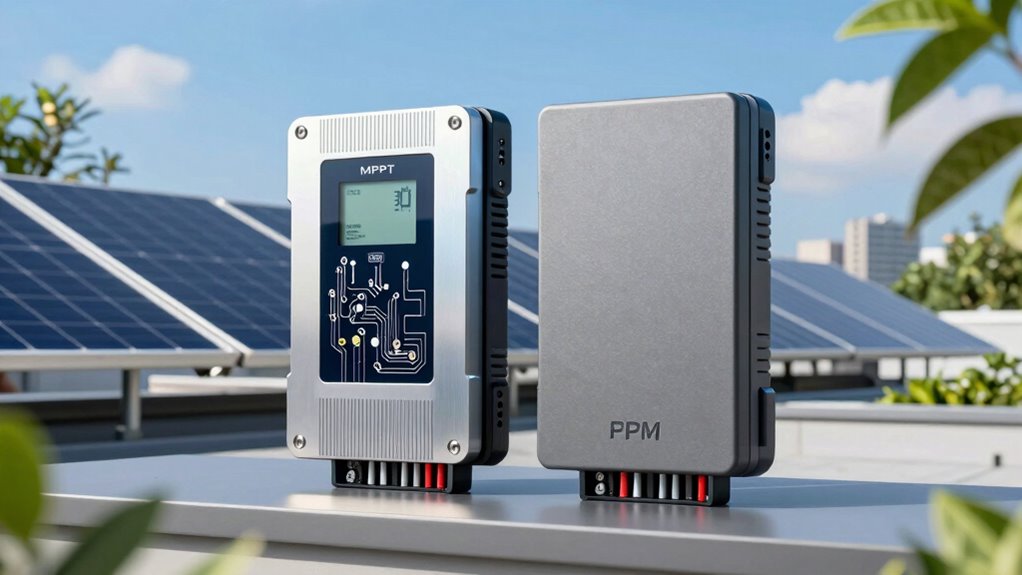

Choosing between MPPT and PWM solar controllers can transform your system’s efficiency and longevity. MPPT controllers optimize energy harvest by adjusting voltage and current, especially in variable sunlight, and are best for larger or complex setups. PWM controllers are simpler and more budget-friendly, ideal for small, straightforward systems. To maximize your investment and performance, understanding how each works and where they excel is key—discover more to make the right choice for your needs.
Key Takeaways
- MPPT controllers offer higher efficiency (up to 98%) and better energy harvesting, especially in variable sunlight and larger systems.
- PWM controllers are more affordable, simpler, and suitable for small, low-voltage setups with fixed voltage regulation.
- MPPT adjusts voltage and current dynamically, maximizing power output, whereas PWM connects panels directly to batteries at a fixed voltage.
- Long-term savings from increased energy efficiency and battery health often justify MPPT’s higher initial cost.
- Choosing the right controller depends on system size, panel voltage, environmental conditions, and budget considerations.
MPPT solar charge controller
As an affiliate, we earn on qualifying purchases.
As an affiliate, we earn on qualifying purchases.
Understanding MPPT and PWM Solar Controllers: Which Is Right for You?
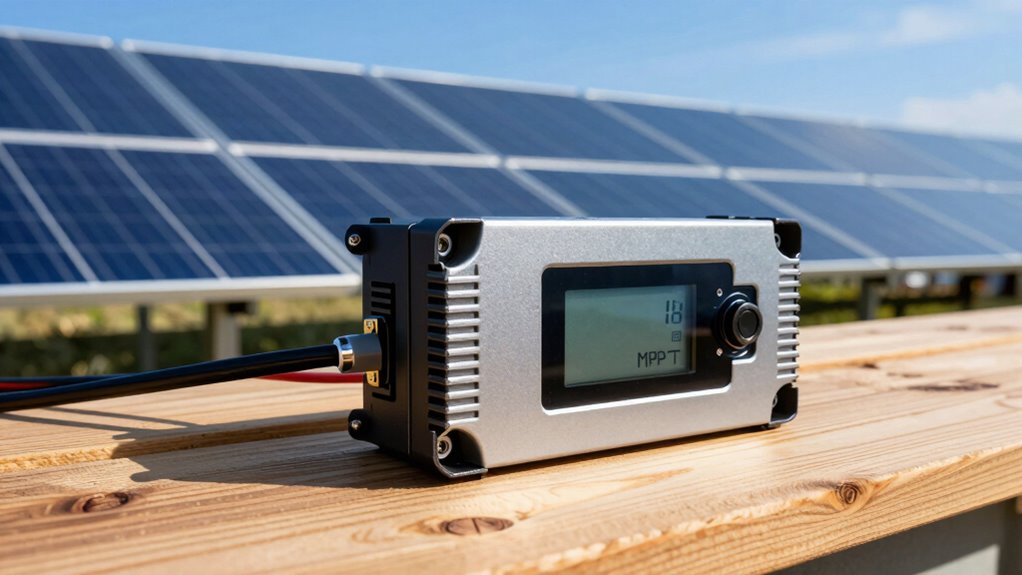
Choosing the right solar controller depends on understanding the differences between MPPT and PWM technologies. MPPT controllers optimize energy transfer from your solar panels to your battery storage, especially when paired with a solar inverter, by adjusting to the best voltage and current. This solar technology can significantly increase your system’s efficiency, particularly in areas with variable sunlight. MPPT controllers are especially beneficial in variable sunlight conditions, where they can extract maximum power from the panels. This makes them more efficient in varying sunlight conditions and better suited for larger systems. PWM controllers, on the other hand, connect panels directly to batteries, which simplifies the system but can waste energy if panel voltage doesn’t match battery voltage closely. If you’re aiming for maximum efficiency and have a larger or more complex setup, an MPPT controller is often the better choice. However, for smaller systems or tighter budgets, PWM controllers still provide reliable performance.
PWM solar charge controller
As an affiliate, we earn on qualifying purchases.
As an affiliate, we earn on qualifying purchases.
How Do MPPT and PWM Solar Controllers Charge Batteries Differently?
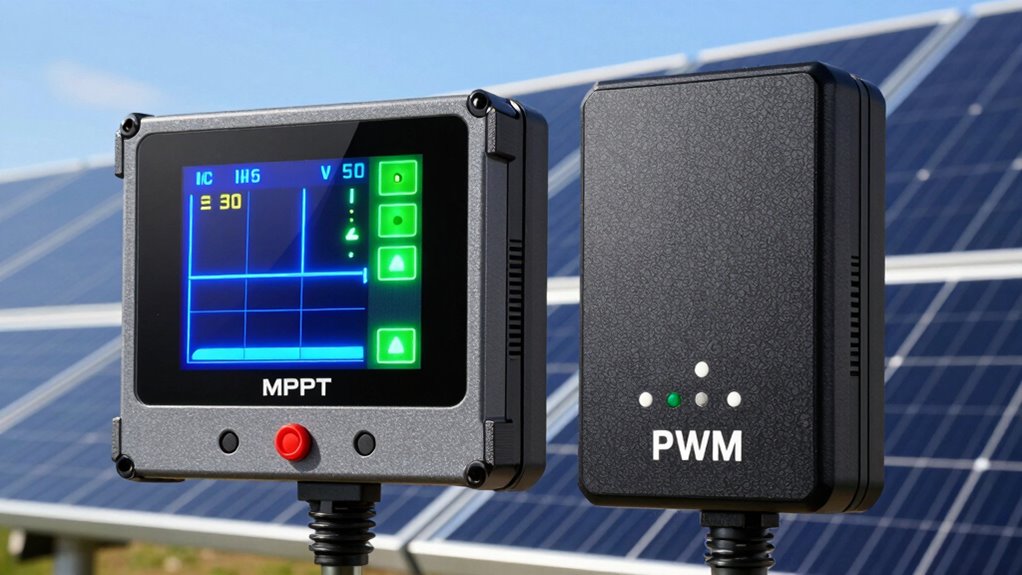
You’ll notice that MPPT and PWM controllers handle charging differently, especially in how they convert voltage and maximize power. MPPT controllers adjust their voltage to improve efficiency and harvest more energy, while PWM controllers operate at a fixed voltage limit. Understanding these differences helps you see how each type charges your batteries and manages power effectively. Additionally, MPPT controllers are particularly advantageous in cold climates or when the solar array voltage significantly exceeds the battery voltage, as they optimize energy transfer through voltage conversion. Properly managing performance metrics ensures your solar power system operates at peak efficiency and prolongs battery life. Moreover, solar panel configuration can impact the effectiveness of each controller type, influencing overall system performance. Recognizing the importance of system compatibility can help you choose the right controller for your specific setup. For optimal results, consider how environmental conditions affect the performance and selection of your solar charge controller.
Voltage Conversion Efficiency
MPPT (Maximum Power Point Tracking) controllers typically convert a higher voltage from your solar panels into a lower voltage to charge your batteries more efficiently. This process enhances voltage conversion efficiency by maximizing power extraction during each sunlight condition. Unlike PWM controllers, which simply connect panels directly to batteries, MPPT units optimize power by continuously tracking the maximum power point. Here’s how they compare:
| Controller Type | Voltage Conversion Efficiency | Power Optimization |
|---|---|---|
| MPPT | Up to 98% | High |
| PWM | Around 80-85% | Moderate |
| Both | Varies based on conditions | Varies |
| Ideal Use | High-voltage panels | Low-voltage panels |
This efficiency difference means MPPT controllers make better use of available sunlight, especially with high-voltage panels, delivering superior power optimization. The key advantage of MPPT controllers is their ability to adapt to changing sunlight conditions, ensuring maximum efficiency throughout the day. Additionally, their voltage regulation capabilities help prevent battery overcharging and extend battery life. Furthermore, their adaptability allows for more flexible system designs, accommodating different panel configurations and voltage levels. Incorporating innovative technology into solar charge controllers enhances overall system performance and longevity.
Charging Voltage Limits
While MPPT controllers maximize power extraction by tracking the most favorable voltage and current, they also regulate the charging process differently from PWM controllers. MPPT units adapt to charging voltage limits through precise voltage regulation, ensuring batteries aren’t overcharged. They do this by:
- Monitoring the battery’s voltage and adjusting the input voltage accordingly, maintaining an *ideal* charge rate.
- Keeping the voltage within safe limits to prevent damage or overvoltage conditions.
- Using dynamic voltage regulation to *maximize* charging efficiency without exceeding the battery’s maximum voltage.
- Advanced regulation techniques enable MPPT controllers to optimize charging parameters based on real-time system conditions. These techniques incorporate power point tracking algorithms to continually adapt to changing sunlight and load requirements, further enhancing safety and efficiency.
- This adaptive approach allows MPPT controllers to respond swiftly to fluctuations in solar input, maintaining consistent and safe charging levels. Additionally, the integration of smart algorithms helps in fine-tuning the charge process for different battery chemistries and states of health. Furthermore, these smart algorithms can adjust charging profiles based on battery temperature, ensuring optimal performance and longevity.
Power Harvesting Methods
MPPT and PWM controllers differ markedly in how they extract and transfer power from solar panels to batteries. MPPT controllers continuously adjust their input voltage to match the panel’s maximum power point, optimizing energy harvest, especially with varied battery chemistry and installation guidelines. PWM controllers, however, connect panels directly to batteries, dropping voltage to match battery voltage, which can waste energy. MPPT is ideal for high-voltage panel setups and complex battery chemistries, while PWM suits simpler systems. Here’s a clear comparison:
| Feature | MPPT | PWM |
|---|---|---|
| Power Harvesting | Maximizes energy transfer | Less efficient, simpler process |
| Panel Compatibility | Works with high-voltage panels | Best with 12V batteries |
| Battery Compatibility | Suitable for various chemistries | Limited to basic setups |
| Installation Guidelines | Requires proper setup | Easier to install |
| Efficiency | Higher, especially in low-light | Lower, less adaptable |
solar controller for large solar system
As an affiliate, we earn on qualifying purchases.
As an affiliate, we earn on qualifying purchases.
Efficiency of MPPT vs PWM Controllers in Different Sunlight Conditions?
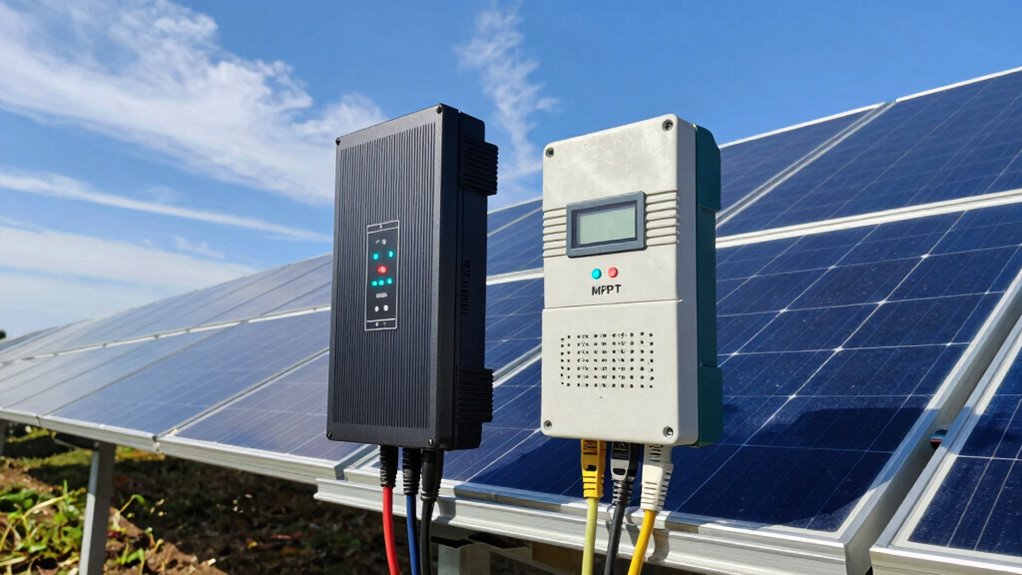
The efficiency of solar controllers varies markedly depending on sunlight conditions, and understanding how MPPT and PWM technologies perform under different scenarios is crucial for maximizing energy harvest. In bright sunlight, MPPT controllers excel by tracking maximum power points, especially when solar panel degradation has lowered efficiency. They convert excess voltage more effectively, reducing stress on your inverter compatibility. Conversely, in low-light or cloudy conditions, PWM controllers tend to perform similarly to MPPT, but with less overall efficiency. Additionally, Free Floating systems can benefit from selecting the appropriate controller type based on specific environmental factors, as the solar panel characteristics such as voltage and current ratings influence the optimal controller choice. It is also important to consider the appliance power requirements, as matching the controller type to panel specifications can further optimize performance. Moreover, understanding the ambient sunlight levels can help determine which controller will deliver the best energy conversion efficiency in varying conditions.
budget solar charge controller
As an affiliate, we earn on qualifying purchases.
As an affiliate, we earn on qualifying purchases.
MPPT vs PWM Cost: Which Offers the Best Value for Your System?
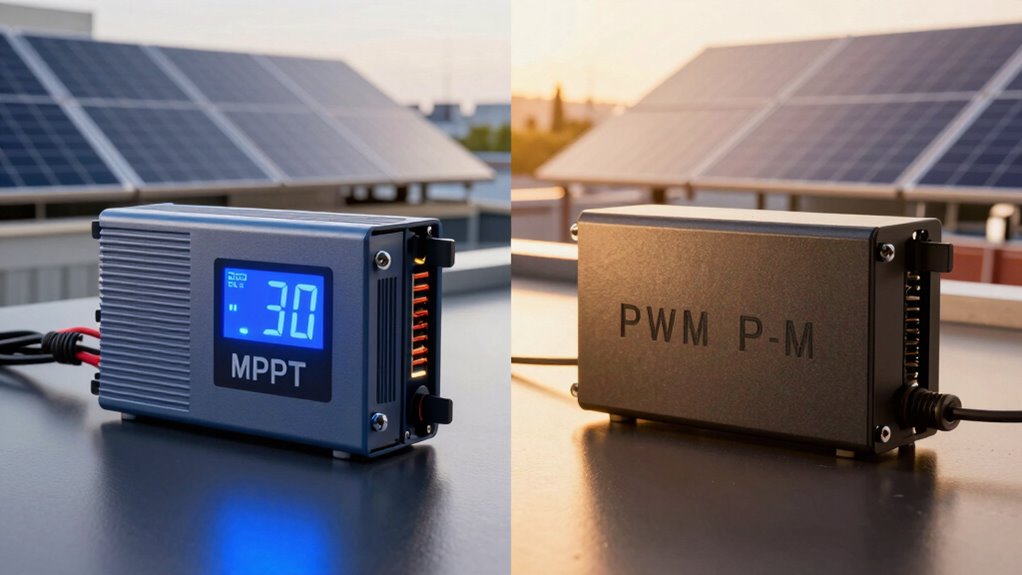
When choosing between MPPT and PWM controllers, cost is a key factor to contemplate. You’ll want to weigh the initial purchase price against potential long-term savings from improved efficiency. Additionally, make sure the controller you pick matches your system’s compatibility needs to maximize value. Considering the system capacity is essential to selecting the most suitable and cost-effective option. It’s also important to understand how solar panel characteristics can influence the overall system performance and cost-effectiveness. Understanding the efficiency differences between MPPT and PWM controllers can further help inform your decision, especially in relation to your specific energy needs and budget.
Initial Purchase Price
Choosing between MPPT and PWM solar controllers often comes down to initial cost, as this can substantially impact your overall system budget. The initial investment for MPPT controllers is typically higher, but they may offer better value over time. Consider these points:
- MPPT controllers usually cost 2-3 times more upfront than PWM options.
- The higher initial purchase price reflects advanced technology and greater efficiency.
- Your upfront costs influence your budget, but also determine potential performance benefits.
While PWM controllers are more affordable initially, MPPT units require a larger upfront investment. Your choice depends on your budget and long-term goals, but keep in mind that the initial purchase price plays a pivotal role in shaping your system’s overall value.
Long-Term Savings
Although MPPT controllers require a higher upfront investment, their ability to maximize energy harvest often translates into significant long-term savings. By optimizing power conversion, they improve efficiency for battery storage systems, allowing you to store more energy and reduce reliance on grid power. Over time, this means lower electricity bills and better utilization of your solar investment. Additionally, MPPT controllers excel in grid integration, helping you feed excess energy back into the grid more effectively. This can generate credits or income, further boosting your savings. While PWM controllers are cheaper initially, their lower efficiency results in less energy captured and higher operating costs over the long run. Ultimately, MPPT controllers deliver better value through enhanced energy management and savings that outweigh their higher initial price.
System Compatibility
System compatibility plays a crucial role in determining whether MPPT or PWM controllers offer the best value for your solar setup. Your battery chemistry influences this choice, as some chemistries benefit more from MPPT’s higher efficiency. Temperature compensation is also critical, especially in extreme climates, where MPPT controllers adapt better to temperature fluctuations, protecting your batteries. To evaluate compatibility:
- Check if your battery chemistry (e.g., lithium, lead-acid) requires specific charging parameters.
- Determine if your system operates in variable temperatures, favoring MPPT’s temperature compensation features.
- Assess whether your solar array voltage exceeds your battery voltage, making MPPT more suitable for maximum energy transfer.
Matching these factors ensures you select the controller that maximizes system performance and value.
How Do MPPT and PWM Controllers Impact Battery Life and System Durability?
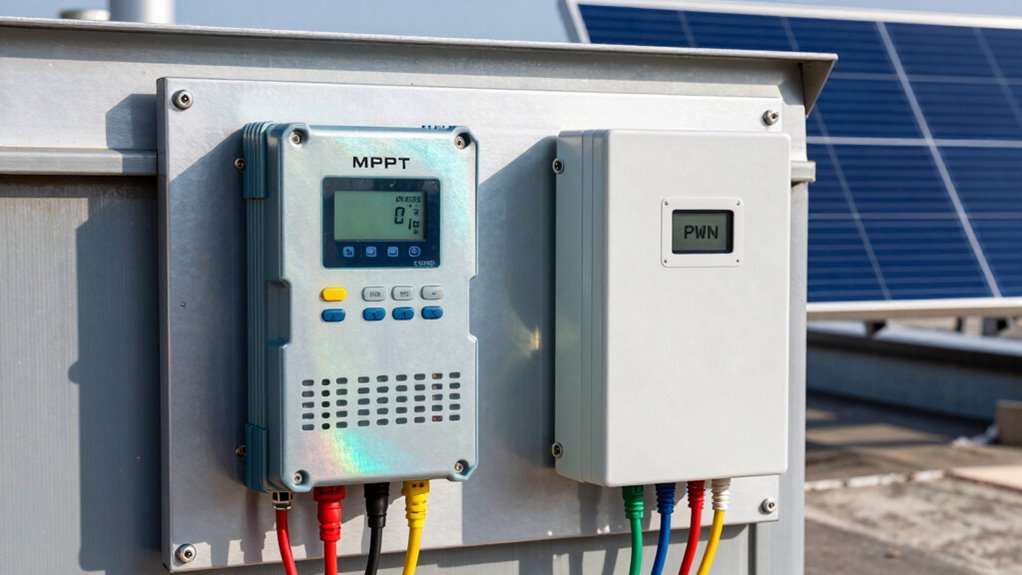
MPPT and PWM controllers can substantially influence your battery’s lifespan and the overall durability of your solar power system. The type of controller affects how efficiently your battery chemistry is maintained during charge cycles, which directly impacts longevity. MPPT controllers optimize voltage and current, reducing stress on batteries and allowing for smoother charge cycles. This gentle charging process minimizes wear and tear, extending battery life. PWM controllers, on the other hand, provide a more direct, less refined charge, which can lead to faster degradation over time. Consistently overcharging or undercharging batteries shortens their charge cycles and accelerates system aging. Hence, choosing the right controller helps preserve your batteries and ensures your solar system remains reliable and durable in the long run.
When Should You Choose an MPPT Controller Over PWM? Key Scenarios?
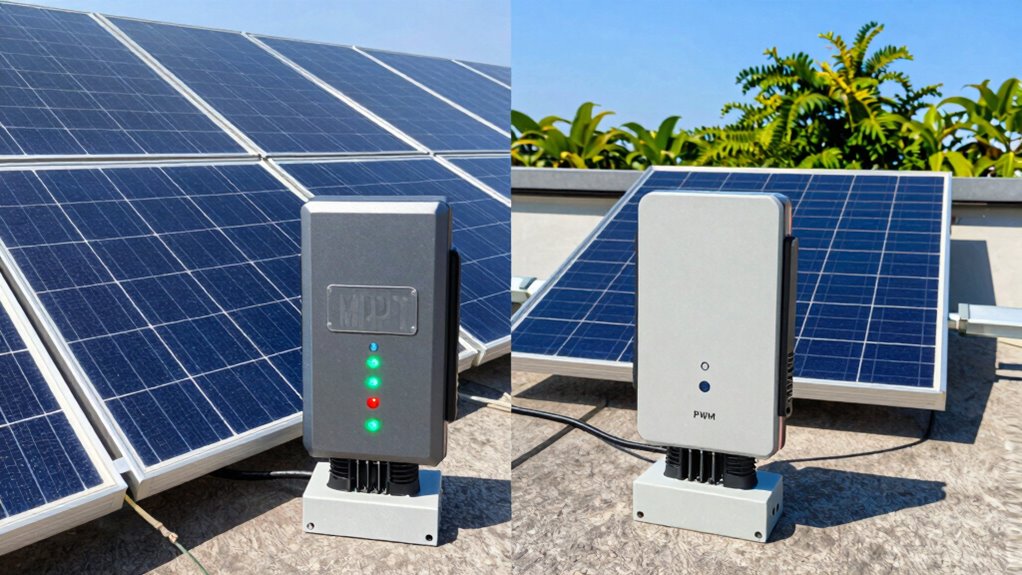
You should choose an MPPT controller over a PWM when your solar setup involves high-voltage panels or is located in areas with limited sunlight. MPPT controllers optimize power transfer, improving battery maintenance and extending your solar panel lifespan. Consider these key scenarios:
- You have high-voltage panels, where MPPT increases efficiency by converting excess voltage into current.
- Your location receives inconsistent or limited sunlight, making maximum energy extraction vital.
- You want to maximize system performance without sacrificing battery health, especially in colder climates or shaded environments.
In these cases, MPPT’s ability to adapt to varying conditions ensures better energy harvest, prolongs your system’s life, and maintains ideal battery health, making it the smarter choice.
Common Performance Challenges and Limitations of MPPT and PWM Controllers?
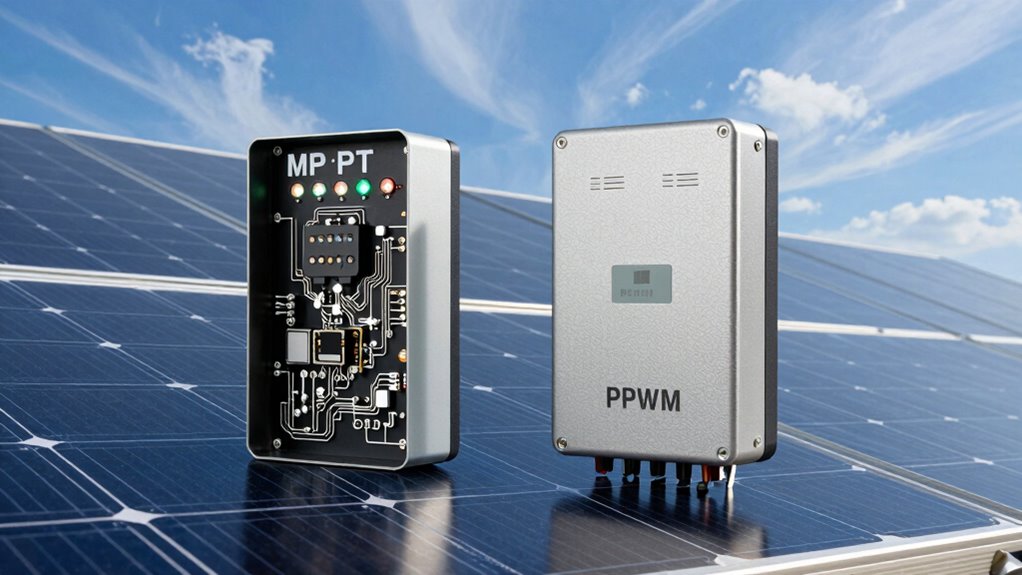
While MPPT controllers offer significant advantages in optimizing energy harvest, they also face performance challenges that can impact overall efficiency. One issue is installation complexity, which requires careful wiring and configuration, potentially leading to errors. Additionally, both MPPT and PWM controllers can cause battery overheating if not properly managed, risking damage or reduced lifespan. MPPT units tend to be more sensitive to environmental conditions, affecting performance in cold or hot climates. Here’s a quick overview:
| Challenge | Impact | Mitigation |
|---|---|---|
| Battery overheating | Reduced battery lifespan, safety risk | Proper ventilation and monitoring |
| Installation complexity | Increased setup time, errors | Follow manufacturer guidelines |
| Environmental sensitivity | Performance dips in extreme weather | Regular system maintenance |
How to Pick the Best Solar Controller for Your System Size and Budget?
Choosing the right solar controller depends on matching its features and capacity to your system size and budget. Start by evaluating your total solar panel capacity and energy needs. Then, consider these steps:
- Determine if an MPPT or PWM controller aligns with your budget and system complexity, noting that MPPT units handle larger arrays better.
- Factor in environmental impacts—if your location has frequent temperature fluctuations, an MPPT controller may optimize efficiency and reduce solar panel maintenance.
- Ensure the controller’s rated voltage and current match your panels and batteries, avoiding overspending on unnecessary features.
Real-World Performance: MPPT vs PWM in Various Environments?
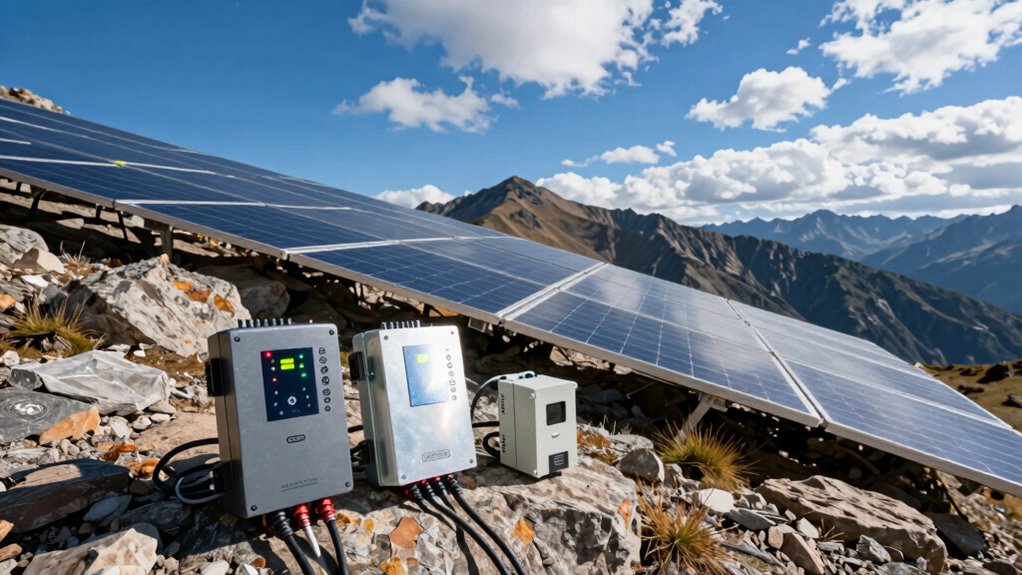
In real-world conditions, MPPT controllers often outperform PWM units, especially in environments with variable temperatures and shading. They extract more power from your panels, which can lead to better battery longevity over time. This is particularly noticeable when sunlight is inconsistent or partially blocked. While MPPT units may involve increased installation complexity, their ability to optimize energy capture makes them worth the effort. PWM controllers are simpler but less efficient, especially in challenging conditions, which can result in reduced battery life and overall system performance. If you face fluctuating weather or shading issues, choosing an MPPT controller guarantees your batteries stay healthier longer and your system operates more effectively. That’s why understanding real-world performance is essential for making the right choice.
Which Solar Controller Is the Game-Changer for Your Solar Setup?
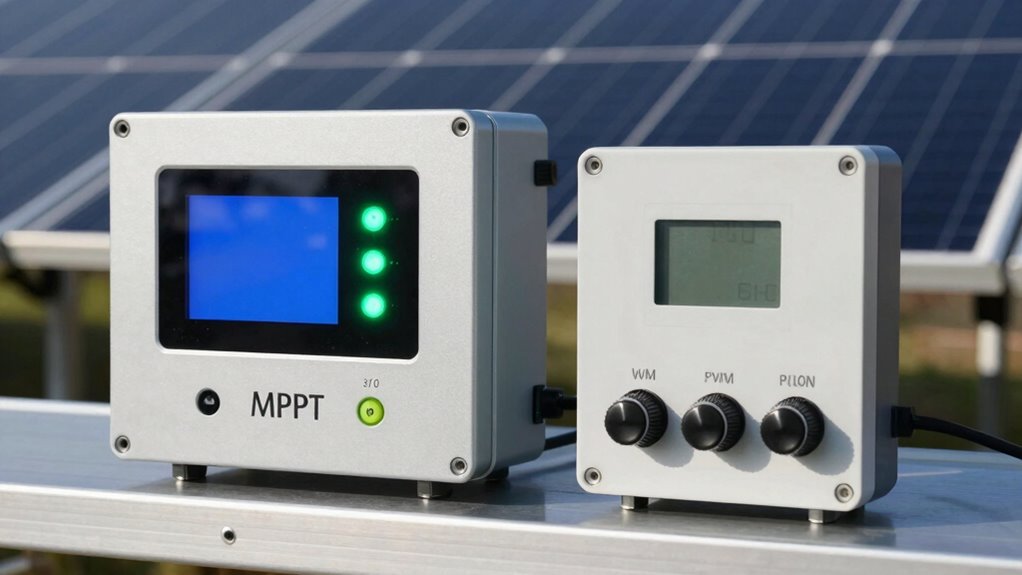
Choosing the right solar controller can substantially impact your system’s performance and budget. You need to take into account efficiency and power gains, as well as compatibility with your setup. Let’s explore how cost and flexibility factor into finding the game-changing controller for you.
Efficiency and Power Gains
When it comes to maximizing your solar system’s efficiency, the type of controller you select makes a significant difference. MPPT controllers generally deliver higher power gains by optimizing voltage and current, especially in colder or variable conditions. PWM controllers are simpler but less efficient, often wasting energy. Consider these points:
- Power Gains: MPPT can extract up to 30% more energy, boosting your system’s overall output.
- Battery Safety: MPPT controllers regulate charging more precisely, protecting your batteries from overcharge or damage.
- Installation Ease: PWM controllers are typically easier to install and maintain, making them suitable for straightforward setups.
Choosing the right controller depends on your goals for efficiency, safety, and ease of setup.
Compatibility and Flexibility
While efficiency and power gains are essential, compatibility and flexibility often determine how well a solar controller fits into your existing setup. MPPT controllers generally offer greater compatibility with different battery chemistries, such as lithium, lead-acid, or gel, making them more adaptable to various setups. They also tend to handle complex installation requirements more smoothly, providing versatile options for wiring and system integration. PWM controllers, on the other hand, are simpler but may have limited flexibility, especially with non-standard batteries or complex configurations. If your setup involves multiple battery types or requires intricate wiring, an MPPT controller can reduce installation complexity and improve overall system integration. Choosing a controller that aligns with your battery chemistry and installation needs ensures a more reliable, adaptable solar power system.
Cost and Investment Balance
Balancing cost and investment is essential when selecting a solar controller, as it directly impacts your overall system affordability and long-term savings. To optimize your investment strategy, consider these points:
- Cost comparison: MPPT controllers often have a higher upfront price but deliver better efficiency, saving you money over time. PWM controllers are cheaper initially but may lead to less energy harvest and higher operating costs.
- Long-term savings: An MPPT controller can maximize power output, making it a smarter choice if you plan to expand or upgrade your system.
- Budget considerations: If your budget is tight, PWM controllers provide a budget-friendly option with decent performance, but weigh this against potential energy losses and future costs.
Choosing the right controller depends on balancing these factors for your specific needs.
Frequently Asked Questions
Can PWM Controllers Handle Higher Voltage Panels Effectively?
Yes, PWM controllers can handle higher voltage panels effectively, but their voltage compatibility is limited. They work best with panels whose voltage closely matches your battery voltage, ensuring efficient charge transfer. While PWM controllers are more cost-efficient upfront, they may not maximize power from higher voltage panels like MPPT controllers do. If you’re using higher voltage panels, an MPPT controller generally offers better efficiency and energy harvest, making it worth the extra investment.
How Does Temperature Affect MPPT and PWM Controller Performance?
Think of your solar controllers as delicate plants—they thrive best within certain temperatures. Temperature affects MPPT and PWM controllers differently; MPPTs are more temperature sensitive, causing efficiency variations as temperatures change, especially in hot weather. PWM controllers are generally more stable across temperature ranges but less efficient overall. You’ll notice performance dips in extreme heat, so choose a controller suited to your climate to guarantee ideal energy harvest.
Are There Specific System Sizes Better Suited for PWM or MPPT Controllers?
For small, simple systems, PWM controllers are typically more cost-efficient and easier to install, making them suitable for limited scalability. In contrast, MPPT controllers excel in larger or more complex setups where maximizing energy harvest is essential, offering better system scalability. If you have a bigger installation or want higher efficiency, investing in an MPPT controller pays off, while smaller systems benefit from PWM’s simplicity and lower upfront costs.
Do MPPT Controllers Require More Maintenance Than PWM Units?
You won’t find that MPPT controllers require substantially more maintenance than PWM units. Both types are designed for durability, but MPPT controllers may need occasional checks to guarantee ideal performance, especially in harsh conditions. Their maintenance frequency stays low, just like PWM units. Focus on proper installation and regular inspections, and you’ll keep either controller functioning well without extra effort, ensuring long-term durability and peak efficiency.
Can Hybrid Systems Combine MPPT and PWM Controllers Effectively?
Yes, hybrid systems can combine MPPT and PWM controllers effectively. You need to guarantee proper hybrid integration by checking controller compatibility, so they work seamlessly together. By doing this, you optimize your solar setup, balancing the high efficiency of MPPT with the affordability of PWM. Just make sure each controller’s specifications align with your system’s voltage and current requirements for smooth operation and maximum energy harvest.
Conclusion
Choosing between MPPT and PWM is like selecting the perfect compass for your solar journey. Picture the sun’s rays dancing on your panels, and your controller guiding the energy smoothly into your batteries. Whether you want maximum efficiency under bright skies or a budget-friendly option, your choice shapes your system’s future. Make an informed decision today, and watch your solar setup thrive like a vibrant, unstoppable sunrise.