TL;DR

Prime made for students and young adults
- Fast, free delivery for dorm and study essentials
- Prime Video and Amazon Music included
- Member-only deals
In a laboratory experiment, bleached fragments of the coral Pocillopora damicornis recovered after touching healthy fragments from the same genet. The researchers observed transfer of symbiotic algae through a tissue bridge; fragments kept a few millimetres apart died within 20 weeks. The method has not been shown to work at reef scale or under changing ocean conditions.
Bleached fragments of Pocillopora damicornis recovered in a laboratory after touching healthy fragments from the same genetic individual, researchers report in a study published in Science Advances on October 14. The team observed symbiotic algae spreading through a tissue bridge between the fragments, suggesting a possible route to coral recovery that has not yet been tested at reef scale.
The work began after marine scientist Stephen Palumbi noticed colour moving from a healthy coral fragment into a bleached fragment where the two had accidentally touched in a laboratory tank. Danny Collins, then a Stanford doctoral researcher studying disease spread through coral contact, investigated whether the algae that give corals colour and nutrients could also move between fragments.
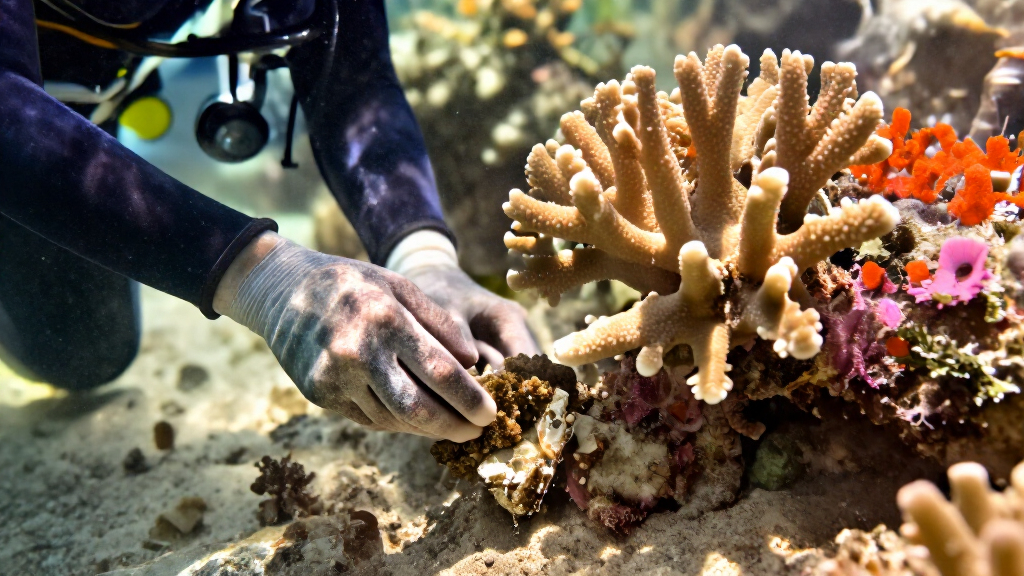
Collins and colleagues prepared 10 pairs of fragments from the same coral animal. In five pairs, a bleached and healthy fragment touched; in the other five, they were separated by a few millimetres. The bleached fragments in the touching pairs recovered within eight weeks. The report says symbiont populations were doubling every four days by week two. In the separated pairs, the bleached fragments died after 20 weeks.
Microscopy indicated that touching fragments fused by forming a tissue bridge, through which symbiotic algae could pass. The fusion occurred between fragments from the same genetic individual, or genet. Fragments from different species and from different animals of the same species did not fuse, according to the study. Researchers also found that after a bleached branch had touched a healthy one for a week, it could continue recovering after separation.
A Possible Route to Coral Recovery
The findings offer a laboratory demonstration of a rapid recovery mechanism for bleached coral, a condition linked to heat stress that can leave corals without the algae supplying much of their nutrients. If the method can be adapted beyond controlled experiments, it could inform coral restoration work by showing how contact between compatible fragments may help restore symbionts.
That possibility remains preliminary. The experiment involved a small number of paired fragments from one coral species, and the reported recovery depended on genetic compatibility and direct contact. It does not establish that the approach will reverse bleaching in wild reefs, protect corals from continued heat stress, or work at a scale large enough to affect reef decline.
As an affiliate, we earn on qualifying purchases.
How Bleaching Affects Coral
Corals are animals that host microscopic symbiotic algae in their tissues. The algae provide much of the coral’s nutrients through photosynthesis and contribute to its colour. When rising sea temperatures stress corals, they may expel the algae, leaving the coral pale or white; this is known as bleaching. Without the algae, corals face a greater risk of starvation and death.
The research arose from an accidental observation in early 2025 and was then examined through a controlled comparison of touching and separated fragments. The Nature report says the transfer-associated recovery was faster than recovery reported in studies of corals recovering naturally in the wild. The study’s findings concern fragments from the same genet, not a general ability of unrelated corals to nurse one another.
“This incredible new result — that fast and full recovery is possible in bleached coral — can inspire solutions that eventually may be scalable.”
— Fiorenza Micheli, marine ecologist at Stanford University’s Center for Ocean Solutions and study co-author
Limits Beyond the Laboratory
The reported experiment does not show whether the same process works in wild reef conditions, where water movement, disease, temperature changes and other stresses may affect contact and recovery. The source describes trials involving one species and 10 fragment pairs; it does not establish how broadly the result applies across coral species or populations.
It is also unclear whether the method could be used safely and practically in restoration projects, or whether recovered fragments would remain healthy through further heat stress. The report does not provide evidence that the approach can prevent bleaching or reduce the underlying pressure of warming seas. Claims about scalability remain prospective.
Testing the Method at Reef Scale
The study establishes a result in laboratory conditions, while practical use would require further testing across coral species, genetic lines and environmental settings. Researchers would also need to determine whether tissue fusion and symbiont transfer can be reliably achieved outside controlled tanks and whether recovery lasts when corals face the stresses that caused bleaching.
For now, the next step is to treat the finding as a potential research lead rather than an established restoration technique. The available report does not specify a planned field trial or a timeline for broader testing.
Key Questions
What did the researchers find?
In a laboratory experiment, bleached fragments of Pocillopora damicornis recovered after touching healthy fragments from the same genet. The team observed symbiotic algae moving through a tissue bridge formed where the fragments fused.
How quickly did the fragments recover?
The touching bleached fragments recovered within eight weeks. By week two, the study reported that the symbiont population was doubling every four days. The source also says a branch could continue recovering on its own after a week of contact.
Did fragments recover without touching?
No recovery was reported for the fragments kept a few millimetres apart. Those bleached fragments died after 20 weeks, according to the study summary.
Could this restore bleached reefs?
That is not established. The findings come from a laboratory experiment with one coral species and genetically matched fragments. The researchers’ suggestion that the result might lead to scalable solutions is a possibility, not proof that the method works across reefs.
Source: hn
Halloween Picks
halloween
As an affiliate, we earn on qualifying purchases.