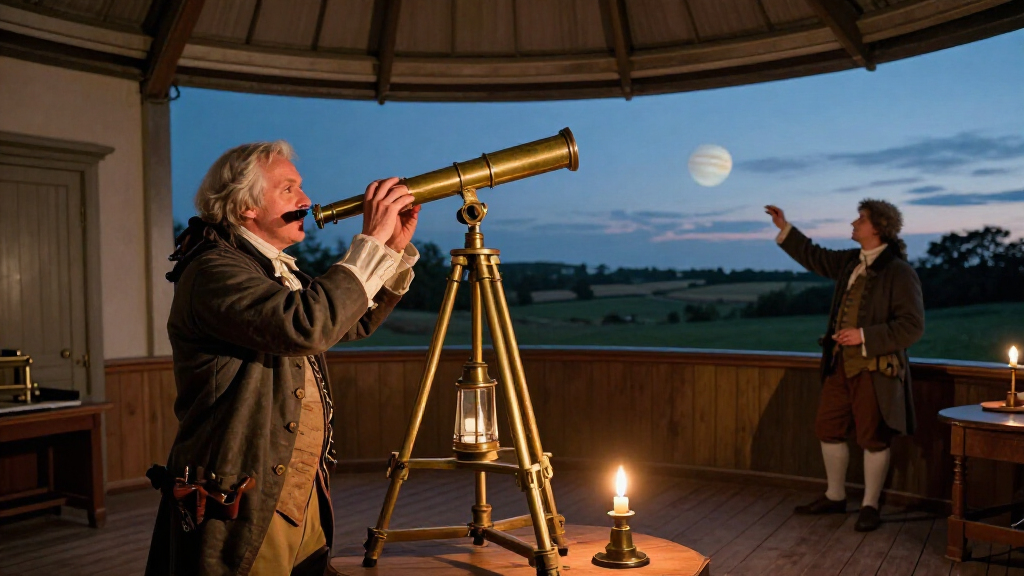
TL;DR
In September 1676, Danish astronomer Ole Rømer predicted that Jupiter’s moon Io would emerge from the planet’s shadow 10 minutes later than expected. The prediction was borne out on November 9, providing evidence that light travels at a finite speed; his estimate was about 25% below the modern value.
Danish astronomer Ole Rømer showed in 1676 that light takes time to travel, after correctly predicting that Jupiter’s moon Io would emerge from the planet’s shadow 10 minutes later than expected. The observation gave scientists evidence that light does not move instantaneously, a finding that later became important to astronomy and the measurement of the universe.

Prime made for students and young adults
- Fast, free delivery for dorm and study essentials
- Prime Video and Amazon Music included
- Member-only deals
Rømer presented his prediction to members of the Académie des Sciences in Paris in September 1676. He forecast that Io would emerge from Jupiter’s shadow late on November 9. The event occurred as predicted. Rømer’s findings were published on December 7 in the journal Journal des sçavans, according to ScienceNorway’s account of the historical episode.
Io repeatedly passes into and out of Jupiter’s shadow, creating events astronomers could time. Rømer and other observers recorded those eclipses. He noticed that the events appeared later than expected as Earth moved farther from Jupiter, and earlier as Earth moved toward it. The pattern made sense if light needed more time to cross the greater distance between the planets.
Professor Jacob Wüsthoff Linder of the Norwegian University of Science and Technology told ScienceNorway that Rømer estimated light took about 22 minutes to cross the diameter of Earth’s orbit. That implies a speed of roughly 225,000 kilometres per second, compared with the modern value of about 300,000 kilometres per second. His estimate was about 25% too low, but the central result was that light’s speed was finite and could be estimated.
How Io Revealed Light’s Travel Time
Rømer’s method connected a change in the timing of a distant astronomical event to the changing distance light had to travel. It offered a way to test a question that had long been debated: whether light crossed space instantaneously or took time to arrive.
The finding also changed what observations of the sky mean. As Linder explained to ScienceNorway, light from distant objects began its journey before it reaches Earth. Looking at faraway objects therefore means seeing them as they were in the past. That principle is central to astronomy’s account of how stars, galaxies and the universe have changed over time.
Rømer’s number was not precise by modern standards, and the result did not settle the matter immediately. Its importance lay in demonstrating a measurable effect and giving later scientists a basis for further tests.
Popular right now

KitchenAid Artisan Mini Tilt-Head Stand Mixer, 3.5 Quart, Aqua Sky Blue

Ninja Luxe Café Mini Plus Espresso and Drip Coffee Machine with AutoFroth, Stainless Steel, ES351

Dyson Cyclone V10 Origin Cordless Vacuum
As an affiliate, we earn on qualifying purchases.
From Paris Observations to Wider Acceptance
Rømer moved from Denmark to Paris in 1671 and spent a decade working at the Paris Observatory and as a member of the scientific academy, according to the Great Norwegian Encyclopedia, as cited by ScienceNorway. Io’s regular eclipses offered a recurring event that astronomers could use like a clock. The timing could also have practical value for navigation, according to Ole Eggers Bjælde, a curator at Aarhus University’s Science Museums, in an article cited by ScienceNorway.
Rømer was not the first person to suggest that light might have a finite speed. Earlier thinkers, including Empedocles, Ibn al-Haytham, Abu Rayhan al-Biruni and Roger Bacon, had considered the possibility. Rømer is regarded as the first to demonstrate it with observational evidence, ScienceNorway reports.
Acceptance developed over time. Linder said there were early critics, including the head of the observatory where Rømer worked. The idea received support from prominent scientists such as Christiaan Huygens and later Isaac Newton. About 50 years afterward, astronomer James Bradley’s discovery of stellar aberration provided an independent confirmation: the apparent annual shifts in stars’ positions could be explained by Earth’s motion while light travels toward us.
““Io regularly disappears behind Jupiter, and this regularity made it possible to use the moon as a clock.””
— Jacob Wüsthoff Linder, professor of physics at the Norwegian University of Science and Technology, speaking to ScienceNorway
Limits of Rømer’s Measurement
Rømer’s estimated speed was approximate, not a modern precision measurement. ScienceNorway reports that his calculation corresponded to about 225,000 kilometres per second, roughly 25% below today’s value. The article’s account does not provide a detailed breakdown of the observations or calculation, so the estimate should be understood as an early measurement rather than a direct match to the present figure.
How quickly scientists accepted the result is also not stated with precision. Linder described acceptance as gradual, with critical voices at first, followed by support from Huygens and Newton and later independent evidence from Bradley. The source does not establish that Rømer’s prediction alone immediately persuaded the scientific community.
The Anniversary and Its Legacy
The anniversary is a chance to revisit the observation rather than a new scientific announcement. The historical record described by ScienceNorway centers on the 1676 prediction, its successful timing and the later support for Rømer’s explanation.
There is no new experiment or upcoming milestone identified in the source material. The next step for readers seeking more detail is to consult the original 1676 publication or historical accounts of the later work by Huygens, Newton and Bradley. The source does not give further anniversary events or newly released research.
Key Questions
What did Ole Rømer predict in 1676?
In September 1676, Rømer predicted that Io would emerge from Jupiter’s shadow 10 minutes later than expected on November 9. The event occurred as he forecast.
How did Io’s eclipses show that light has a finite speed?
Rømer compared the timing of Io’s eclipses as Earth’s distance from Jupiter changed. The eclipses appeared later when Earth was moving away and earlier when it was moving toward Jupiter, consistent with light taking more or less time to travel.
How close was Rømer’s estimate to the modern speed of light?
ScienceNorway reports that Rømer’s estimate was about 225,000 kilometres per second, compared with the modern value of about 300,000 kilometres per second. That is roughly 25% lower.
Was Rømer the first person to suggest light travels at a finite speed?
No. Earlier thinkers had proposed that light might have a finite speed. Rømer is regarded as the first to demonstrate the idea with observational evidence, according to the source report.
Why does light’s finite speed matter to astronomy?
Light takes time to reach Earth, so observations show distant objects as they were when their light began travelling toward us. The farther away an object is, the further back in time astronomers are seeing it.
Source: sciencenorway.no