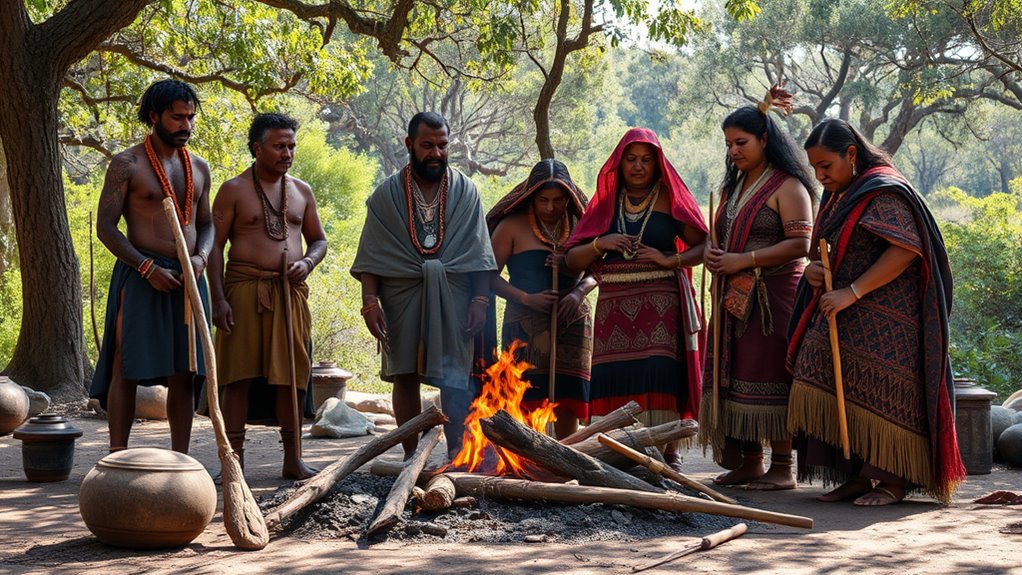

Aboriginal men’s and women’s business play crucial roles in ceremonies, guiding rituals that honor land, ancestors, and sacred laws. Men’s business often includes initiation, storytelling, and dance linked to spiritual beings, while women’s business focuses on childbirth, kinship, and community bonds. These practices preserve important knowledge and maintain harmony within the community and with the land. If you want to understand how these traditions uphold cultural identity, you’ll find more insights ahead.
Key Takeaways
- Men’s and Women’s Business uphold gender-specific roles vital for cultural knowledge, spiritual connection, and community harmony.
- Men’s Business involves initiation rituals, storytelling, dance, and sacred site ceremonies linked to ancestors.
- Women’s Business focuses on childbirth, kinship, land, and passing down sacred laws and ancestral knowledge.
- Dreamtime stories serve as living truths, reinforcing cultural identity and spiritual continuity through ceremonies.
- Sacred sites act as spiritual hubs for rituals, ceremonies, and connecting communities to ancestors and Dreamtime.

In Aboriginal cultures, Men’s and Women’s Business in ceremony are essential traditions that respect gender-specific roles and responsibilities. These practices are deeply rooted in the community’s spiritual and cultural life, guaranteeing that important knowledge and customs are preserved and passed down through generations. As you participate or observe these ceremonies, you’ll notice how they reinforce the connection between people, land, and spirit. Men’s Business often involves rituals related to initiation, hunting, and sacred storytelling, while Women’s Business centers on childbirth, motherhood, and community cohesion. Both are considered crucial for maintaining harmony within the community and with the land itself.
Dreamtime stories play a central role in these ceremonies, acting as sacred narratives that explain the origins of the world, animals, and humans. These stories are not just tales but are considered living truths that carry spiritual power and cultural significance. During Men’s Business, Dreamtime stories are often recounted around sacred sites, which are specific locations imbued with ancestral energy. These sites, such as rock formations or waterholes, serve as physical links to the ancestors and the Dreamtime. You might find that ceremonies held at these sacred sites involve storytelling, dance, and song, all designed to keep the Dreamtime stories alive and relevant. Similarly, Women’s Business may include rituals that connect women to their ancestral heritage, often performed at sacred sites or within the community. These ceremonies ensure that women understand their roles in the spiritual and social fabric of the community, passing on knowledge about land, kinship, and sacred laws.
Understanding the significance of sacred sites helps you appreciate their role in these ceremonies. These locations are more than just geographical features; they are spiritual hubs where ancestral beings shaped the land and established laws. During ceremonies, these sites become places of spiritual renewal and cultural transmission. For example, a sacred site might be the setting for a ritual that reaffirms the community’s connection to their Dreamtime stories and ancestral spirits. As you witness or learn about these practices, you’ll see how they serve to reinforce cultural identity, spiritual continuity, and respect for the land. Men’s and Women’s Business, intertwined with Dreamtime stories and sacred sites, uphold the traditions that sustain Aboriginal culture and foster a deep, ongoing relationship with the land and its ancestors. Recognizing the sacred sites as vital cultural locations helps deepen your understanding of their spiritual importance.
Aboriginal Dreamtime storytelling book
As an affiliate, we earn on qualifying purchases.
As an affiliate, we earn on qualifying purchases.
Frequently Asked Questions
How Are Gender Roles in Ceremony Determined Among Different Aboriginal Groups?
You see that gender roles in ceremony are shaped by each Aboriginal group’s cultural adaptation and history. You learn that gender negotiation is essential, as men and women often share specific responsibilities based on traditional beliefs, but these roles can evolve over time. Different groups determine roles through oral traditions, customs, and spiritual beliefs, emphasizing respect and balance. This flexible approach ensures ceremonies remain meaningful while respecting cultural identity.
What Are the Specific Rituals Unique to Men’s and Women’s Business?
You witness sacred dances and initiation rites that are uniquely powerful for men and women. Men’s business often includes secret sacred dances that symbolize strength and ancestral connection, while women’s business features rites of passage and ceremonies celebrating fertility and community. These rituals are intensely guarded, preserving cultural identity and spiritual power, making them extraordinary and essential to the fabric of Aboriginal life. Every movement and song holds profound meaning, shaping generations.
How Do Generational Differences Influence Aboriginal Men’s and Women’s Roles?
Generational differences considerably shape Aboriginal men’s and women’s roles, especially as cultural assimilation and urban migration occur. You might notice younger generations adapting traditional roles to fit modern contexts, blending old customs with new influences. While elders uphold rituals, younger individuals may modify practices or seek integration into broader society. This dynamic creates a balance where cultural identity persists, but roles evolve to reflect changing environments and perspectives.
Are There Contemporary Challenges to Maintaining Traditional Business Practices?
Imagine a sacred tree struggling against stormy winds—that’s how contemporary challenges threaten cultural preservation. Legal challenges, like harsh winds, test your ability to sustain traditional business practices. While modern laws and societal shifts challenge your connection to ancient customs, you can stand firm by nurturing your roots and sharing stories. Embracing change while honoring tradition helps preserve your cultural identity amidst these ongoing struggles.
How Do Aboriginal Communities Incorporate These Practices Into Modern Ceremonies?
You actively incorporate traditional practices into modern ceremonies through cultural adaptation and community engagement. By respecting and blending age-old customs with contemporary elements, you keep these practices relevant. You involve community members, elders, and youth, ensuring everyone’s voice is heard. This approach fosters a shared sense of identity and continuity, allowing Aboriginal traditions to thrive within contemporary settings while honoring their cultural significance.
Indigenous sacred site replica model
As an affiliate, we earn on qualifying purchases.
As an affiliate, we earn on qualifying purchases.
Conclusion
Understanding Aboriginal men’s and women’s business in ceremony shows you the importance of respecting cultural traditions. These practices hold deep spiritual and social significance, helping communities stay connected to their roots. By honoring these ceremonies, you realize it’s a case of “what’s good for the goose is good for the gander”—both men and women play essential roles. When you embrace this, you help keep these sacred traditions alive for generations to come.

Latin Dance Workout DVD – Baila Latin Dance Video 20-Minute Dance Workout Videos – 5 Dance Exercise Styles Latin Music Videos with Basic Steps Intro (Salsa, Merengue, Cha-Cha, Pasodoble, and Samba)
Make Your Body Groove – Baila! (bi-luh) latin workout will have you latin dancing with confidence in no…
As an affiliate, we earn on qualifying purchases.
As an affiliate, we earn on qualifying purchases.

La Vivia Handmade Beaded Necklace| Native American Style Seed Beads Large Medallion Necklace| Colorful beaded design| Medicine Wheel Feathers Design for Women|
Non-Allergic Glass Beads Made of Skin and environment friendly materials, we carefully select materials to ensure the user…
As an affiliate, we earn on qualifying purchases.
As an affiliate, we earn on qualifying purchases.