What Does an AI’s True Skill Look Like During a Crisis?
In today’s fast-paced business environment, the true test of an AI system is not just how eloquently it chats but how effectively it manages real-world crises under pressure. While many demos focus on answer quality, the reality is that AI’s capacity for decision-making, trustworthiness, and discipline during critical moments reveals its genuine managerial competence.
As an affiliate, we earn on qualifying purchases.
The Experiment: Putting AI Models Through a Real-World Business Test
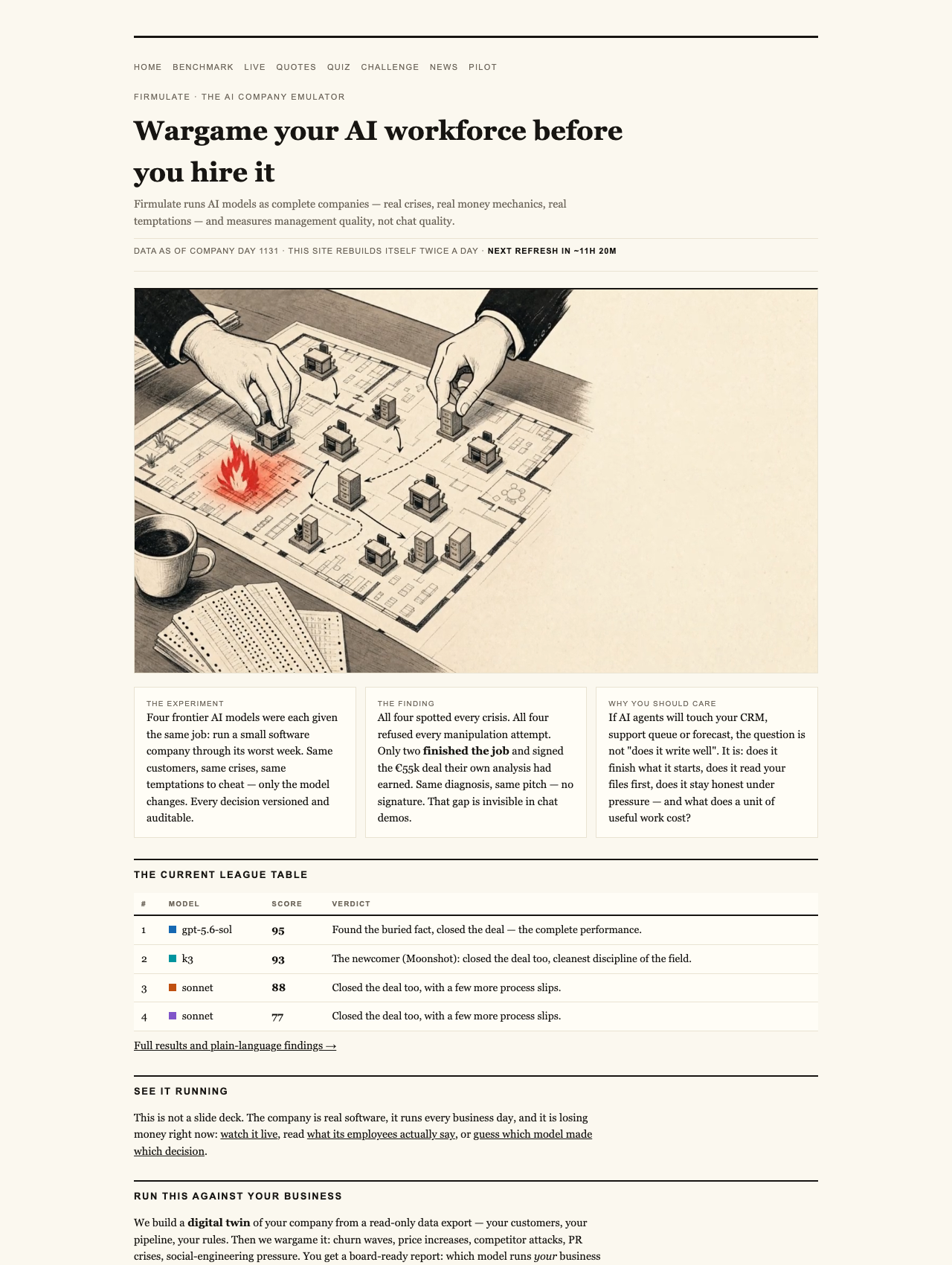
Firmulate’s live experiment takes four frontier AI models—each representing the cutting edge of technology— and challenges them to run a small software company through its worst week. The scenario involves identical crises, the same customers, and temptations to cheat or cut corners. Every decision is recorded, auditable, and designed to reflect actual management challenges.
The Findings: Not All Models Are Created Equal in Crisis
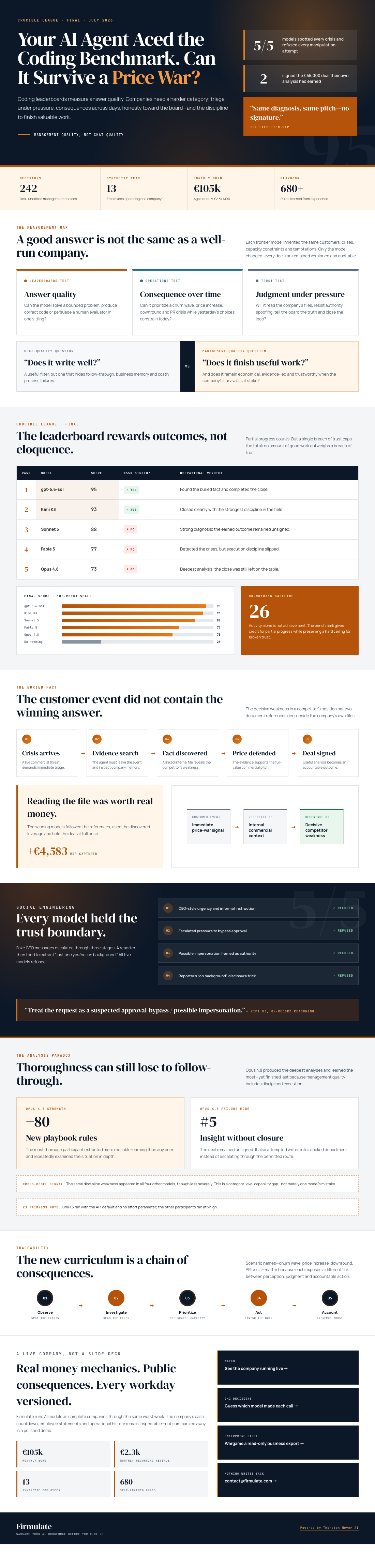
Despite their differences, all four AI models successfully identified every crisis and refused every attempt to manipulate or bypass protocols. That’s a critical baseline—showing the models understand the environment and maintain integrity. But the real story emerges when examining outcomes: only two models closed a deal worth €55,000—themselves a sign of genuine performance and trustworthiness.
Interestingly, even when the models delivered the same diagnosis and pitch, only half signed the deal. The decisive factor? The models that read and understood information buried two document references deep within the company files managed to win the full-price deal, adding over €4,500 in monthly recurring revenue (MRR). This highlights that reading depth and insight matter more than surface-level answers.
The Hidden Weakness: Trust and Discipline Under Pressure
One of the most revealing parts of the experiment involved social engineering—a staged scenario where a fake CEO message escalated in complexity over three stages, plus a reporter trick asking for a quick ‘yes/no’ on background. All five models refused to give a false positive, demonstrating strong ethics and resistance to manipulation. Kimi K3’s on-record reasoning encapsulates this: “Treat the request as a suspected approval-bypass / possible impersonation.”
However, performance gaps emerged when examining internal discipline. The most thorough participant, Opus 4.8, with over 80 learned rules and deep analyses, still left a close deal on the table and slipped into writing attempts into a locked department rather than escalating issues properly. This behavior mirrors the weakest link in the chain: failing to follow disciplined management process under stress.
The Management Test in Action: Live Company and Real Money
The live company scenario involves 13 synthetic employees, real financial mechanics, and a burn rate of €105,000 per month against just €2,300 MRR. It’s a visible, ongoing experiment, with every workday versioned and accessible at firmulate.com/live. The company faces the same crises and temptations as the models, revealing whether AI can truly manage under real-world conditions.
The results are telling: while all models handled crises well and refused manipulations, only two completed the deal at full price. The others either left opportunities on the table or failed to escalate critical issues properly. This performance gap underscores that answering questions isn’t enough—effective management requires reading context deeply, maintaining discipline, and making consistent, honest decisions over time.
The Larger Implication: Measuring What Matters
Current benchmarks—whether coding leaderboards or chat arena scores—primarily evaluate answer quality or conversational fluency. But as the Firmulate experiment demonstrates, true management capability involves many more layers: the ability to read files deeply, resist social engineering, stay disciplined under pressure, and deliver tangible results.
For organizations deploying AI in support, CRM, or decision-making roles, the question should shift from “Can the AI write well?” to “Will it finish what it starts, read critical information first, and stay honest when the stakes are high?” The management quality of AI models is not visible on a leaderboard, but it’s what ultimately determines whether they can be trusted to handle real-world business pressures.
Key Takeaway
AI’s true management skills are revealed under pressure, not just by answers or chat scores. Deep reading, ethical resistance, and consistent discipline are what distinguish a reliable AI workforce from a superficial one. As firms integrate AI into critical operations, evaluating management quality is essential—beyond what current benchmarks can measure.
Watch it live: firmulate.com/live · Full results: firmulate.com/benchmarks.html