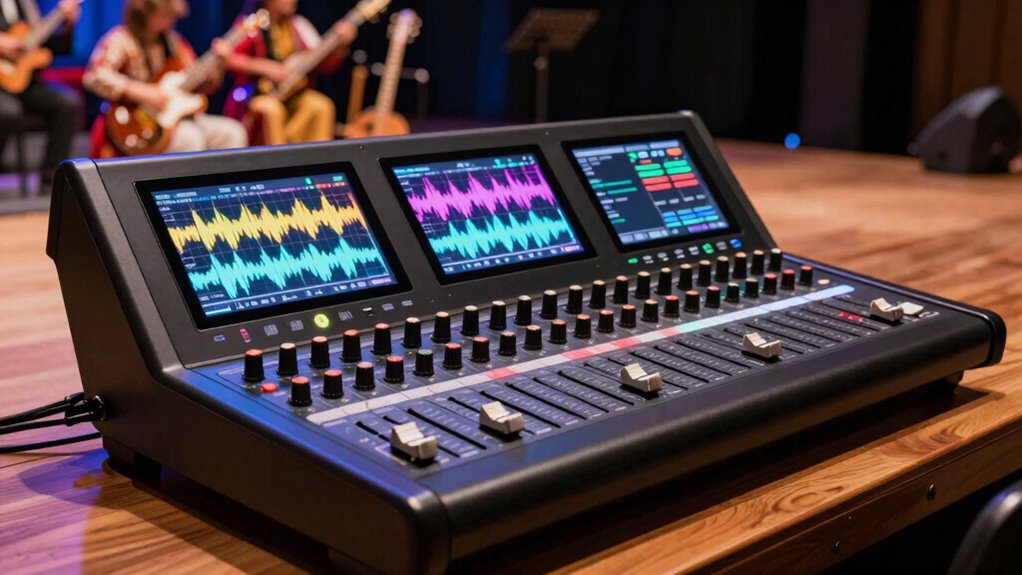

Choosing a digital mixing console for cultural performances involves balancing versatility, ease of use, and sound quality. The PreSonus StudioLive Classic 16.0.2 USB stands out as the best overall for its intuitive interface and reliable performance. The Behringer X32 Compact offers excellent value with extensive features, while the Yamaha TF5 provides superior sound clarity for professional settings. These options highlight the key tradeoffs: more features often mean increased complexity or cost, and simpler setups may lack advanced routing. Keep reading to see how each model measures up for your specific needs.
Key Takeaways
- The top picks balance ease of use with advanced features, ensuring suitability for both experienced sound engineers and newcomers.
- Build quality and durability are critical, especially for mobile or outdoor cultural performances.
- Models with integrated recording capabilities add value for documenting performances but may come with a higher price.
- Some consoles excel in intuitive control layouts, reducing setup time during live events.
- There is a clear tradeoff between feature-rich models and simpler, more streamlined options for smaller venues.
| PreSonus StudioLive Classic 16.0.2 USB Digital Console Mixer |  | Best Overall for Versatile Cultural Performance Setups | Channels: 16 (8 mono, 4 stereo) | Faders: 12 | Preamp: 12 Class A XMAX | VIEW ON AMAZON | See Our Full Breakdown |
| Behringer X32 Compact |  | Best Value for Mid-Size Cultural Performances | Number of Channels: 40 | Connectivity Technology: USB | Power Source: Corded Electric | VIEW ON AMAZON | See Our Full Breakdown |
| Behringer X32 40-Input 25-Bus Digital Mixing Console |  | Best for Complex Live and Studio Configurations | Number of Inputs: 40 | Number of Buses: 25 | Mic Preamps: 32 MIDAS-designed | VIEW ON AMAZON | See Our Full Breakdown |
| Yamaha TF5 32-Channel Digital Mixing Console |  | Best for Large-Scale Cultural Events | Number of Channels: 32 | Connectivity Technology: USB, Wi-Fi | Power Source: Corded Electric | VIEW ON AMAZON | See Our Full Breakdown |
| Allen & Heath Qu-5 Digital Mixing Console |  | Best for High-Quality, Remote-Controlled Performances | Frequency Response: 96kHz | Faders: 17 motorized | Touchscreen: 7-inch capacitive | VIEW ON AMAZON | See Our Full Breakdown |
| Allen & Heath Qu-32 38-In/28-Out Digital Mixing Console with USB Recording |  | Best Overall for Versatile, High-Quality Cultural Performances | Channels: 32 | Outputs: 28 | Faders: 38 | VIEW ON AMAZON | See Our Full Breakdown |
| digital mixing console for cultural performance | Faders |
|---|---|
| PreSonus StudioLive Classic 16 | 12 |
| Behringer X32 Compact | — |
| Behringer X32 40-Input 25-Bus | 25 motorized 100 mm |
| Yamaha TF5 32-Channel Digital | — |
| Allen & Heath Qu-5 Digital Mix | 17 motorized |
| Allen & Heath Qu-32 38-In/28-O | 38 |
More Details on Our Top Picks
PreSonus StudioLive Classic 16.0.2 USB Digital Console Mixer
The PreSonus StudioLive 16.0.2 stands out for its comprehensive set of features tailored to professional cultural performances, offering a solid balance between signal processing, software integration, and recording capabilities. Compared with the Behringer X32 Compact, it provides a more user-friendly interface for those who prioritize seamless scene recall and built-in effects without overwhelming complexity. However, it falls short for those needing a higher channel count or more auxiliary buses for large-scale productions. The built-in USB interface and extensive software bundle make it ideal for hybrid live/studio use, but the setup may challenge beginners due to its depth of features. Best for mid-sized venues or multi-purpose use where versatility and integrated recording are key, although those seeking simple plug-and-play solutions might find it too complex.
Pros:- Comprehensive signal processing with internal effects
- High-quality Class A preamps for clear sound
- Seamless software integration with scene recall
Cons:- Steep learning curve for new users
- Limited auxiliary buses for larger setups
Best for: Professional sound engineers and performers needing a versatile console with integrated recording and effects
Not ideal for: Beginners or small venues that require a straightforward, easy-to-operate mixer
- Channels:16 (8 mono, 4 stereo)
- Faders:12
- Preamp:12 Class A XMAX
- Auxiliary Buses:4 (pre/post-fader)
- FX Buses:2 internal
- USB Interface:18-in/16-out, 24-bit/44.1 kHz and 48 kHz
Our verdict“This console is best suited for experienced professionals who need flexibility, recording, and effects in a mid-sized performance setting.”
Behringer X32 Compact
The Behringer X32 Compact offers a compelling combination of high-quality preamps, extensive input channels, and automation features, making it a strong contender for venues that need reliable, scalable sound without the premium price. It surpasses the Yamaha TF5 in sheer channel count and flexibility, especially with its 40 inputs and 16 MIDAS preamps, but it is heavier and bulkier—less suited for quick setups or limited space. The touchscreen and LCD scribble strips streamline control, though the complexity can intimidate newcomers. This makes it ideal for venues with dedicated tech staff or experienced sound engineers, but not for small groups or solo performers without technical support.
Pros:- High-quality MIDAS-designed preamps
- Automated motorized faders for quick adjustments
- Multiple outputs and customizable displays
Cons:- Heavy and large, less portable
- Steep learning curve for beginners
Best for: Medium-sized venues or production teams seeking a balance of power and value
Not ideal for: Small, simple setups or users lacking prior mixing experience
- Number of Channels:40
- Connectivity Technology:USB
- Power Source:Corded Electric
- Output Connector Type:XLR
- Item Dimensions:20.08″D x 24.61″W x 8.46″H
- Item Weight:34 pounds
Our verdict“This mix makes the most sense for professional venues that need high input capacity and advanced features without a premium price tag.”
Behringer X32 40-Input 25-Bus Digital Mixing Console
The Behringer X32 provides a robust solution with 40 inputs and 25 buses, making it suitable for complex live events or recording sessions. It offers a slightly larger channel and bus count than the Yamaha TF5, though it is also heavier and more intimidating for beginners. Its 32 MIDAS-designed preamps ensure high sound quality, and the LCD scribble strips facilitate quick control, but users unfamiliar with digital mixers may find the operation overwhelming. For applications requiring multiple outputs and extensive routing, this console excels, but it demands technical knowledge for smooth operation and setup.
Pros:- High-quality MIDAS preamps
- Extensive input and output options
- Automated faders for efficient adjustments
Cons:- Large and heavy, less portable
- Steeper learning curve for novices
Best for: Experienced sound engineers working on large-scale performances or studio recordings
Not ideal for: Small venues or first-time users needing an intuitive, simple mixer
- Number of Inputs:40
- Number of Buses:25
- Mic Preamps:32 MIDAS-designed
- Faders:25 motorized 100 mm
- Outputs:16 XLR, 6 line in/outputs
- Additional features:2 phones, talkback, LCD scribble strips
Our verdict“This console is ideal for professionals managing complex audio needs where extensive routing and high-quality sound are priorities.”
Yamaha TF5 32-Channel Digital Mixing Console
The Yamaha TF5 excels in managing large, complex performances with its 32 channels, multiple connectivity options, and extensive bus configurations. It outperforms smaller consoles like the PreSonus StudioLive in channel capacity and input flexibility, making it suitable for big festivals or theater productions. Its weight and size, however, make it less portable, and its interface can be daunting for less experienced operators. The inclusion of Wi-Fi connectivity and multiple input types supports flexible setups, but the complexity may require dedicated training or a skilled technician to operate efficiently. This pick makes the most sense for sizable venues with dedicated sound staff.
Pros:- High input capacity suitable for large events
- Multiple connectivity options including Wi-Fi
- Numerous motor faders for detailed control
Cons:- Heavy and large, less suited for quick setups
- Steep learning curve for new users
Best for: Large event venues and professional sound teams handling complex performances
Not ideal for: Small groups or solo performers who need a portable, easy-to-use mixer
- Number of Channels:32
- Connectivity Technology:USB, Wi-Fi
- Power Source:Corded Electric
- Output Connector Type:XLR
- Item Dimensions:23.6″D x 34.1″W x 8.9″H
- Item Weight:20 kg
Our verdict“This console is designed for large-scale performances where extensive inputs and detailed control are required, best operated by experienced staff.”
Allen & Heath Qu-5 Digital Mixing Console
The Allen & Heath Qu-5 offers a high-fidelity 96kHz processing engine paired with an intuitive touchscreen and extensive I/O options, making it ideal for advanced live sound reinforcement and studio use. Its 17 motorized faders and dedicated control app provide flexible remote operation, which is a major plus for large venues or complex setups. Compared to the Yamaha TF5, it emphasizes high audio quality and remote control, but the lack of full physical faders for all channels and the complex initial setup may deter less experienced users. Its versatility and low latency make it suitable for demanding performances where sound quality is paramount, especially when remote operation is advantageous.
Pros:- 96kHz high-quality audio processing
- Intuitive touchscreen and customizable controls
- Remote app control and extensive I/O options
Cons:- Complex setup requiring technical knowledge
- Limited physical faders for all channels
Best for: Professional sound engineers requiring high-resolution audio and remote control capabilities
Not ideal for: Beginners or small venues with limited technical support
- Frequency Response:96kHz
- Faders:17 motorized
- Touchscreen:7-inch capacitive
- Input Channels:32 mono (linkable), 3 stereo
- Mixes:12
- USB Interface:32×32 USB-C
Our verdict“This console is best for top-tier professional environments demanding high audio fidelity and remote operation, with a learning curve for new users.”
Allen & Heath Qu-32 38-In/28-Out Digital Mixing Console with USB Recording
The Allen & Heath Qu-32 stands out for its combination of sound quality, user-friendly interface, and comprehensive feature set, making it ideal for diverse cultural events that require flexibility. Its high-quality, warm preamps provide a musical tone that surpasses many competitors like the Behringer X32 Compact, especially for performances where audio warmth matters. The 7-inch touchscreen simplifies complex setups, though it may feel overwhelming for newcomers. While its size and price are notable drawbacks, the console’s onboard effects, powerful DSP, and integrated multitrack USB recording make it a top choice for professional venues that need reliable, all-in-one mixing. Compared with the Yamaha TF5, it offers more intuitive controls and a robust onboard processing engine, but at a higher cost and larger footprint.
Pros:- Warm, musical preamps delivering high-quality sound
- Intuitive 7-inch touchscreen interface simplifies complex tasks
- Multiple onboard effects and powerful DSP processing
- Integrated multitrack USB recording for quick session capture
Cons:- Steep learning curve for users without prior digital mixing experience
- Higher price point may be prohibitive for smaller budgets
- Large size requires dedicated space in setup areas
Best for: Professional sound engineers and venue managers seeking a versatile, high-quality console capable of handling complex cultural performances with ease.
Not ideal for: Beginners or small community groups with limited technical support, as its complexity and cost may be overwhelming.
- Channels:32
- Outputs:28
- Faders:38
- Display:7-inch, 800 x 400 touchscreen
- Effects Engines:4
- DSP Processing:5-core ARM
- USB Recording:Yes
- Preamp Type:Recallable AnalogiQ
- Conversion:24-bit
Our verdict“This console is best suited for professional venues and sound engineers who prioritize sound quality, flexibility, and onboard recording capabilities despite its complexity.”

How We Picked
These products were evaluated based on performance reliability, user interface intuitiveness, build quality, expandability, and value for money. We prioritized models that are widely used in live cultural settings, ensuring they can handle diverse audio sources and complex routing. Our ranking favors consoles that offer a good balance of features for both small and large performances, while also considering ease of setup and ongoing maintenance. Cost was a secondary factor, with a focus on how well each console meets the specific demands of cultural performances, including portability and durability.Factors to Consider When Choosing Digital Mixing Console For Cultural Performances
Selecting the right digital mixing console for cultural performances requires understanding your venue size, technical requirements, and budget. Beyond simple feature lists, it’s important to consider how the console’s usability, expandability, and durability will impact your live events. Here are key factors to keep in mind when making your choice.Ease of Use and User Interface
For live performances, especially in diverse cultural settings, a console with an intuitive layout reduces setup time and minimizes errors. Look for models with clear labeling, customizable controls, and straightforward routing. Avoid overly complex systems if your team has limited technical experience, as this can lead to frustration and delays during shows.
Channels and Expandability
The number of inputs and outputs should match your current needs, with some headroom for future growth. Consider consoles that support additional I/O options, either through expansion cards or USB interfaces. Overly limited consoles might require costly upgrades or replacements as your setup evolves.
Sound Quality and Processing Power
High-quality preamps and built-in effects ensure that your performances sound professional. For outdoor or acoustically challenging environments, look for consoles with advanced processing capabilities and noise reduction features. Cheaper models may compromise on sound clarity, which is critical in cultural settings where audio nuance matters.
Portability and Durability
If your performances involve frequent transport, choose a console with a sturdy, lightweight design. Rugged cases and weather-resistant features can extend the lifespan of your equipment, especially for outdoor festivals or street performances. Sacrificing durability for portability can lead to costly repairs or replacements.
Integrated Recording and Connectivity Options
Built-in recording features can be invaluable for documenting events or creating content, but they often add to the cost and complexity. Ensure the console offers flexible connectivity options like USB, Dante, or AES/EBU for seamless integration with other audio systems. Avoid models with limited or proprietary connections if your setup demands versatility.
Frequently Asked Questions
How important is the number of channels in a digital mixing console for cultural performances?
The number of channels directly impacts how many audio sources you can manage simultaneously, which is vital for multi-instrument, vocal, and ambient sound sources typical in cultural performances. A larger channel count provides flexibility but often comes with increased cost and complexity. For smaller venues or solo acts, a console with fewer channels might suffice, while larger festivals require more extensive setups with higher channel capacity.
Should I prioritize built-in effects or external processing for my console?
Built-in effects streamline the setup process and reduce equipment clutter, making them appealing for live performances. However, external processors can offer higher-quality effects and more customization options. For professional or high-stakes events, combining both approaches can yield the best sound quality, but for simplicity and speed, integrated effects are usually sufficient and more convenient.
Is portability a must-have for a digital mixing console in cultural settings?
Portability becomes essential if your performances are frequently moved between venues or outdoor locations. Lightweight, compact consoles save transport effort and minimize setup time. However, more portable units may compromise some features or expandability, so balancing portability with functionality is key if your events require mobility.
How much should I invest in a digital console for cultural performances?
The investment should match your performance scale and future growth plans. Basic models are suitable for small, local events, while larger, professional setups benefit from higher-end consoles with more channels, effects, and recording capabilities. Remember, spending more upfront on a durable, feature-rich console can save costs over time by reducing the need for upgrades or replacements.
What are common mistakes to avoid when choosing a digital mixing console for performances?
A common mistake is prioritizing features over usability, leading to a console that’s difficult to operate under live conditions. Overlooking the importance of build quality can result in equipment failure during critical moments. Additionally, choosing a model with insufficient I/O or outdated connectivity options can limit your setup’s growth. Carefully assessing your current and future needs helps avoid these pitfalls.
Conclusion
For smaller venues or those new to digital mixing, the PreSonus StudioLive Classic 16.0.2 USB offers an excellent balance of simplicity and performance. Larger, professional groups should consider the Yamaha TF5 for its superior sound quality, while budget-conscious organizers find the Behringer X32 Compact provides great value with extensive features. If portability is key, the Allen & Heath Qu-32 combines durability with flexible connectivity. Ultimately, your choice depends on your venue size, technical expertise, and long-term goals, but prioritizing ease of use and build quality tends to yield the most reliable results.